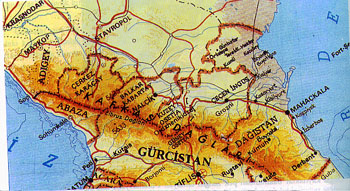
Surface Area: 19.200 Km2
Population: 1.350.000
Capital: Grozni
Today's Tchetchenistan has a surface are of 10.300 square meters and a population of 1.450.00 (1st November 1991). It is surrounded with Daghestan in the north and east, the Republic of Ingush and the North Osetya in the west, and Azerbaijan in the south. However, the historical name of Tchetchenistan was given to the area between the Sulak River in the west, the River of Upper Sunca (Sunja) and Lower Sunca and the River og Terek in the north of the Northern Caucasus on the Russian side. The southern borders of the country extended to the regions in which Andi and Avar people from Daghestan lived together with the Tuşen and Kevsu people. Similarly and in accordance with the Russian reference books, the eastern parts of Tchetchenistan were called as the Great Tchetchenistan and its western parts were called as the Lower Tchetchenistan that was a hilly country full of forests. The River Argun detaches these two regions from one another.
Nevertheless, the Ottoman statesman, jurist and historian, Ahmed Cevdet Pasha stated tht the region in the east of the Northern Caucasus was Daghestan, and it was called with this namedue to the fact that there were sometimes from Dak nation living there. According to the classification of Cevdet Pasha, it was explained that Tchetchens lived in the middle and northern regions of Daghestan even though their names were not cited. Coming from the Middle and Eastern Caucasus, Tchetchens called themselves as Nahçi or Veynak/ Vuynak (with the meaning of our people). Their neighbours, Osets called them as "Çançan" and "Makalun", Kabartay people named them as "Şanşan", Kumuk people called them as "Miniçi", Avars called them as "Çeçen", and Tatars named them as "Masaget". Furthermore, it was stated that the name of Tchetchen was firstly called as Javçen, and then Jou, Juan and Cucen before it took its last form of Tchetchen.
Before the First World War (1914-1918), the majority of the Tchetchens lived within the boundaries of Tersky Province connected to the General Governorship of the Northern Caucasus that was also bound to the Russian Tsardom. In the census of 1926 that was made pursuant to the Soviet Revolution, the population of Tchetchens in the Tchetchenian Autonomous State (Province) was 244.000 and this number constituted 34.3% of the general population in this state. However, the population of the Tchetchens that lived in the Tchetchenian-Ingush Autonomous Republic was found as 244.000 in the census of 1959. The reason of this decrease was the exile of the Tchetchens to the Middle East (Kazakhstan) and those that were exiled have not returned yet. In the census carried out after exactly 20 years (1979), the population of the Tchetchens that lived in the Tchetchenian-Ingush Autonomous Republic was found as 611.405.