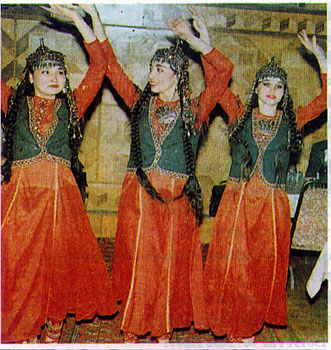
It is known that the term of "Tatar" was used among Turks and Mongols in the centuries VI-XI. There were some tribes that called themselves as "Tatar" mong the Mongol founders of the Altin Ordu State (Golden Army State). As a result of the ethnical developments between the centuries XIII-XIX, Kipchaks in the State of Altin Ordu affected the other nations under the influence of their own cultures. The term of "Tatar" was not accepted in this period. The Europeans, Russians and some of the Asian nations would call the people of Golden Army as "Tatar". The high-ranked soldiers and the state officers would call themselves as "Tatar" in the khanates established pursuant to the dissolution of the State of Golden Army. These people played a significant role in the transmission of the term of "Tatar".
When the high-ranked state officers called themselves as "Tatar", it led the other people to envy this name. Pursuant to the disintegration of the khanates, the name of "Tatar" got widespread among the public. The role of the Russians is of great significance in this case since the Russians would call the people living in Khanates as "Tatar", but this term could not be easily appropriated. Even in the century XVI, the term of "Tatar" would be perceived as negative among Idyll-Ural Tatars, and all groups would use local names. In the second half of the century XIX., the "Tatar sense" started to arouse among Tatars in the period of becoming a nation. The intellectuals got aware of the process of awakening in the public and they played a significant role in the appropriation of the common term of "Tatar". One of the first and the most significant intellectuals that gave a great struggle for the adoption of the Tatar identity was undoubtedly Şahabeddin Mercanî. As an expression for their respect to Mercani who had completed his education in Turkistan and then returned to Kazan, Tatar People would address Mercani as "Şahabeddin Hazret" (His Excellency Şahabeddin) like they used to address the important religious leaders.
In his book named as Kazan and Bulgar Tarihi" (History of Kazan and Bulgaria) published in the year of 1885, Mercani mentioned about Kazan people who deemed themselves as the only Muslims, used the small tribal names and defines their languages as "Turkish Language". In the same book, Mercani warned the people of Kazan for the first time in history stating that "Some people deem the identity of Tatar as a deficiency. They hate that name and give a fight urging that they are Muslims, not Tatars. Hey, the Shiftless! If the enemies against your religion and nation knew that you had another name than the name of Muslim, would they discriminate against you? If you are not Tatar, not Arabians, Tadzhik, Chinese, Russian, Prussian, or Austrian, then who are you'". Addressing his own people with these harsh words, Mercani expresses the lack of national sense and conscience among the Tatars in his same book as follows: "The greatness of the history of our tribe have not been known by our fathers, ancestors, uncles, and our people as well as the world scholars, great doctors and rulers. They were entirely concealed under a cloth of ambiguity. Furthermore, the majority of our nation supposes that we have been living under the Rrusian domination from eternity. They despire and exaggerate what they hear of from the Bulgarian Kazan history. They do not know anything but to utter that It is the affair of the period of Khan. They even could not perceive the meaning of what they say in a sensible manner. They are not aware of the rulers much more glorious than their own tribes."
The speech of Şahabeddin İbn-i Bahaeddin Mercanî that illuminated the people and his works of art about the Bulgarian and Kazan histories played a significant role in the appropriation of the Tatar identity. This name got widespread among all groups. The majority of Tatars deemed themselves as "Tatar" in the census carried out in the year of 1926.
The ethnical roots of Idyll-Ural Tatars appeared in the Idyll-Ural state that was one of the early states of the Eastern Europe founded in the Middle Idyll in the beginning of the century X. The ethnical structure of the Idyll Bulgarians was also complicated. The subgroups of these people experienced long ethnical developments. There were Bersils, Esegels, and Siberians, Suvars (the ancestors of Chuvash people of today) in this region. Therefore, they started to form a nation that has an early feudal structure in Idyll Bulgarian State. The conquest of the Idyll-Bulgarian State by the Altin Ordu (Golden Army) caused political and ethnical changes. Idyll-Bulgarian State became a province of Altin Ordu State. We know that there were independent districts under the government of a bey centred in Bulgar, Cükatav, Naravcat (Mukşi) and Kazan in the centuries XIV-XV.
to be continued