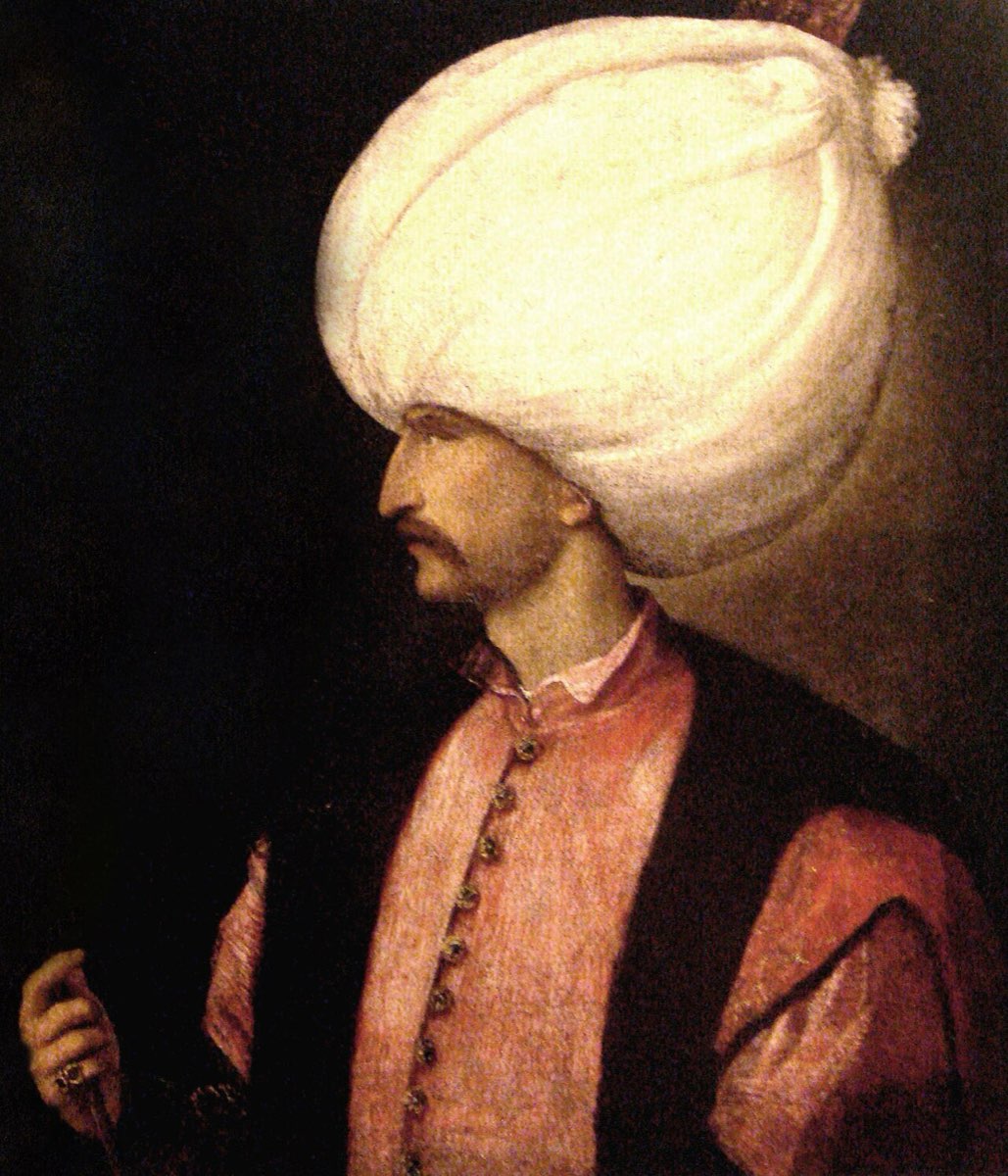
SULEYMAN THE MAGNIFICENT
He is the Ottoman sultan whom the world knows as magnificent and Turks know as Kanuni. He was born in Trabzon on 27 April 1495 where his father Yavuz Sultan Selim was a governor. He succeeded to the throne in 1520 and became the Ottoman sultan who reigned for the longest time. In the period of his reign lasting for 46 years, Ottoman Empire reached its peak. Kanuni, after he saw the son of his grandson, died in his tent in the battlefield during Zigetvar siege on 7 September 1566.
Suleyman the Magnificent, who reigned during the peak period of Ottoman empire, was a conqueror sultan. The sun rose in one edge of his empire and set in the other.Turkey was a "country of sun". The Muslim and Christian citizens lived in complete freedom and prosperity. The Christian citizens carried out their rites and worships freely just as Muslims did in mosques. Trade was free, and reached the top.
The population of Ottoman Empire had reached 110 million in 16th century when Suleyman the Magnificent reigned. There was no other state with such a great population in the world. The area of the Empire was eight million square kilometers and the state dominated over three continents with European Turkey, Asian Turkey and African Turkey. Our borders extended from the gates of Vienna to Caucasus, and Morocco. The Empire was ruling over exactly thirty eight states. Europeans called Suleyman as Suleyman the Magnificent because of the magnificence of his period and Turks as Kanuni, since he made laws.
Suleyman the Magnificent is the son of Yavuz Sultan Selim. Yavuz Sultan Selim was residing in Trabzon together with his mother Gulbahar Sultan and his wife Hafize Ayse Sultan. His father Beyazit the 2nd had appointed him as the governor of Trabzon. His wife Hafize Ayse Sultan was facially very beautiful with a high heart. Hafize Sultan gave birth to a son in Ortahisar palace in Trabzon in1494. Yavuz Selim named his son Suleyman. He informed his father Beyazid-i Veli of the birth of his son. Since Hafize Sultan's could suckle less than necessary, the mother of Yahya Effendi, one of the Sheiks of Besiktas convent, was appointed as his suckling mother. His grandmother Gulbahar Sultan, whom he loved much, died when Suleyman was 11. They buried her to the graveyard of Imaret Mosque. After that, his mother took care of Suleyman. Suleyman was the only son of Yavuz. He had four daughters.
Mevlana Hayreddin from Kastamonu, one of the greatest scholars of the period, was appointed as hodja for Prince Suleyman. This hodja taught him reading, writing and other sciences. Suleyman learned jewelry art at the same time. Master Kostantin, one of the most famous jewelers of Istanbul who had a shop in Unkapani, taught him jewelry. One day Prince Suleyman did not do his homework. His master, getting angry with him, swore:
"I will give a thousand beating to you...". The mother sultan, hearing that, called his hodja and requested that he forgave his son. She promised that she would give a thousand gold monies if he forgave. Kostatin Usta accepted Mother Sultan's request.
Then he called his apprentice Suleyman and told him to make one hundred fine wires from some gold. He gathered these wires and hit ten times on his sole to fulfil his oath.So could Suleyman overcome his punishment slightly. Yavuz Sultan Selim marched toward his father with an army and succeeded to the throne dethroning Beyazid-i Veli. Suleyman had grown up then. Yavuz appointed his son as the governor of Manisa to familiarize him to state works.
Suleyman was a good poet as his father. He wrote poems with "Muribbi" penname. His poems are gathered in a Divan. One of his poems reads:
Allah, Allah diyelim rayet-i şah çekelim
Gözüne sürme deyu dûd-i siyahı çekelim
Pâyimâl eyleyelim kişverini sürh-serin
Yürüyüp her yanda şarka sipahi çekelim.
He has some precious sayings towards the end of his life. One of them is:
Halk içinde muteber bir nesne yok Devlet gibi,
Olmaya devlet cihanda bir nefes sıhhat gibi.
Upon his father's dying in Çorlu in 1520, Grand Vizier Piri Mehmet Pasha called him as the sultan. Suleyman the Magnificent ruled for exactly forty six years as the tenth sultan of Ottoman throne as from 1520 when he was 26 years old.
His father had left a rich treasury, wide country, strong and experienced army to him. Suleyman the Magnificent became the khan of Turks, Caliph of all Muslims and the greatest ruler of the world in 16th century. This century is called "Turkish century" in the history. Turks reached the peak in the world in civilization. Suleyman the Magnificent wrote the following letter expressing his greatness and grandeur to French King Fransua:
" I am Sultan Suleyman Khan, son of Sultan Selim Khan, son of Sultan Beyazid Khan, and the sultan of the Mediterranean and Black Sea and Rumelia and Anatolia and Karaman and Greece and Dulkadir Province and Diyarbekir and Kurdistan and Azerbaijan and Acem and Damascus and Aleppo and Egypt and Mecca and Medina and Jerusalem and all Arabic lands and Yemen and many more lands conquered by my ancestors; and you are the governor of French province, Franchesko... "
Contrary to his father, who enlarged the territories of the empire towards east, Suleyman the Magnificent pursued the policy of extending toward Europe. Reoccupation of Belgrade, Rhodes' invasion, the sea and land operations made to save French king François from Charles Quint upon his sending a messenger to Suleyman the Magnificent, Hungary expedition, Mohaç pitched battle, conquest of Budin, Second Hungary expedition and Vienna siege, third Hungary and German expeditions were all results of this policy. He did not neglect the east and carried out expeditions of Iran and Baghdad, sent navies to everywhere from Red Sea to India, and included Aden and Yemen into the borders of the empire.
The most famous persons of Ottoman history appeared during his sultanate. In the period when he was the ruler, great artists like Architect Sinan, Fuzuli, Baki, heroes like Barbarossa Hayreddin, and major statesmen like Piri Mehmet Pasha and Sokullu Mehmet Pasha showed themselves. The unique vizier of Suleyman the Magnificent, Piri Mehmet Pasha told him: My Sultan: the gate to Europe is Belgrade, and the lock of Mediterranean is Rhodes!, upon which Suleyman the Magnificent decided to conquer the soils he pointed at. He conquered Belgrade in 1521 and Rhodes Island in 1522 from Saint Jean Knights. He appointed Makbul Ibrahim Pasha as the vizier after these conquests. He had bought Ibrahim in Manisa as a slave and trained him with his own correction. The greatest expedition of Suleyman the Magnificent is Mohaç war. He departed for Hungary with and army of four hundred thousand soldiers to conquer Hungary. Turkish Army entered Europe with magnificence. The Allied Crusaders Army was waiting for Turkish Army in Mohaç plain.
On 29 August 1526, Turkish Army took war order. The sun had just rose. The voice of a call-to-prayer woke all soldiers up. All of them performed their prayers turning towards Kaba. Four hundred thousand Turkish soldiers with caps in several colors and kinds looked like flowers at this green plain. The soldiers performing their prayers prayed for victory from God by opening their hands to the sky. After the Prayer, Suleyman the Magnificent sat on his throne placed in front of his tent having wore a bright armor. Nine flags of the sultan were planted at the same time. Then standard-bearers came around shouting word of unity of God. Royal Treasury coming with the army was guarded. An old soldier came before the Sultan and kneed an said to the Sultan: My Sultan, what is more honorable than war in the world? All army repeated this word. When this old soldier turned back to his place, the spahis constituting the majority of the army got off their horses. They put their scimitars down on the ground and stepped on them, and then unsheathed their scimitars and shouted altogether: Our Sultan, we came here to give our head for religion and nation, we are ready! And sprinkled some soil on their head and took spahi oath. After this ceremony, Suleyman the Magnificent ordered for an assault. Before the assault, Janissary band of Musicians started to play war melodies. It was the tradition that this band played until the end of the war.
The sounds of great instruments on elephants and camels caused resound everywhere. When the assault started, first Azaps, and then janissaries took the offensive. Hungarian King Lui initiated counterattack with heavy Hungarian horsemen. They pulled the enemy in and surrounded in a pocket. At the same time, the spahis in the right and left wings surrounded allied army. A bloody war started. Hungarian King Lui died during this war. All army was routed and some of them were taken captive. Mohaç expedition lasted for two hours. There was no such kind of fast war in the history. Suleyman the Magnificent conquered whole Hungary with Mohaç Expedition. The next day he listened to congratulations for his victory in the palace of the king. Ferdinand, the brother of German Emperor Şarlken, took the offensive on Hungary territories. So, Suleyman the Magnificent marched toward Germans with a great army in 1529. He besieged Vienna city when he could not see an army against him. However, he could not occupy Vienna since he had not taken with him heavy artilleries. However, Turkish raiders had raids as far as the center of Germany. Therefore, whole Europe went excited.
Suleyman the Magnificent conquered Baghdad with an expedition on Iran after western expeditions. In this period when Turkish armies were dominating on the land, Turkish admiral Barbarossa Hayrettin was waving Turkish flag in Mediterranean. Barbarossa Hayrettin defeated Venetian Admiral Andrea Doria navy in Preveze. Mediterranean became a Turkish lake as a result of this great victory. Turkish navy carried on warring against Portuguese colonists in Indian Sea too. Suleyman the Magnificent passed most of his time before his death with Hurrem Sultan, whom he loved very much. At last, he was influenced by this Russian girl named Roksolan. Hurrem Sultan killed Prince Mustafa, who was born from a Turkish mother, in Konya Eregli to enthrone her son Selim.
All Turkish sultans were children of Turkish mothers until Suleyman the Magnificent. However, after death of Mustafa, children of Christian mothers started to succeed to the throne too. After that, the decline of the Empire started. Hurrem Sultan caused Hırvat Rustem Pasha, her son-in-law to succeed to the position of Grand Vizier. This vizier gave an opportunity to bribes method. The last grand vizier of Suleyman the Magnificent was Sokullu Mehmet Pasha. This powerful vizier administered the foreign policy of the country with success. However, he did something wrong by harming "Tımar" method.
The thirteenth and last expedition of Suleyman the Magnificent's 71-year magnificent life was Zigetvar. Suleyman the Magnificent, seeing that German Emperor, who paid taxes to him, did not keep his word, initiated this expedition despite his being old, sick and exhausted. He did not feel good. This was the first time he traveled in a carriage. He had rode horses for 10 years 3 months and 5 days in his sultanate of 46 years. Siege of Zigetvar Castle of Germans started on 5 August 1566 on Hungarian territory. Suleyman the Magnificent was watching the siege from his tent.
He was getting worse everyday. This conqueror sultan who was 71 years old was no more able to stand out of the bed at the end of the first month of the siege. His life full of thousands of glories and honors was about to come to an end. He was living the last days of his life which passed among Grand viziers such as Pîri Mehmet Pasha, Makbul İbrahim Pasha, Ayas Pasha, Hadım Süleyman Pasha, Rüstem Pasha, Semiz Ali Pasha, Sokullu Mehmet Pasha, powerful captains of sea such as Barbarossa Heyrettin Pasha, Aydın Reis, Pîri Reis, Turgut Pasha, Seydî Ali Reis, renowned sailors such as Piyâle Pasha, Uluç Ali Reis, famous commanders such as Devlet Giray, Lala Mustafa Pasha, giant artists leaving immortal monuments such as Architect Sinan, Karahisarî, Nakkaş İbrahim, Fuzulî, Bakî.
Sultan Suleyman Khan, the conqueror Sultan, who was also a poet who wrote the following immortal lines:
Halk içinde mûteber bir nesne yok devlet gibi
Olmayâ devlet cihânda bir nefes sıhhat gibi
Saltanat dedikleri bir cihân gavgasıdır
Olmayâ baht u saadet dünyada vahdet gibi
died on 7 September 1566 Saturday toward the morning among the sounds of artilleries, swords, instruments in his tent on the battlefield when Zigetvar castle was about to fall. Therefore, the great Grand Vizier Sokullu Mehmet Pasha hid the news of death of the sultan from the soldiers. The chief doctor Kaysunizade Mehmet Çelebi performed embalming procedure of the corpse in the tent. Chief Royal Imam Derviş Effendi performed religious duties during this procedures.
Thus, this major sultan of the great empire who dominated three continents was buried at his tomb near the mosque bearing his name in Istanbul pursuant to three funeral prayers performed in three different places.