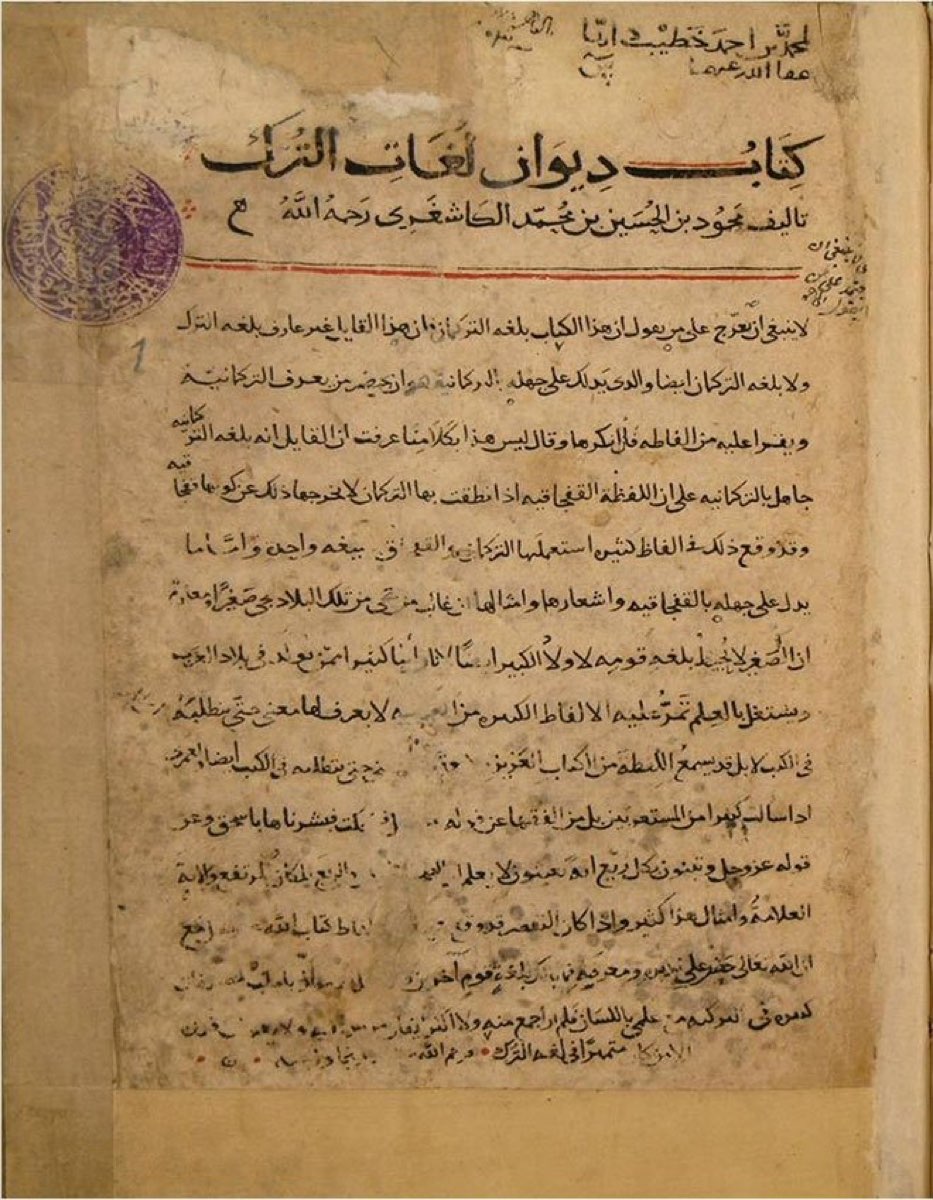
He is a Turkish linguist who lived in 11th century. He is famous with his book named Divân-ı Lügati't-Türk. He is from Karahanli lineage. He presented to Abbasi caliph el-Muktedi Billah his book he began to write in 1072 in Baghdad having completed in 1074. The only handwritten copy of the book is found in 1910 in Fatih Millet Library.
Translation by Kilisli Rifat Effendi was published in three volumes, and the translation by Besim Atalay was published in five volumes between 1915-1917. The exact birth date of Kasgarli Mahmut, khe first Turkish linguist who grew up in Karahan period, is not known but estimated to be 1025. His father was an emir from Barsagan. Mahmut, who lived in Baghdad between 1071-1077, played an important role in introduction of Turkish culture to Arabs. Kasgarlı Mahmut, who strolled around in all Turkish provinces together with famous scholars of his age, İbn-i Fadlan, Gerdizi, Tahir Mervezî, Muhammed Avfî and Beyhakî, who were interested in Turkish life and communities, was supported by Karahanli State which accepted Turkish as the official language. In this period when Turkish began to develop, Yusuf Has Hacip from Balasagun also served Turkish language a lot. These two great Turkish scholars had significant contributions in strengthening of unity of Turkish language with their books.
Kasgarli Mahmut, who was a philologist, ethnographer and first Turkish cartographer, determined the dialects of Turkish provinces and clans of his period. In his book which he gave the scheme about 24 tribes of Oghuz Turks, Mahmut tried to prove the richness of Turkish language and its value besides Arabic and Persian. Thus, he wrote the grammar book named Kitâbu Cevâhirü'n-Nahvi Lügâti't-Türk to teach Turkish to Arabs.
Kasgarli Mahmut, who talked about the Turkish names of regions, Turkish stamps and Turkish communities besides Turkish language grammar, turned back to his country Kaşgar towards the end of his life and probably passed away there in 1090. His tomb in Azak village 35 kilometers far from Kasgar city in East Turkistan was found in 1983 in July.
Kasgarli Mahmut, who included the materials pertaining to Turkish language and culture in his books having carefully examined by strolling in all Turkish provinces, districts and steppes; worked out the dialects of Turks, Turkmens, Oghuzes, Cigils, Yagmas and Kirghizes in comparison with each other. For him; the easiest of Turkish dialects was Oghuz dialect, the most upright and useful one was Yagma and Tuhsi dialect, and the most literary one was Kasgar Turkish.
Divân-ı Lügati't-Türk, consisted of introduction and dictionary chapters. The introduction notes the description of Turkish language, the properties of the dialects and determines linguistic rules in comparison with that of Arabic. He says his native language is much superior to Arabic and examplifies. At the same time, he describes how he obtained this information and how he strolled in all countries. The second chapter, that is the dictionary, contains the Arabic explanations of Turkish words. Therefore, the book is a Turkish dictionary written in Arabic. Or it is a dictionary from Turkish to Arabic. Explanations of more than 7500 words listed in accordance with Arabic grammar were made.
The great linguist showed the contexts and sense of the words in his explanations. Since our written literary examples before and after this book are not known, we learn from Kasgari's book the oral literature examples pertaining to the previous centuries. With a view to his examples of threnodies called Sagu, Ballads called Koşuk, proverbs called sav, and examples from other verse types, we find out, for instance, existence of an epic hero named Alp Ertunga from Divân-ı Lügati't-Türk. Therefore, Kasgarli Mahmut's Divân-ı Lügati't-Türk is a source containing very important documents with regard to our history of language, literature, society and sociology. However, this source book was not known before 1910. In fact, the bibliography of Katip Çelebi named Keşfüzzünûn mentioned about Kasgarli Mahmut too. However, it contained only limited information.
A lady, one of the relatives of Vanizade Nazif Pasha, found this giant book in the dusty shelves strolling at Sahaflar Shopping center in Istanbul in 1910. The bookseller, who could only then understand how a valuable book he had, increased the price up to 25 gold monies, and so she could not be able to buy the book. However, he notified Ministry of Education of this. "Ministry of Education rejected buying this book, on grounds that "a handful of gold monies cannot be given to a book, the nature of which is uncertain2.
The book was bought by deceased Ali Emiri Effendi, who was a crazy reader. He gave his books to the nation as a gift and founded Fatih Millet Library and Ali Emiri Effendi, who had done his first directorate, took the bookseller, and after he examined the book, locked the man in the library and went out to find some money. Divân-ı Lügati't-Türk, which was purchased on loan, was kept in his library by Ali Emiri Effendi, with a jealous fastidiousness. Ali Emiri Effendi agreed publication of this book only upon the recommendation of Grand Vizier Talat Pasha.
Although the handwritten copy he had was not Kasgarli Mahmut's handwriting, it was written by a master calligrapher named Mehmet from Damascus 192 years after his death, and is the only copy in the world. Kasgarli cites two hadiths of the Prophet on two occasions to make Arabs accept his book:
"Sublime God said: I have an army I called Turk. I united them in the East. If I get angry with a nation, I give the duty of punishment to them..."
"Sublime God said: Learn Turkish, because Turkish shall have a long sultanate...".
Divân-ı Lügati't-Türk constituted a priceless source for many scholars engaged in Turkology in all over the world. Many experts, either Turkish or foreigner, have made many examinations on it.