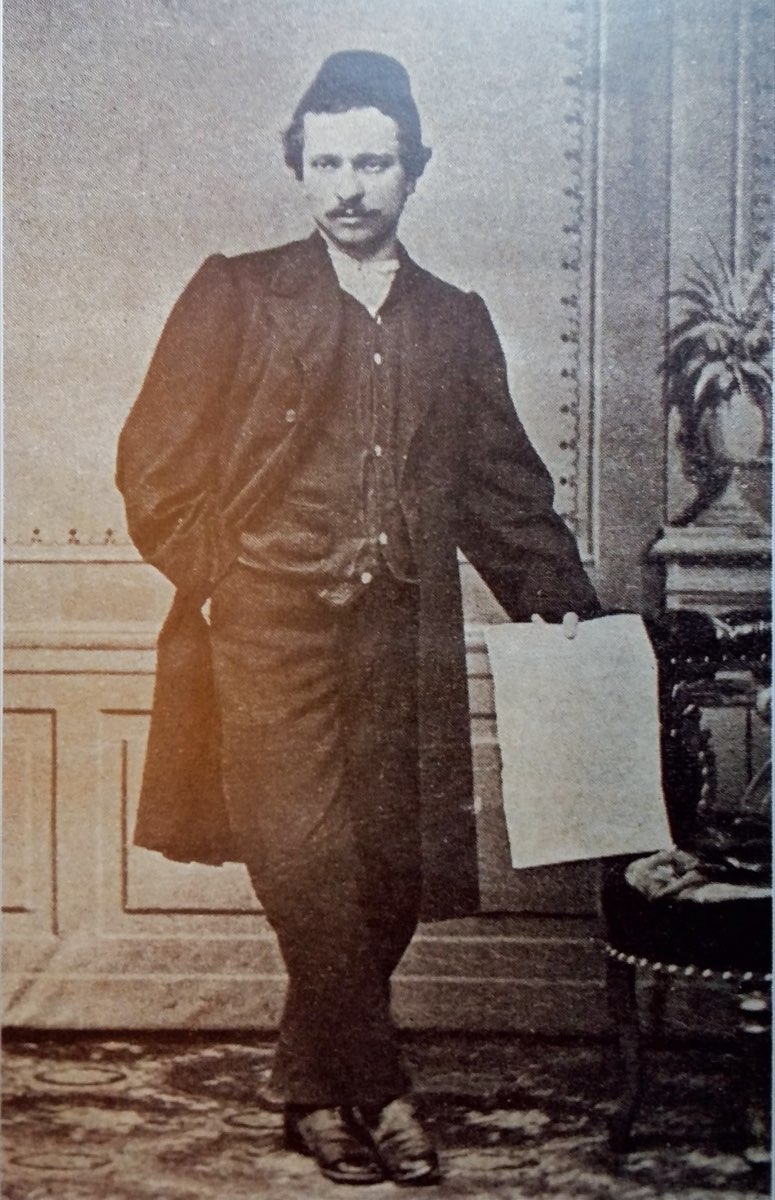
Poet, novel-writer, journalist and statesmen. He was born in Tekirdağ in 1840. He was brought up with special education under the education of his grandfather. He met Sinasi while he was working at Translation Chamber. He had started to write poems in his little ages. He started to work as a journalist in a newspaper he issued under the name "Tasvir-i Efkar". He entered New Ottomans Organization. He escaped to Paris in 1867 and then London. After 1870, he returned to Istanbul and became Gelibolu Mutasarrıf. He died in 1888 when he was Sakız Mutasarrıf.
In the evening on 1 April 1873, the Ottoman theatre in Gedikpaşa experienced extraordinary excitement. The drama, written by Kemal Bey, during his days as mutasarrıf in Gelibolu, one year ago, Vatan Yahut Silistre, was to be put on play for the first time. In the five storey lodge of Gedikpaşa theater, there were members of the palace, renown and reputed people. Some ministers and some viziers had even come.
Since there was no other theaters left in Istanbul after Gullu Agop's being vend in the authority by the sultan to put on play works based on texts five years ago, the play was to be put on play here. The hall, with the lodges covered with red velvet with armchairs in the same color in the form of a horseshoe was high. Everywhere was full.
The reputation of Kemal Bey, publishing Ibret newspaper was well-known by everyone. As soon as the curtain was opened and the words of Islam Bey and Zekiye Hanim praising the native land began to be told in a brave manner appropriate for the scene, the audience showed signs of enthusiasm. Zekiye was played by Yeranuhi Karakaşyan. People forgot themselves and shouted at the scene "Well-done!". In the second and third screens, enthusiasm grew. Voices rising in the theatre "long live Kemal! Long Live Kemal of the Nation!" were nearly heard by the people passing the street.
After the play ended in enthusiastic cheers and cries lasting for minutes, the people did not want to leave the theatre. They wanted Kemal Bey to appear on the scene.After some time, having understood that he was not in the theater, they decided to go to the directorate of İbret newspaper. More that fifty reputed people walked from Gedikpaşa to İbret newspaper in Haçapulo passage in Galatasaray, yelling "Long-live Kemal" loudly during the road in the grandeur of a torchlight procession with lanterns and torches in their hands because Istanbul Streets were not yet illuminated in those times. They woke up Aleksan Effendi, the owner of the newspaper. They told their problem. Kemal Bey was not there. So they left leaving a note full of praises.
In the next day, İbret newspaper mentioned about the events and published this note. Upon the will of people, the administration of the theater was able to get the permission to put on scene the play for a second time in the evening on 2 April. The play was going to be put on in favor of Karakasyan, impersonating Zekiye.
In the evening on 4 April, the adaptation of Teodor Kasap, named Pinti Hamit was going to be put on scene in the theatre. Namik Kemal and Mustafa Nuri, who were in the literary delegation of the theater, was discussing the events in the administrative room. İbret was closed indefinitely one day ago. The reason was the style of expressing the events. It seemed to incite people for rebel against the sultan. A stranger came in, opening the door at the same moment. He asked wheather Kemal Bey was there. He was wanted by Military Police Marshal Pasha. He took Kemal and went. After some time, a military police major came. He took Mustafa Nuri. After that, they took Ahmet Mithat Efendi, during the play that night. Ebüzziya Tevfik and others were taken one by one. The first person taking advantage of theater to incite native land consciousness in the country was thus sent into exile to Magosa, with Abdulaziz's order in contradiction with Tanzimat Decree. The others were also sent to various places and imprisoned on grounds of being "freedom supporters".
Namık Kemal wrote his greatest books in Magosa. He was forgiven after Sultan Murat the 5th was enthroned in 1876 and returned to Istanbul. He was rearrested upon Abdulaziz the 2nd's ascending the throne in a short periodof time. He appeared before the court. He was acquitted. But his staying in Istanbul was prevented. He was appointed to mutasarrıf in various places to do this.
He passed away on 2 December 1888 not being able to recover from tuberculosis while he was serving as Sakiz Mutasarrif. He was buried next to the tomb of Prince Suleyman Pasha, the conqueror of Rumelia. Namik Kemal had many important skills. For example, his son Ali Ekrem Bolayır wrote in his book named Ruh-ı Kemal that he made a few people write a few distinct texts at the same time. His other superior aspects such as being able to keep in mind everything he heard helped his development in young ages.