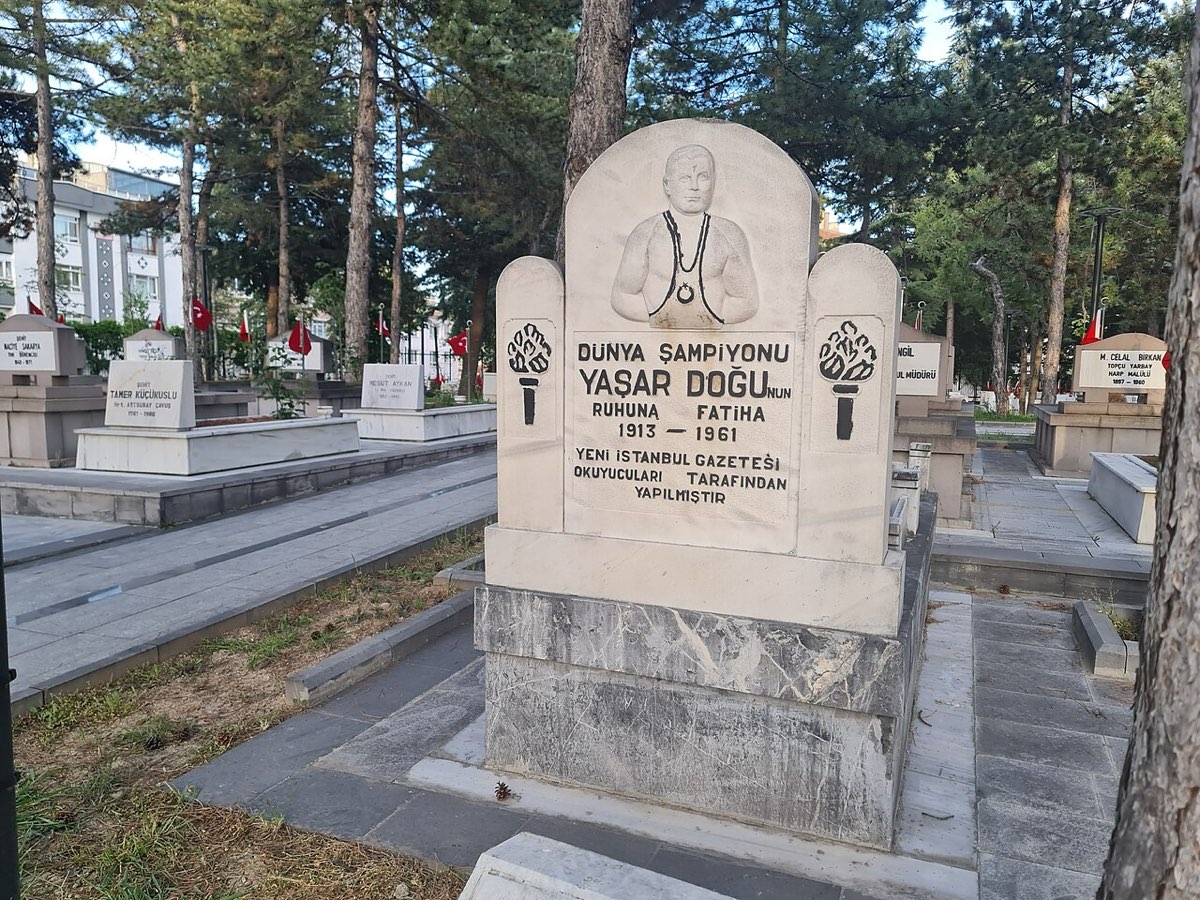
Famous Turkish wrestler Yaşar Doğu was born in Karli village of Kavak district of Samsun in 1915. He was brought up in Emirli, his grandfather's village. He started wrestling there. He began wrestling on mat first when he was performing his military service in Ankara in 1938. He kept his place wearing Turkish colors for twelve years (1939-1951). He became the champion in 6 of 7 championships he took part. He died in 1961 in Ankara. His tomb is there.
He is from Caucasus Turks in origin. His ancestors went as immigrants to Samsun. His father fell martyr in the front when he was only a baby, and so he had to migrate to Emirli with his mother, which was the village of his grandson. He started wrestling in this village he passed his childhood and made himself heard all around as a very strong wrestler as a teenager.
He attended Ankara Wrestling Club on persistence of one of his friends while he was performing his military service and started wrestling on mat there. He had a bitter strength and great wrestling skills and showed himself in wrestling in a short time. But the managers, thinking that he was inexperienced and would be defeated in European Championship, did not want to admit him to the staff.
Onni Pellinen, the Finnish Trainer of the national team pressed and he was included in the national team. Thus he performed the first national contact of his wrestling life full of successes in Oslo after European Championship in 1939. He defeated his three rivals despite his being inexperienced and lost European Championship and got second being considered defeated with point in one of his matches. That was a great success too.
After having won the first championship of his wrestling life in Balkan Games in Istanbul in 1940, a period of 6-year-pause started because of the 2nd World War.
He was admitted to our National Wrestling Team as a unrivalled wrestler in 1946 again. Despite he wrestled with a fever of 40 degrees because of malaria in European Championship in Stockholm, he won all of the six wrestles and became European champion in 73 kg. He kept his place as a member of Turkish national team in European Greco-Roman Championship too.
This championship which the "Iron Curtain" took part the first time, was very interesting. Because, Soviet Russia and its satellites were in full alliance in the championship. Yaşar, seeing the unjust decisions of the umpire, saw that he had to defeat not only his Russian rival but also the umpire. He started wrestling with this motivation and after having defeated all of his rivals, he came across his Russian rival. He started like storm. He hit him to the ground. He was applying several techniques subsequently. He laid his rival's back to the ground once. The umpires ignored. Then he did it again. The same. Yaşar was angry. He attacked and overcame the Russian. Then he rotated him. He spread out his rival like a rug on his back, and then sat on his chest. He looked at all umpires one by one. He was full of anger. He was as if to say "So this not touch either?". The umpires said "Yes" involuntarily. Yaşar had forcedly made them accept both touch and his championship...
In Swedish terms, he shined as a "black-haired strength god", and consolidated his name with 1948 Olympics, and 1949 European Championship. In the tour he visited Iraq and Pakistan in 1950, he had the opportunity to promote his strength and wrestling knowledge to the eastern world.
He wore the Turkish colors in 87 kg again in the World Championship held in Helsinki in 1951. He had a body which could put on weight easily but could not lose weight. Therefore, his weight was increasing in years. As a matter of fact, he won the last championship of his wrestling life he started as 67 kg, in 87 kg in Helsinki. Thus he added a world champion title to his bright wrestling life.
Yaşar, who won 46 of his 47 matches he wore Turkish colors, touched in 33 of them, and won 11 of them with agreement, and 1 abandoning, and one with majority. His 46 wrestling contests should have lasted for 690 minutes; but he reduced this period to 372 minutes 26 seconds with his touches.
After he completed his wrestling life, he became our National Wrestling Team trainer. He had a severe heart attack in Sweden he went with our National Team in 1955. He had a long medical treatment. The doctors told him to take care of himself well, and not to tire and excite himself. But he did not. He dedicated himself to wrestling again as soon as he turned back from Sweden and died in Ankara on 8 January 1961 because of a heart attack.