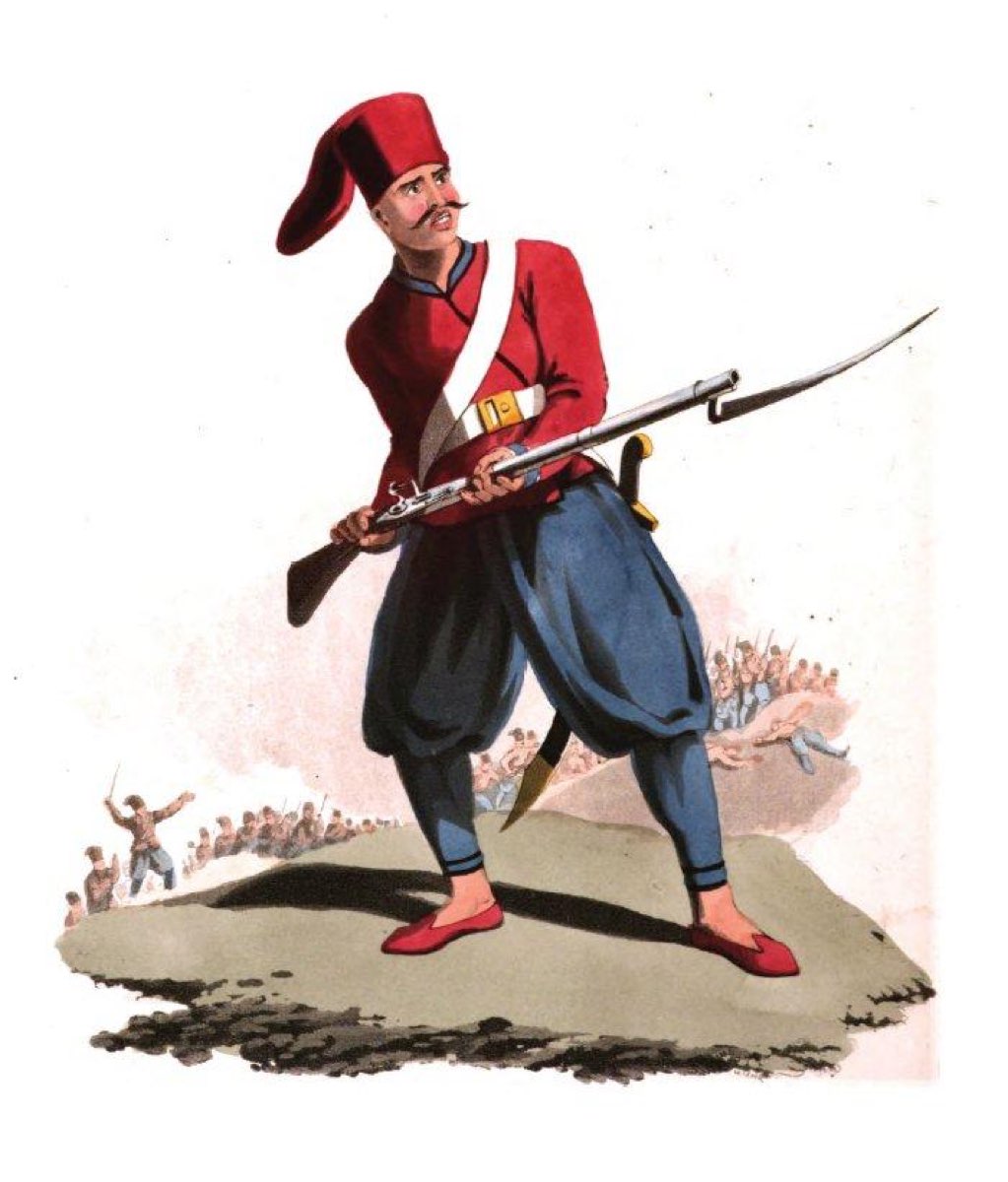
The war with Russians between the years of 1768-1774 was a turning point in the lifetime of the Ottoman State. Actually, it would be defeated in this war for the first time in its history. The first reason was the total degeneration of the army, the inclination of the janissary societies towards cruelty that had become tramp bullies and the useless and ineffective functions of this undisciplined crew in the wars. The Turks that had repulsed the enemies who had landed troops in Mora (spring of 1770) was defeated in the Eagle Battle (1st August 1770). Similarly, the Turkish Navy was totally destroyed with the loss of terrible casualties in Çeşme (6th/7th July 1771). Mustafa died as a result of his grief and sorrow. Since the middle of the year of 1770, Turkey was not the first state of the world any longer. It had been revealed that the countries of England, France, and Russia were much more powerful than Turkey. Kaynarca Agreement (21st July 1774) gave an end to the war. The right of independence was entitled to the Crimea supposedly. It was submissive to Turkey in respect of some ties and connections; actually, it had been under the Russian domination. The Black Sea was not a Turkish lake any more. It was a sea that would be jointly used with Russia. Excluding the Crimea, the Ottoman State did not lose a significant land. However, the loss of prestige was much greater. A vain war took place against Iran that lasted for 4 years (1775-1779). On the date of 9th July 1783, the Russians annexed the Crimea to their lands. This situation caused a terrible crisis and awakened an everlasting national hatred against the Russians among the Turks. As a matter of fact, the Crimea had been a Turkish homeland for 1500 years. Hundred thousands of Turks were put to the sword by the Russians and they were exiled from their lands. They were abandoned to death in poverty and misery. Those who could save their lives had taken shelter in the Ottoman lands.
In order to prevent the devastation of Poland and the abolition of the balance in the Eastern Europe, Turkey ventured a war between the years of 1768-1774. As a result of this war, it was obvious that there would be a struggle between the Turks- Russians. A new Russian war took place (13th August 1787). Germany (Austria) entered the war on the side of Russia against Turkey (9th February 1788). Upon this event, the balance of the war was lost against the Ottoman State. However, the Vizier Koca Yusuf Pasha overwhelmed the German army in Şebeş; the Emperor Joseph II could hardly save his life under great difficulties. Turks destroyed the German lands thoroughly (21st September 1788). The Turks that stopped the Germans turned towards the Russians. However, they were defeated against the Russians. The Castle of Özü that was near Odessa was lost (17th December 1788). The Prince Potenkin who penetrated into the castle with his army that was composed of 80,000 people slaughtered all the Turkish soldiers composed of 25000 people, the civil inhabitants, women and children. Abdulhamit I who read the viziers letter that explained about these details had a stroke while he had grasped the letter in his hand due to his deep grief and he died after a few days.
Selim III (1789-1807) who was the son of Mustafa III and he nephew of Abdulhamit I ascended the throne. The war with the Germans came to an end with the Ziştovi Peace Treaty (4th August 1791) and the war with the Russians came to an end with Yaş Peace Treaty (9th January 1792). Selim III could not achieve any success against these two enemies of him despite all his efforts; however, he did not lose much more lands within the turmoil of French Revolution. He had perceived that he could not do anything with a disorganised army. Therefore, he withdrew from the wards. Accordingly, he maintained Hotin under the Ottoman domination, but he abandoned Odessa and its environs to the domination of Russia. From that date on, he concentrated on the focus of the reorganisation of all the state institutions including particularly the army and the navy that constituted the guarantee for the survival of the state. All these reforms of Selim III was called in general as Nizamı Cedit= New Order. This period was initiated officially on the date of 24th February 1793. It lasted for 14 years until the year of 1807.
General Bonaparte invaded Egypt. The Sublime Ottoman Government that was shocked with is unexpected strike fought against France since the year of 1798 until the year of 1802. Finally, the French people evacuated the province of Egypt; however, there were some rebellions in Arabia. There were some feudal lords that appeared in Anatolia and Roumelia. The authority of the Sublime Ottoman Government and even the ruler over the provinces was undermined through terrible shocks. The Serbian Revolution broke out in the year of 1806 and the state started to wage war against Russia again. Under these circumstances, a new dishonourable revolution took place within the state. Upon the Kabakçi Revolution (25th May 1807), Selim III was dethroned and overthrown. This great ruler had abstained from resorting to the army of New Order in the suppression of the rebellion of Janissary guards. Therefore, this great work of this significant ruler was totally destroyed. The New Order was annihilated. Mustafa IV who was the paternal nephew of Selim III (the eldest son of Abdulhamit I) was enthroned as the ruler.
In these years, France and Napoleon wanted to establish dominion in the entire Europe and even all over the world. On the verge of the century XIX, the population of the world was 839,2 millions in the year of 1800: 541,5 millions of people in Asia (% 65), 189 millions of people in Europe (%22,2), 76,9 millions of people in Africa (%9), 16 millions of people in the North America (%2), 13 millions of people in the South America (% 1,5), 3 millions of people in Oceanica (% 0,3).
The surface areas and the populations of the Big States were as follows: Republic of France (the surface area of 3 318 849 km2, and the population of 31,1 millions), Kingdom of England (the surface area of 13 242 866 km2, and the population of 78,6 millions), Russian Empire (the surface area of 17 850 091 km2, and the population of 22 millions), Turkey Empire (the surface area of 12 187 705 km2, and the population of 63,7 millions), Chines Empire (11 765 119 km2, and the population of 280 millions), German Empire (the surface area of 980 236 km2, and the population of 41,5 millions), Kingdom of Spain (the surface area of 14 887 048 km2, and the population of 32,2 millions), Prussian Kingdom (the surface area of 280 000 km2, and the population of 9,5 millions), Iran Turkish Empire (1 735 654 km2, and the population of 12,5 millions).
The supporters of the New order had selected one of the viziers, Alemdar Mustafa Pasha as their leader. Alemdar came to Istanbul with his army. Mustafa IV had Selim III to be killed (28th July 1808). However, he was dethroned and his brother, Mahmud II (18081839) ascended the throne as the ruler.
The New Order was reinvigorated under the name of Sekban-ı Cedid (New Janissaries) and the renegades were annihilated. Those who were involved in the event of the murder of Selim III even with a distant relation (nearly a thousand of people) were totally executed. Mahmut II who was 23 years old was brought up by Selim III who did not have any sons like his real son with the greatest care and affection. He was the inheritor of all the opinions of Selim III that he called as uncle (actually, his uncles son despite the high difference of age). However, the Janissaries had overstepped the mark and the young ruler did not have any influence on them. The Grand Vizier, Alemdar Mustafa Pasha did some mistakes and he could not attain any affection. Even the ruler gave him the cold shoulder. The Janissaries rebelled and they killed Alemdar as a March yr (15th November 1808). Then, they attacked to the palace in order to kill Mahmud II. The naval forces had also attended in this civil war. Istanbul witnessed a civil war that it had never experienced in the past and it would never experience in the future. The ruler fought against the Janissary guards with his well-trained new Janissaries. The navy that was faithful to the ruler bombarded Suleymaniye from the Sea of Marmara (There was the official palace of the chief commander of the Janissaries in Süleymaniye). Suleymaniye was totally destroyed. The great masterpiece of Mimar Sinan (Architect) was not struck by a miraculous chance. Any of the both sides, the ruler and the Janissary guards could not overwhelm the other. Mahmud II declared that he had given up his reforms and the establishment of a modern army. Then, the Janissaries did homage to him. Turkey lost its most valuable 18 years. Within this period, Mahmut II reigned the state in the equilibrium with a hairs breadth. He positioned his fellows in the Janissary societies step by step without getting bored. On the other, he struggled with the great foreign problems.
The Russian war that took place between the years of 1809 1812 came to an end with the conclusion of the Bucharest Agreement (28th May 1812). Accordingly, Turkey lost Bessarabia (70 000 km2). A small Serbian princedom that included Belgrade and its environs was entitled with the state of autonomy. In these days when Tepedenli Ali Pasha was declared as a renegade, the Greek Revolution broke out (12th February 1821).
The Greek people who caused revolution in Romania were immediately annihilated. However, the revolution diffused within Mora, some of the Aegean Islands and Attica and this revolution was supported by the entire Europe. In this period in which Russia did anything in order to establish dominion in Turkey and Iran, these two Turkish Empires waged war against each other that was the last war between them in the histories of both empires (1821 1823). The Greek revolution was suppressed in the years of 1825 1826. However, the great European States would officially interfere in the affairs of the Greece this time and they would reinvigorate the fire of sparkles again.
Under these circumstances, Mahmut II developed his situation in a proper manner. Pursuant to this sufficient development, he declared that he had abolished all the other Janissary guard societies and he established the modern Turkish army that would replace them. This revolution could be enabled through a civil war. Upon this event that was called as Vaka-i Hayriyye (Beneficial Event) (15th June 1826), Mahmut II annihilated all the Janissary guars with his modern troops that he had arranged by means of the supports of the scholars and the people. Therefore, the second period of the sultanate of Mahmut II started. In this period, The ruler had gotten rid of the pressure of the Janissaries. The ruler that had perceived that the big states were determined and resolute to swallow Turkey acted in a very radical manner. He executed all his authorities and set in motion thereof. The modern period in Turkey could be identified as the results and conclusions of the event of Vaka-i Hayriyye. The Western civilisation of Turkey commenced as of this date. Turks who had reached to the highest level in Eastern civilisation have been experiencing what they could do within the Western civilisation for a period of one and a half century since the event of Vaka-i Hayriyye. However, since the technical civilisation and the national culture has been sometimes confused in some periods, the Turkish society came face to face with enormous difficulties and this nation suffered from great losses thereof.