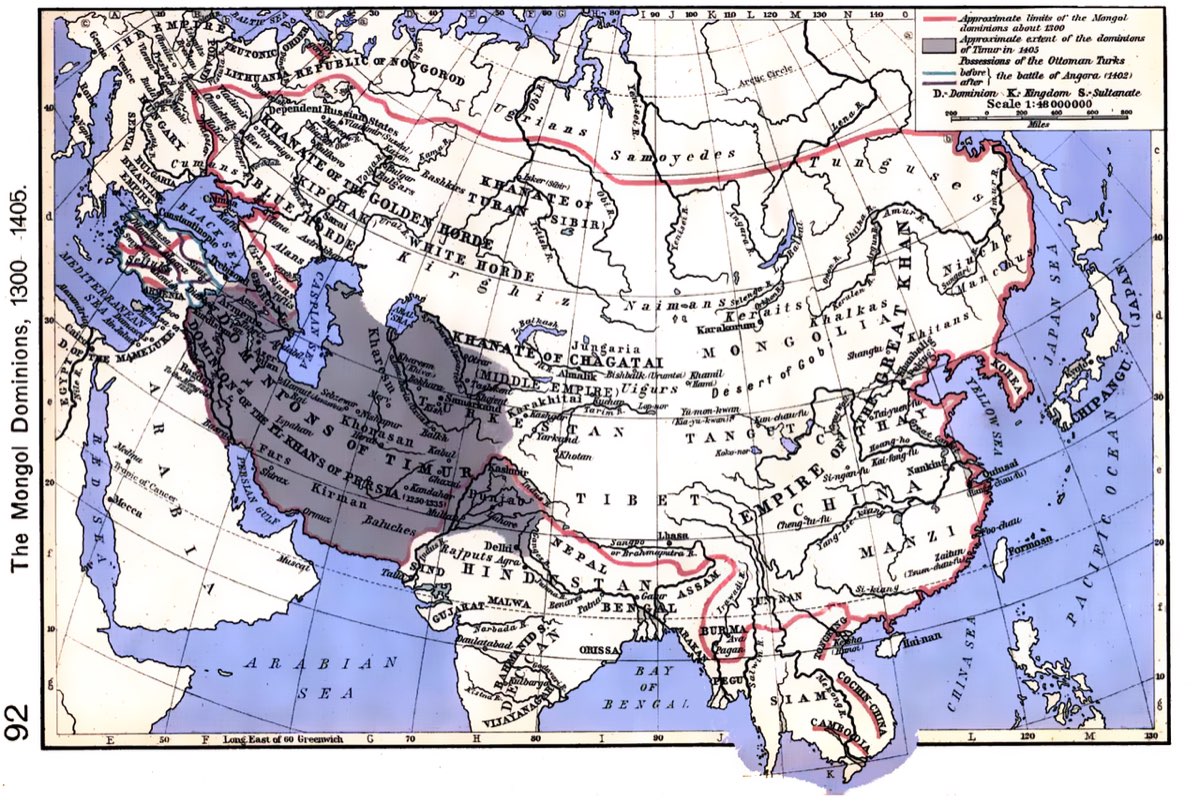
Significant events had taken place in the end of the century XII and the beginning of the century XIII that concerned not only the world of Turks, but also all the nations in Asia and Europe that included most of the regions on the world. These events had emerged in the form of the establishment of the Turkish-Mongolian Empire that tried to reshape the world. This empire has been called sometimes as the "Jenghiz Empire" due to its founder and sometimes "Mongolian" or "Turkish-Mongolian Empire" (or: "Khanate", "Khanate").
In the beginning, the dominant element of this empire had been the Mongolians; but when the state had expanded, the great majority of the people and the soldiers were composed of Turks within a short period. The principles of the state organisation and several institutions have been the continuation of the ancient Turkish traditions. Therefore, it would be much proper to call the state established by Jenghiz Khan as "Turkish- Mongolian Empire".
In this period, all of the Turkish countries (excluding very few of this) had been united under the structure of a unique empire. This great empire included the borders of the entire Asia and the entire Eastern Europe excluding the Chinese India and Arabia. Therefore, the Turkish- Mongolian invasions and Khanate concerns the Turkish history very much. Due to some historical events and the emotional effects, "Turkish- Mongolian and Tatar" issues could not be explained satisfactorily or they are tried to be based on different interpretations in accordance with persons and nations. Not only the period of Jenghiz that we have called as "Turkish-Mongolian Empire", but also the Turkish states that emerged as a result of the dissolution of the empire have sometimes been alleged to be disconnected from the Turkish history.
However, it is a reality that the Khanate established by Jenghiz had essentially constituted an integral part of the Turkish history. In fact, according to some rumours, Jenghiz was of Turkish origins. The tribes near the Kerulen River that had played hardly any role in the history until that time started to show great activities within a short time by means of the genius of Yesügey-bagatur's son, Timucin (Temucin).
In the course of their first emergence in the history in the end of 12th century, the following principal tribes lived in and within the environs of Mongolia and they had been involved in cruel struggles and fights with one another. Noyman people that lived between Irtish and Orhon Rivers and in the north of Altay Mountains; Kereyit people that lived within the environs of Orhon River in the east of them; Merkit people that lived in the north of Kereyit people in the central and lower regions of Selenge river; Oyrat people that lived in the west of Merkit people and in the north of Nayman people; Tatars that lived within the environs of Buyur lake; and the Mongolians who had not have a power and influence in the beginning. However, the name of the Mongolians had become a general national name pursuant to the integration of all the tribes by Jenghiz Khan. Nayman and Kereyit people had been the neighbours of Uighur Turks and they had been under their influence in respect of culture; and they had been superior when compared with their other neighbours.
We have observed that the political activities had been accelerated in Mongolia in the century X; and Khirghiz people were repulsed towards the regions of Yenisey River and Kitay people that settled in the Northern China had established a dynasty called as Liao. Liao State was abolished in the year of 1225 and some of them immigrated towards the west and established Kara-Hitay State that lived in the valley of Tarim and Ferghana for a century.
The main group of the people was the member of the religion of nature and shamanism like in the ancient Turks. Buddhism had diffused among the Mongolian tribes and the Christianity had been disseminated among Nayman and Kereyit people. The Chinese culture had also shown its effects due to the continuous struggles and contacts with China. Chinese people had sometimes cited the tribes in the north together with their names (for example; Hiung-nu=Hun; T'u,K'üe=Turks), but they mostly called them as Tatars (Ta-ta) without the discriminating them as Turks or Mongolians. In the beginning of the century XIII, they grouped the Mongolians in accordance with their proximity to the Chinese borders and their level of civilisation such as "White Tatars", "Black Tatars" and "Wild Tatars".