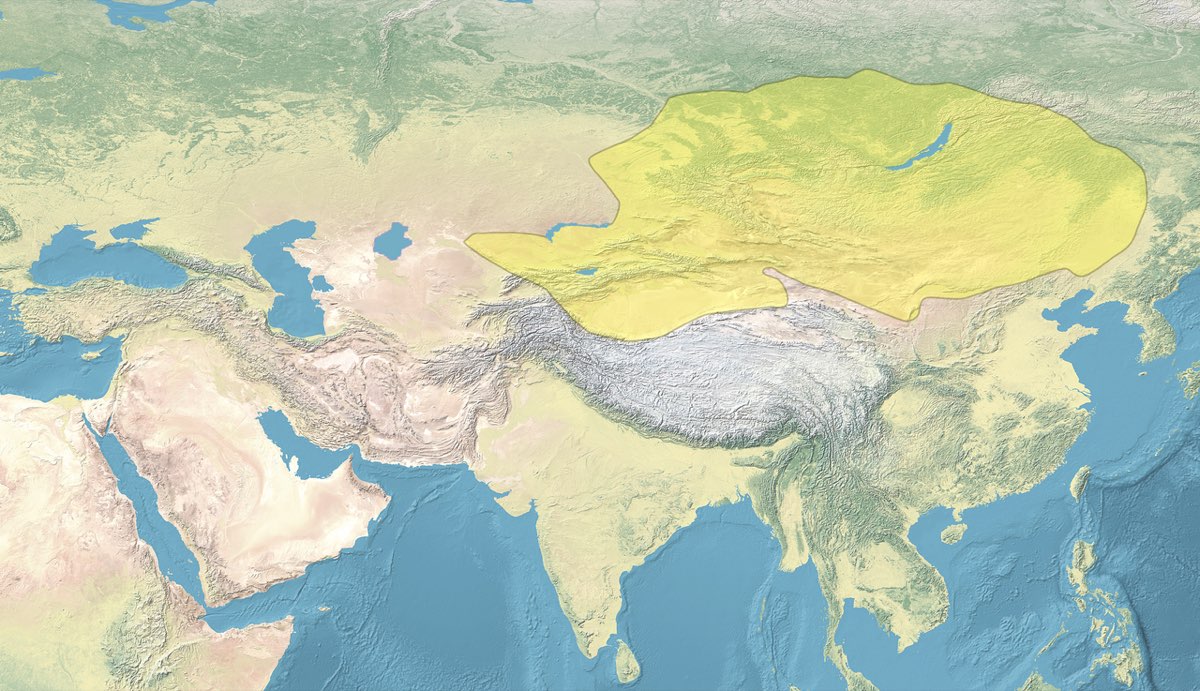
It is known that Hakas people were under the dominion of Huns in the century II BC in the course of their history that extends to the ancient times. Like the other Southern Siberia Turks, the written history of Hakas people start from this date on. Hakas people had learned to write under the dominion of Hun State. This tribe mostly lived in Abakan Steppes in the period of Gokturk dominion and in the following periods. The titles of Khan pertaining to their rulers show that they were composed of a powerful community in those times. Therefore, neither Gokturk State nor Uighur Turks were able to eradicate the political existence of Khirghiz people. Nevertheless, we know that Khirghiz people succeeded in the advance towards the lower sections in 840, abrogation of Uighur State and the conquest of Orhun Region.The struggles of Khirghiz people with Gokturk State took place in the period of Ilteriş Khan's son, Kapgan Khan. Kapgan Khan was one of the greatest conquerors of the Turkish history. Having completed his campaign towards China, Kapgan Khan advanced towards the Khirghiz people that lived on the banks of Yenisey. The season was winter and the way was so long and difficult, but this campaign was obligatory. As it was stated in Tonyukuk Inscriptions, they told that "(the Powerful Khirghiz Khan) Let's collaborate with the Chinese and On-Ok Khans and gather in Altun forests (in Altay Mountains), and unite our forces. Then, let's attack to Gokturk Khan, otherwise they will annihilate us since the Khan is so brave and his ayducu (counsellor) is so wise". The Gokturk Army in the command of Kapagan and Tonyukuk surmounted the Köpgen Mountains through the trackless valley "melting the snow, hanging on the branches of the trees, and sometimes taking the horses in tow". They trapped the Khirghiz people on the banks of Ani River in the place near to the spring of Yenisey. The Khirghiz country whose Khan was destroyed was surrendered (687).
When the Gokturk State collapsed in Otuken, the historical Turkish country in the year of 745, the Uighur Khanate was established instead. The Khirghiz people who lived in Abakan had always been a dangerous source within this state. The Uighur Khanate and Khirghiz Khanate fought two times. The Khirghiz people were defeated in both the first war in the period of Uighur Khan, İl İtmiş Kapan in 758 and the second war in the period of Alp Kutluk Bilge Kağan (779-789). Therefore, they were taken under the dominion of Gokturk and Uighur States. Then, Khirghiz people initiated a strong attack in the year of 840 and destroyed the Uighur State and established their own state in Otuken. However, they could not stay there for long. Ki'tan people who invaded the whole Mongolia in 920 repulsed the Khirghiz people from Otuken Region towards their former homeland and some of them immigrated to the western parts. Ki'tan and Karahitay people did not push into the environs of Yenisey. Then, Cenghiz Khan established dominion on Khirghiz people in 1207.
Therefore, the Khirghiz people became the first Turkish tribe that was subject to Cenghiz Khan. One year after the resistance initiated against the Mongolians in 1217, Cenghiz Khan's son, Coçi passed over the frozen Yenisey River and abolished the Khirghiz Khanate totally. Khirghiz people lived on the banks of Yenisey included within the lands of Tolui nation in two sections administered by a chief.
The Khirghiz people who could not settle in Otuken that they invaded pursuant to the abolition of Uighur Khanate played a negative role in the Turkish history. They were the cause of the invasion of Otuken region by Mongolian K'i-tans, the eradication of "Orhun Culture" that they could not entirely comprehend and adopt and therefore the invasion of the ancient homeland of Turkish khans by the Mongolians that could not be taken back.
While the religion of Islam started to spread in Turkistan in the centuries IX-X, the Khirghiz people were living on the banks of Yenisey. Their relations with the Turks that had adopted the Islam were due to the commercial reasons. A caravan would come from the Transoxania in every two years and it would bring lots of commercial goods particularly the textile products. It would return with valuable firs, musk and especially some trees used in the manufacture of arrows. According to Hududu'l-alem (written in 982), the Khirghiz Khan used to dwell in the city called as Kemcikeş. There were not any cities of Khirghiz people but this city. The only Turkish tribe that incinerated their dead was the Khirghiz tribe.
The majority of Khirghiz people were forced to leave the banks of Yenisey and to settle in their homelands in Turkistan called as Kyrgyzstan today by Kalmuk Mongolians in the century XIII. In Manas Epic, it was stated that this big migration was carried out under the leadership of Manas Khan, the great hero of Khirghiz people. The second Khirghiz group with less population stayed on the banks of Yenisey and lived together with Hangoray State (mastery).Established after the Mongolian invasion in the century XIV, the Hangoray (or Hooray) Mastery survived until the Russian invasion. It should be emphasised with great significance that the lands of this state established in the region that we today call as Hakasia were named as "Khirghiz Place" or "Khirghiz Lands". Even the Russian soldiers who invaded Hakasia in the century XVII called this region as Khirghiz Lands. Four Turkish groups with their names of that period lived in Hangoray State that was rooted from Yenisey Khirghiz people. These groups were Altısar, Isan, Altin and Tubin people or their tribes.
These groups that constitute the people of Hangoray State give important clues about the union of the Turkish world. As far as we know, the Tubin group was a Turkish group that was the ancestors of Bashkurd Turks who lived in the Idyll-Ural Region miles away from Hakas people. A tribe called as Tabın lives in Bashkiria today.As it is repeatedly stated, if the names of the people, tribes and clans of the Turkish nation that played an important role in the tribal migrations in the history and their migrations could be enlightened, we will observe that the same people, tribe, or clan had played an important role in the origin of nearly all Turkish people that we have identified under different names. This information shall have a great contribution to the termination of the micro-ethnos irritation in the Turkish world and the union of "Turkish" identity" under the "Turkish core ethnos".