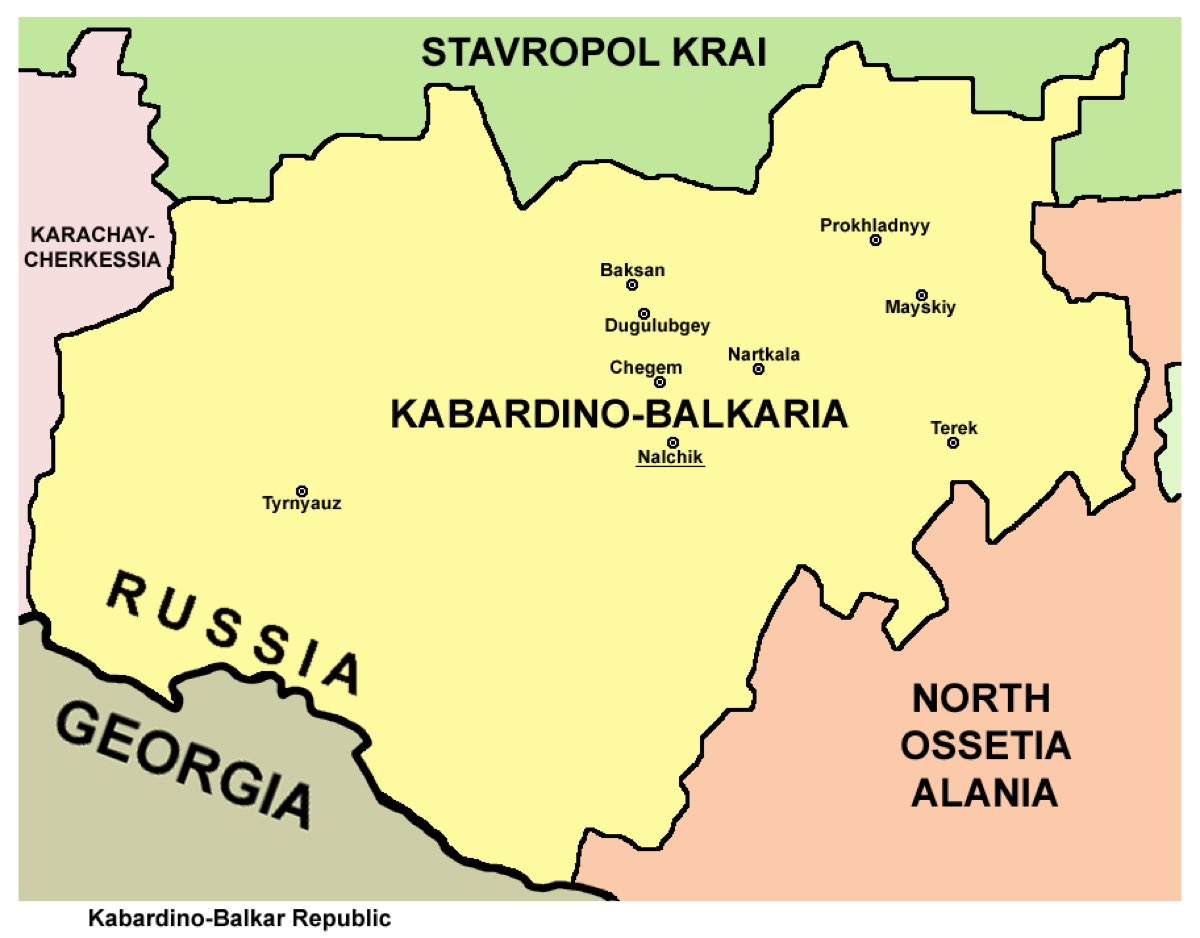
It is an autonomous republic connected to the Russian Federation that is located in the Northern Caucasus and in the northern skirts of the Caucasus mountain chain. It is surrounded with the Russian Federation on the north, the North Osetya on the east, Georgia on the south, and the Karacay-Circassian Republics on the west. It is not possible to distinguish the Karacay and Malkar people from one another that constitute the most important part of the Turkish element among the people who live in the Northern Caucasus. The principal element of Karacay and Malkar people is composed of Bulgarian Turks, Khazars and Kipchak Turks.
In the course of the Great Migration of Turks starting from the Middle East, these Turks had firstly come to the banks of Idyll, and then to the Northern Caucasus. These Turks had founded great empires in this region for centuries. Some of them settled in this region while the others advanced towards the internal parts of the Balkans and Europe. As a result of the historical, anthropological, archaeological and sociolinguistic researches carried out in the region, it was found out that the Huns, Bulgarians, Khazars, Kipchaks, Avars and Pecenek Turks that had stayed in the region were the ancestors of the Caucasian Turks of today.
Having settled on the shores of the Kuban River in the Northern Caucasus, these Turks had to retreat to the high peaks of the Great Caucasus mountain chain upon the attacks of Cenghiz Khan's armies in 1223. These Turks who settled in this region formed the Karacay and Malkar people. The researches carried out have shown that the Kipchak Turks constituted the principal element of the Karacay and Malkar people.
In the beginnings, Malkar people lived together with Karacay people in Bashan and Çerek regions in the east of Elbruz Mountain. Pursuant to the war made with Kabar Circassians in the region within the century XVI, most of the Malkar people immigrated to the west of the Elbruz Mountain and the valley of Kuban River and they got separated from the main community. Thus, the two communities that had lived together in the past were divided into two sections. The Turks living on the east of the Elbruz Mountain were called as Balkar Turks while the Turks that immigrated to the West were called as Karacay Turks on account of the places.
The Balkar (Malkar) and Karacay Turks who lived with Karacay Turks in the neighbouring regions were the victims of the policy of USSR towards the separation of these communities from one another. The Russians forced these two Turkish tribes to get separated. Balkar Turks were forced to establish a state with Kabardey people while the Karacay Turks were forced to establish a state with the Circassians. As a result of these events, two separate states were formed in the region, and the state established by the Balkar Turks together with the Kabardey people has survived until nowadays as an autonomous region.
The surface area of Kabardey-Balkar Republic is 12.500 km2. It includes the middle region of the Great Caucasus mountain chain within its southern frontiers. Therefore, its southern regions present a hilly sight while plains are observed towards the northern sections.
The Elbruz Mountain that is the highest hill of the Great Caucasus mountain chain constitutes the borders with the Karacay-Circassian Republic. The Elbruz Mountain with the height of 5.633 m. is the highest altitude. This mountain chain is covered with glaciers above the height of 3.000 m. The lands descend towards the north and they turn into the plateaus with the height of 1000-3000 m. in the middle region and into vast savannas formed by the River Terek and its branches in the norther parts.
The most important river is the River Terek. The Terek River is watered with the glaciers of the Great Caucasus mountain chain. The other streams that are watered from these glaciers are Malkadere, Guzdelendere, Baksav-dere, Cbeyan dere, and Çerek dere.
The population of the Republic is 674.000 (1979). The Balkar Turks has a density over 88 thousands of people. The capital of the Republic is the city of Nalcik and the Turks live about the regions of Çerek, Ceğem, Baksan, Malki and Terek that mostly are hilly and plain lands.
Balkar people that are divided into the branches of Mezengi, Bezingil, Hulamlı, Çezimli, Baksamlı, etc.are Muslim people and connected to the Altay branch of the Turkic language group. Balkar people who call themselves as Bucolic "Tavlu" (People of Mountains) were subjected to the bloody exile of Stalin in the course of the Second World War. They lost thousands of sacrifices in the exile years. Finally in 1950s, they were forgiven and given the permission for the right to return to their countries.