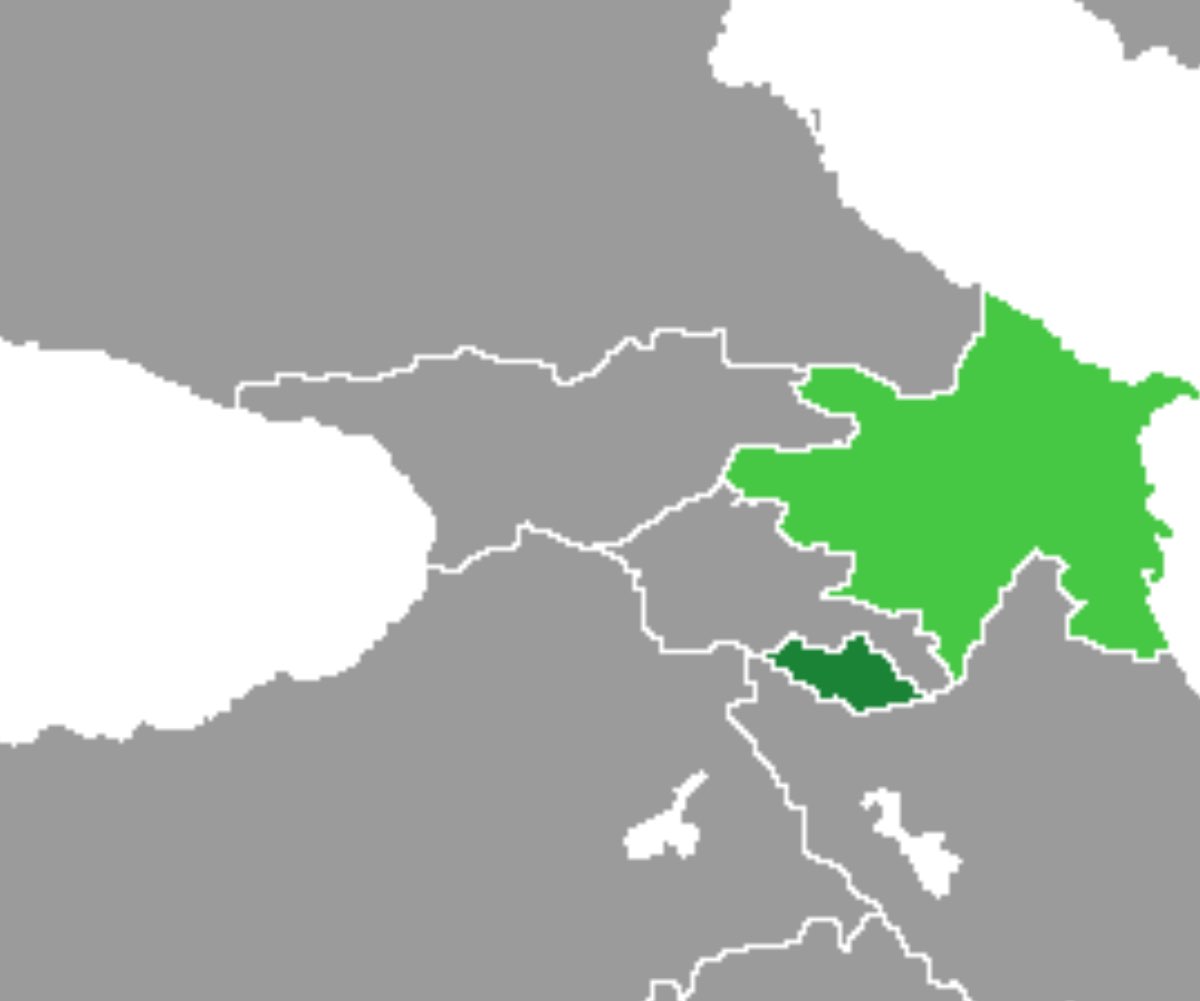
Nachicevan bears the status of an Autonomous Republic connected to the Azerbaijani Republic. Pursuant to the recognition of its autonomy in accordance with the Moscow and Kars Agreements, Nachicevan was established as an "Autonomous Republic" in the year of 1924. In other words, its Constitution was prepared in the aforesaid date and the structure and operation of its Autonomous Status was determined. Nachicevan was considered within the structure of the Soviet Union as connected to the Azerbaijani Soviet Socialist Republic until the year of 1991. Upon the declaration of the independency of Azerbaijan in the year of 1991, Nachicevan gained its independency. The legal organ with the highest authority that administers Autonomous Republic of Nachicevan is the "Nachicevan High Council". The High Council is composed of 70 deputies selected by the public. The president (Chairman) of the High Council is elected by the deputies. Similarly, this High Council establishes the Government of Nachicevan, in other words the "Cabinet of Ministers" (the Board of Ministers) through an election.
The government is composed of the following ministries: Ministry for Studies and Education (Ministry of Education), Ministry for Rural Expenditures (Ministry of Agriculture and Rural Affairs), Ministry for Youth and Training (Ministry for Youth and Sport), Ministry of Civilisation (Ministry of Culture), Ministry for Water Expenditures (Ministry for Water Affairs), Ministry of Finance, Ministry of Foreign Affairs, Ministry for National Safety (Ministry of National Defence). There are some committees instead of some ministries within the structure of the Autonomous Republic. For example: The Committee on Statistics, the Real Estate Committee, the Land Committee, etc.
The civilian administrative structure of the Autonomous Republic was organised on the basis of the districts (sections). The principal districts are as follows: Nachicevan Central section, Ordubad section, Culpha section, Shahbuz section, Bebek section, Sederek section.
The population of the Autonomous Republic is approximately 400.000 as it has been stated above and the population of its capital is around 70.000. Most of the lands of Nachicevan Autonomous Republic are essentially composed of the extended parts of the Savanna of Iğdır. The lands of the country is surrounded by mountains from every direction. The Small Caucasus mountain chain is located between Nachicevan and the Armenia. The typical continental climate in the region is also dominant in Nachicevan. The summers are hot and arid (35°-45°) while the winters are cold (-30°/-35°). The major streams and rivers of Nachicevan are the River Aras, Arpacay, Elince Stream and Gilan Stream.
The industry is not developed well. There are some sorts of small-scale industrial institutions such as electro-technic, bottle-glass, aluminium kitchenware manufacture, wine factories and the similar corporations. The lands of Nachicevan are very rich in respect of the curative waters and especially the mineral waters. These are processed to some specific degree. There are layers of salt in Babek section and there is a little ore of iron in the section of Ordubad.Nachicevan has been underdeveloped in respect of economy. Nachicevan does not have any common borders with Azerbaijan to which it is connected and it only has very long and closed borders with the Armenia. Besides these reasons, the economical and commercial relations with Iran are insufficient. All these reasons lead the country to experience the conditions of a closed economy. The country with which it has the best economic and commercial relations is Turkey. The daily commercial relations are carried out through the province of Igdır.
The educational services in the Autonomous Republic of Nachicevan are developed. Besides the adequate number of the primary and secondary schools, there is also one secondary school that trains various occupational staff members, one "State University" and three private universities. Furthermore, there is also some kind of an Academy of Sciences that is called as a centre of science (Institution of Science). In this academy, the scientists carry out their scientific studies related with their operational fields.