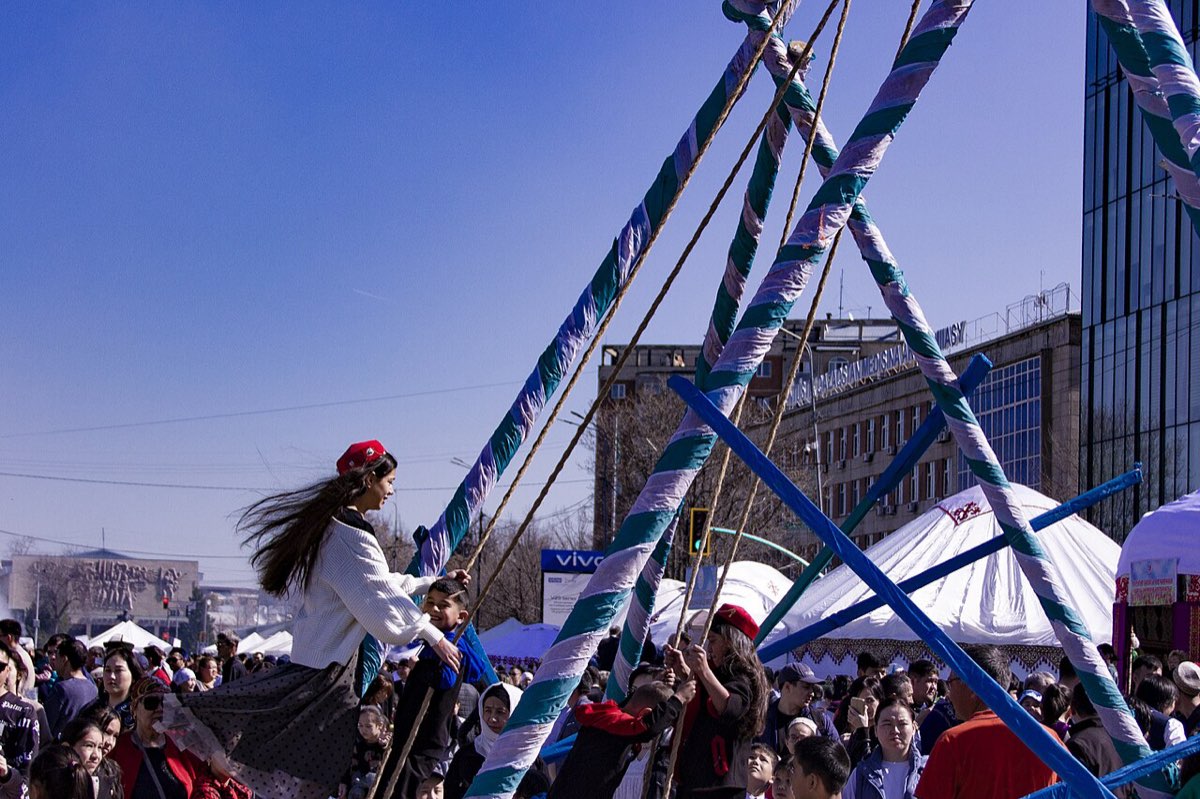
The Common Feast of the Turkish World
"The coming of spring" would surely have an important place in the thinking system of the Turk living in the nature and considering the soil as "the mother". Nevruz is a feast widely celebrated by many of the societies living in an unlimited geography extending from the north of the Turkish world to the south and from west to the east. It is believed that all the feasts are born of a religious and national belief, a common memory, tradition, sentiment and a happening of the nature which affects people.
The spring feast, which is generally called Nevruz, meaning "New Day" in Persian, is a feast that human beings celebrate together with the awakening of human spirit in nature. It is known that such a feast, in other words, a special day due to change in season, is included in the social life of many nations.
For example, "Noel", which Christian world shapes with the religious content and on which Santa Claus carries hopes and good spirits by a sledge carried by the deer in the land of the snow, is another example. In these celebrations, the yearning for the spring is symbolized by the pine tree. When we have a look at these celebrations, also representing a change in the calendar, it is seen that this celebration of "spring feast" also reflects a change in the calendar.
Here, the outstanding point is "the time when spring starts". The Turks identified this calendar change by the "day on which the soil awakens". The Turkish shamans express this enthusiasm in their prays as follows: "...When the great God of the Sky roared for the first time, when the barren soil was decorated with the flowers for the first time, when the animal herds of sixty types neighed for the first time, you (the Ancestor of the Turks) were created!"
This feast has continued as one of the customs, which did not conflict with Islam like the hunting drives, ceremonies, feasts, washing etc. in the first. Thus, such customs have reached the Turkish world of our day as the common inheritance. The traditions have survived from period whose dates we can not determine for sure. The beginning of a new year is observed in the endless geography with no change in characteristics such as renewal, joy and refreshment.We have the records relating to Nevruz from the Chinese sources to Kutadgu Bilig, from Kashgarlı Mahmud to Biruni, from Siyasetname (Book of Politics) of Nizamü'l Mülk to the calendar of Meliksah and the laws of Uzun Hasan Bey of Akkoyunlu.
On the other hand, we know that rulers like Kadi Burhaneddin Ahmed, the ruler of Sivas, Shah İsmail, the founder of Safevi Turkmen State, Ottoman Sultans like Ahmed I and Murad IV and Mustafa Kemal Atatürk; our religious people like Kazasker Baki Efendi and Shaikh al-Islam Yahya Efendi, our poets like Kuloğlu, Pir Sultan Abdal, Kaygusuz Abdal, Şükrü Baba, Hüsnü Baba, Fuzuli, Nev'i Efendi, Nef'i, Nedim, Hüseyin Suad and Namık Kemal, the Vizier of Fatih, Ahmed Pasha, the great poet of Azerbaijan, Shehriyar and great Turkish poet Mahdumkulu have celebrated the oncoming of Nevruz by poems called "Nevruziye" or "Bahariye".
In addition, we know that Nevruz has a past over 700 years as one of the most established makam (a concept of melodic creation that determines tonal relations, tessitura, starting tone, reciting tone and the finalis, as well as an overall indication of the melodic contour and patterns, with closest part in Western music being the medieval concept of mode) the Turkish music. This makam was first used by Urmiyeli Safıyuddin Abdul'min Urmevi (1224-1294). We have more than twenty makams at present.
The tradition of Nevruz is one that has no direct relation with neither Sunni nor Alaouite (member of religious group that reveres Ali) nor Bektashi tradition, it goes far beyond. It is not a feast of a religion or religious sect. For this reason, it is wrong to try to make it look like a feast related to a religion, a religious sect, an ethnical origin and a factor for separatism. It is against the history and culture.
The Turkish republics, Kirghizistan (Kırgızistan), Kazakhistan (Kazakistan), Uzbekistan (Özbekistan), Turkmenistan (Türkmenistan) and Azerbaijan, having acquired their independence in 1990, and Tatarstan (Tataristan) under the Russian federation declared 21st March Ergenekon/Nevruz Feast as the "National Feast".
They attribute great importance to the celebration of this feast. Ergenekon/Nevruz Feast originating from Turkish culture, is a customary national feast, enriched by the Turkish customs and traditions with its origins going back to five thousand years back. In Turkey, it was declared as an official feast with no holiday. Nevruz, is a fire that connects and relates Turkish people to each other and that goes on burning by their ancestors by melting the Iron Mountains. This fire have burnt for thousands of years and will heat thousands of souls in "common culture center". Let Nevruz feast be joyful of the Eurasia and the Turkish world and the Nevruz roses carry hope to the future.
The Names of Nevruz in Turkish World
In Turkish world, it is known that Nevruz (New Day), meaning the union of the awakening of nature and the nation, is celebrated under the following names:
Nevruz
Navruz
Novruz
Sultan-ı Nevruz
Sultan-ı Navrız
Navrez
Nevris
Naorus
Novroz
Navrıs Oyıx
Nevruz Norus
Ulustın Ulu
Küni
Ulusun Ulu Günü
Ulu Kün
Ergenekon
Bozkurt
Çağan
Babu Marta
Kürklü Marta
İlkyaz Yortusu
Yeni Gün
Yengi Kün
Yeni Yıl
Nevruz
Navruz
Novruz
Sultan-ı Nevruz
Sultan-ı Navrız
Navrez
Nevris
Naorus
Novroz
Navrıs Oyıx
Nevruz Norus
Ulustın Ulu
Küni
Ulusun Ulu Günü
Ulu Kün
Ergenekon
Bozkurt
Çağan
Babu Marta
Kürklü Marta
İlkyaz Yortusu
Yeni Gün
Yengi Kün
Yeni Yıl
Mart Dokuzu Mereke
Meyram
Nartukan
Nartavan
Isıakh Bayramı
Altay Ködürgeni
Bahar Bayramı
Yörük Bayramı
Mevris