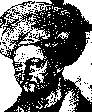
Worldwide famous Turkish mathematician and astronomer ruler. He was born in Semerkant on 22 March 1395. He is one of the grandsons of Tamerlane and the son of ruler Muinüddin Shah Ruh. His real name is Mehmet Torgay. He was the deputy khan of Horasan and Maveraünnehir states when he was 13. Upon his father's death in 1446, he became the ruler. He was closely interested in mathematics and astronomy in his sultanate days. His astronomy table was published in England and France years later. He was killed in 1449 when he was 54 by Abdullatif Mirza, his son who rose against him.
Ulug Bey became the ruler in 1446 after his father Shah Ruf died. First he strengthened the state and saved his country from being broken up.
After he ascended the throne, he tried to establish more frequent relations with Ottoman state. Envoys and scientists began to go to each Turkish countries. He was a ruler who dedicated himself to science more than war. He gathered all scholars of his time in his palace and saved them. He sent delegations to China for researches. He constructed a medresah and a observatory in Semerkant. He worked for development of Astronomy science. The observatory carried medieval astronomy knowledge to its highest level.
Ulug Bey was the full grandson of Tamerlane, the great conqueror who wrote his name into the history as "Asian Conqueror". But he did not have any of his grandfather's military and warrior manners. His grandfather conquered countries on horse holding the sword in spite of his being one-handed and lamed. But Ulug Bey had no such passion. His curiosity was more on the sky, not on the earth. He preferred researches about the sky and trial of solving the secrets of the sky to conquering countries.
Not only his disposition but also his father Shah Ruh had played an important role in his being a scientist. Because Shah Ruh was an admirer of fine arts. He highly respected science and scholars. A mosque he constructed in Meşhed, the capital city of Horasan was a masterpiece.
Ulug Bey also constructed a beautiful pavilion in Herat and embellished the ceilings and walls of this pavilion with pictures which constituted art masterpieces. In his reign, whole country, Semerkant and Bukhara in particular, was ornamented with distinguished products of Turkish architecture. His interest in Sciences and astronomy turned him into one of the greatest astronomers of world history. Ulug Bey, whose statesman qualifications were also high as his scientific character, ruled for 38 years in Semerkant. His palace which he turned into an academy, became a place of scientific discussions where famous scientists of his period gathered and prepared books.
Mathematician, astronomer, historian and poet Ulug Bey, gathered all scholars such as Mesud el-Kaşi, Bursali Kadızade Rumi, Ali bin Muhammad (Ali Kuşçu) in his palace. He enlarged the observatory and medresah of Semerkant and furnished with new equipment. In Ulug Bey's period, new astronomy equipment were made and new devices were developed. An astrolabe in 9th and 10th century did 43 processes, but astrolabe he developed did more than 1000 processes. The astrolabe of Ulug Bey was 40 meters in diameter.
Ulug Bey succeeded in mapping the sky at the same time. The sky map was going to illuminate the astronomy studies of the future generations and guide them. Ulug Bey conducted wide investigations on trigonometry science which constituted the foundation of astronomy studies. He left aside the estimation-based knowledge of Eastern and Western world before him and established scientific principles and opened a new way of trigonometric research. The world met him with his book on astronomy. The studies conducted in his observatory in Semerkant still enlightens today's astronomy.His table named Zic-i Ulügi, his other literature and observances are a consequence of the studies in his palace, which was no different from an academy. The tabl, Zic-i Ulugi, which was also called "Gürgani Calendar", is considered as the only calendar of his age based on scientific principles. The book corrected the books before it and perfectly showed the movements of stars.
Zîc-i Ulûgî, was published in 1655 in Oxford, England in English and in 1853 in French. Then it was translated into various languages . The western science world entitled Ulug Bey as the "Astronomer of 15th century" and International Astronomy Association gave his name to a crater on the moon. The moon map prepared by the astronomers of five countries and a commission consisting of the experts of countries which sent satellites to the Moon involves names of three Turkish astronomers. A big crater was called Ulug Bey. The other two Turkish scientists who had their names in moon atlas are Biruni and Nasireddin Tusi.
His book on cosmography formed a source of several scientific researches until now.
Ulug Bey, who was known as the fairest ruler of the history just as the most scientist one, was also an unfortunate one. His son Abdüllatif Mirza rose against his father and started a civil war. Ulug Bey, showing his strength, was able to overcome the rebels commanded by his son. During this civil war, Abdullatif Mirza was taken captive. Ulug Bey was not a merciless man like his grandfather Tamerlane. He forgave his rebel son, and gave advice to him. He thought as a sensitive father, not as a ruler in this issue, and acted so.
But his son Abdullatif Mirza had a totally opposing character, like he was not the son of that good, scientist and perfect father. He did not take the spiritual lesson from his father after his being defeated. He started to prepare for a new coup d'etat as soon as he was released. He prepared a stronger army this time, and did whatever necessary to succeed. And having completed his preparations, he rebelled against and attacked him again.
The second war was not fortunate for Ulug Bey. In fact, the scientist father did not think that his forgiven son would attack him a second time. Ulug Bey was caught unaware. Everything proceeded in opposite, this time 54-year-old father was taken captive by the rebel son. Unfortunately Ulug Bey did not see the same understanding and mercy he showed to his son. The rebel son, as the victorious commander of the war, sentenced his father to death on 25 October 1449. Ulug Bey, the most famous mathematician and astronomer of the world, lost his life in a bitter end for a father and was buried next to his grandfather Timur.