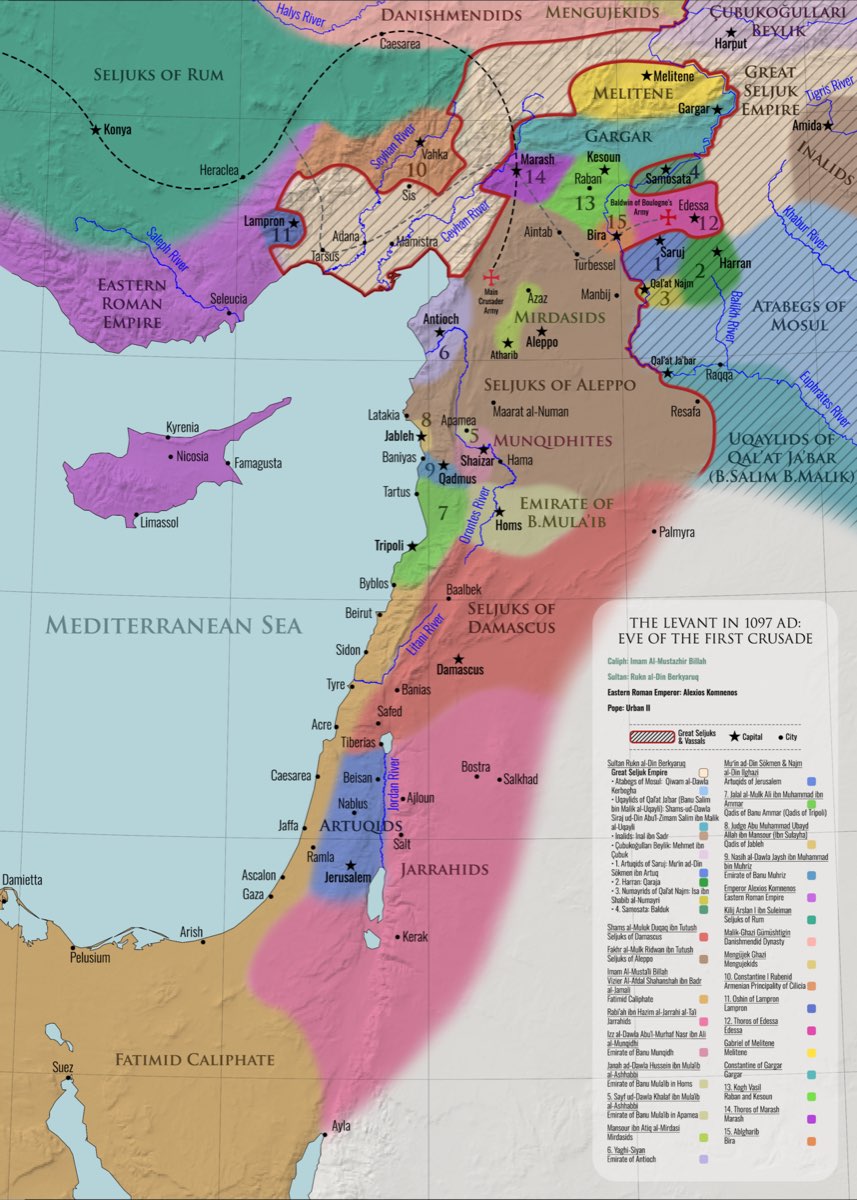
Pursuant to the foundation of Aleppo Seljuks kingdom, the Ruler Ridvan tried to expand his field of domination. First of all, he advanced towards Suruc together with his attendant, the Vizier Cenah ed-Devle. As a result of the successful defence of Artukoglu Sokmen, he retreated and captured Urfa that was under the dominion of Armenian Toros (1096). The Ruler Ridvan assigned Yagi-basan who was the governor of Antioch with the administration of the citadel of the city and then, he returned to Aleppo. Ridvan wanted to capture the city of Damascus and establish dominion in the lands that were dominated by his father in his lifetime. Therefore, he besieged Damascus, but he failed. Fatimi State benefited from this struggle of domination between the two brothers, and they sent an army in the command of Emir el-Cuyus Efdal to Jerusalem. Pursuant to a blockade and war that continued for forty days, Fatimi army took the delivery of Jerusalem from Artuk family (August 1096). In the same month, the Ruler Ridvan organised some attacks for despoil and destruction that extended towards the regions of Antioch. Then, he made some preparations in order to capture Damascus, but this attempt was just a failure. Before long, the Ruler Dukak attempted to advance over Aleppo in return to Ridvan. The armies of both sides fought in Kennesrin. Ridvan defeated Dukak and his attendants in a crushing manner (20th March 1097). Dukak had to recognise and submit to the domination of Ridvan. Meanwhile, Ridvan had needed the support of Fatimi State in order to maintain his domination in Aleppo and he collaborated with this state. As a result of this collaboration, he delivered prayers in the name of el-Musta'li who was Egypt Fatimi Caliph for a period of four weeks in the places under his domination. However, as a result of severe critics and reactions of his retinue, the prayers were delivered again in the name of the Abbasi Caliph and Ridvan had apologised from the Caliph el-Mustahzir (1097). At the same time, we have obsderved that the Crusades had been initiated from the west towards the Muslim countries. The Crusades who passed to Anatolia captured the Antioch (1098). Afterwards, the Crusades tried to expand their fields of domination. Bohemen who was the count of Antioch invaded some castles connected to Aleppo. After a while, the Ruler Ridvan set in motion and recaptured various places that were invaded by the Crusades around Aleppo. Therefore, the threat of the Crusades had been removed for a while.
But this period lasted for a very short term, and Ridvan and the Crusades encountered again in Kinnesrin in the year of 1105. However, Ridvan lost the war that was fought against the Crusades, and he had to retreat to Aleppo (1105). The Crusades got the advantage of his defeat, and they attempted to invade and despoil the region of Aleppo. Muhammed Tapar who was the sultan of the Great Seljuks State had assigned Emir Cavli Sakavu to the region of Mosul in the year of 1106. In order to establish dominion in Mosul, Cavli was involved in a struggle with Kilic Arslan who was the sultan of Turkey Seljuks State and he wanted help from the Ruler Ridvan. Ridvan joined him together with his soldiers. Kilic Arslan who was defeated in the war was drown in the stream of Habur (1107). But afterwards, Ridvan and Cavli were on strained terms. Under these circumstances, Ridvan wrote a letter to Tancred, the prince of Antioch and asked for his help. Furthermore, he stated that Cavli posed a threat for Aleppo and a danger in relation with the Crusade domination in Syria. Tancred collaborated with the Ruler Ridvan, and Cavli allied with Baudouin who was the count of Urfa. The war between the two sides that took place in Tel-Basir ended in the favour of Tancred and Ridvan (October 1108).
The blockade of Urfa by the Seljuk forces under the command of Emir Mevdud (1110) led the Crusades to depart from Syria for a while in order to save this city. The Ruler Ridvan benefited from this situation, and he organised raids to the region of Antioch. Afterwards, Tancred who returned to Antioch informed that the agreement between them was cancelled and he made a counterattack. He captured some important castles and he caused great losses and damages in the region with his marauds for despoil. Under these circumstances, the Ruler Ridvan had to establish a state of peace with Tancred under heavy conditions (1111).
After a while, the Ruler Ridvan was in a difficult situation due to the activities of the Crusades in the region of Aleppo and he applied to the Great Seljuk State for help and support. Numerous Muslims had obeyed to the invitation of Sultan Muhammed Tapar and the Seljuk army under the command of Mevdud besieged Tel-Basir that was under the dominion of Joscelin. But there was not any result obtained from this blockade. The Ruler Ridvan informed Emir Mevdud stating that the Aleppo Seljuks Kingdom was experiencing a danger of extinction as a result of the pressures of the Crusades, and he wanted the arrival of Seljuk army to Aleppo. Emir Mevdud accepted this request and came to the region of Aleppo. However, the harsh and violent attitudes of the Seljuk soldiers had probably led to the closure of the doors of Aleppo by Ridvan. As a result, the Seljuk army had to leave from Aleppo (September 1111).
Under the pressures of the Crusades that gradually increased, the Ruler Ridvan invited Tug-Tegin who was the ruler of Damascus to Aleppo. Tug-Tegin accepted this invitation and came to Aleppo. As a result, Ridvan and Tugitegin made an agreement. Accordingly, Tug-Tegin would deliver prayers and mint coins in the name of Ridvan (1112). We have observed that this agreement was cancelled before long. Against the Crusades that threatened him, Tug-Tegin had asked help from various Seljuk emirs and meanwhile, from the ruler Ridvan. Ridvan did not accept this invitation probably with the fear that he was wary of Antioch Count Roger that he paid annual taxes to. However, Tug-Tegin and Mevdud won the Taberiyye war against the Crusades, and pursuant to this war, he sent one hundred of cavalrymen to them. Tug-Tegin was angry about his bashful attitude and he violated the agreement between then (1113). The Ruler Ridvan did not live for long after this event, and he was infected with a fatal disease. Then, he died in Aleppo on the date of 10th December 1113.
Pursuant to the death of the Ruler Ridvan, his son, Alp Arslan el-Ahras that was sixteen years old had been enthroned as the ruler of Aleppo Kingdom. However, the administration was under the dominion of the Eunuch Lu'lu who was his tutor. In this period, the complaints about the Batini supporters in Aleppo had increased. Sultan Muhammed Tapar sent an envoy and wanted the instruction of the orders for the movement against the Batini supporters and the annihilation of their leaders. Alp Arslan obeyed to this request and killed some of their chiefs. The people of Aleppo who disliked the Batini supporters joined in this operation. However, the kingdom of Alp Arslan lasted for a short period. Alp Arslan had applied to Tug-Tegin for help upon the recommendations of his attendants, and he even visited him under goodwill in Damascus. Tug-tegin has answered his apply with a positive manner. On the other hand, the Tutor Lu'lu was afraid of his irresponsible attitudes with the fear that he would act in accordance with the desires of Tug-Tegin. Furthermore, he considered his life to be in danger, so he had Alp Arslan killed (September 1114).
The Tutor Lu'lu enthroned his brother, Sultan-shah at the age of six instead of Alp Arslan. Therefore, he became the actual administrator of the state for a specific period. However, the lack of a strong ruler and the insufficient number of the army led the Aleppo Kingdom in the state of the defence of the named city only. In order to maintain his domination, Lu'lu sometimes provided the support of the Crusades, Tug-Tegin and Sultan Muhammed and sometimes he applied to Artuklu Ilgazi. As a result, Lu'lu was killed by a Turkish detachment that accompanied her in the course of an expedition in the year of 1117. Then, the other eunuchs dominated the administration. Sultan-shah was the ruler only by name since he was so young in respect of his age. Due to these civil turmoils, the city of Aleppo was in a helpless state that cannot be saved from the destruction and despoil of the Crusades. Artuklu Ilgazi had captured the Aleppo temporarily in the year of 1117. In the following year, Ilgazi established a firm domination in Aleppo upon the invitation of the people who lived in miserable conditions and he arrested Sultan-shah (1118). Therefore, the Aleppo Kingdom, and thus, the Syrian Seljuks State was abolished.