Sovereignty
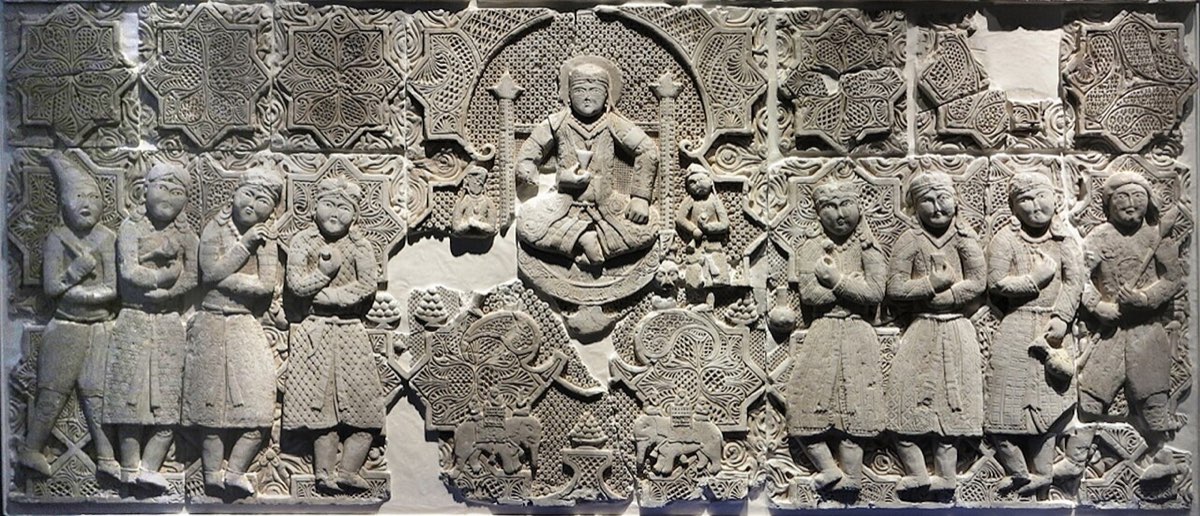
In the Kara-Hanli state, the great khan titled as Arslan Khan reigned the east of the country while another khan titled as Bugra Khan that was under his high sovereignty governed the east of the country. There were some princes that were called as İlig and Tegin. The rank of sovereignty was promoted within the range of Tegin, İlig, then Bugra Khan and finally, Arslan Khan respectively. The members of the sovereign dynasty that governed the country would have a specific military force under their command in the centres of their regions that they were assigned (Balasagun, Ozkend, Kashgar, Sayram, Ilak, Bokhara, etc.) and they could mint coins in their own names upon the permission of the central government. Those who were the regents of the khans in the capital city had used the titles such as Erkin, Sagun, etc. According to Kasgarli Mahmud, there was a board of counsellors governed by the chairman titled as Yugrus that was entitled to the viziers trained among the people and also a state council. The communication between this council and the khan was provided by Tayangu (hacib, ulu hacib= messenger, high messenger); and the internal and external written communications of the country were organised by Bitigçi and the financial affairs were organised by Agıcı.
As it can be observed, the government in the Kara-Hanli State had a quality of the continuation of Steppe Provinces. However, in the high rank offices of the organisation, there was a modification in the technical terms used such as Arslan Khan instead of the ancient word of hakan (= khan, ruler). The innovations that were observed in respect of the religion of Islam were the confirmation of the sovereignty by the caliph as a precondition of legitimacy in the Islamic States, the delivery of prayers in the name of the caliph within the state, the inclusion of the caliphs name in the coins, and the wearing of a çetr (an umbrella made of silver threaded velvet; that was the symbol of the sovereignty) that was put on the head of the ruler. Since the period of Satuk Bugra who was the first person to adopt the religion of Islam, the khans started to use Muslim names and titles; however, they used the title of Sultan towards the 13th century.
The sovereignty in the Kara-Hanli State was essentially based on the principle of legitimacy in Steppe Provinces. This issue was indicated in the famous book of policy titled as Kutadgu-Bilig that was known to be written in Kashgar towards the year of 1070. In this work, the fundamental elements of the Islamic States such as canonical law, caliphate, etc., Koran, Prohets sayings and the religious-legal Islamic institutions were not mentioned and the people were introduced in the quality of a Turkish community rather than an Islamic community. The legitimacy was based on the understanding of the ancient Turkish kut and töre (moral laws) in this work. As it is known, this understanding considered the sovereignty as the gift and donation of the God but it restricted this sovereignty with the provisions of the moral laws and traditions. This understanding did not have any relation with the ancient Indian-Iranian approach.
Gazneli State had had a quality of rather a local Islamic state. Mahmud who was approved by the post of caliphate and entitled with various titles by the caliph was the first ruler whose title of Sultan was conferred to him. Then, this title was used as an official title by the rulers of all Islamic states. However, the Tutor Principalities that were the continuation of Seljuk State in respect of political development and that maintained the capacity of administrative authorities under the high sovereignty of Seljuk State in form had used the Turkish titles, not the Arabian or Iranian titles. Nevertheless, the title of Sultan was not used in the Anatolian Turkmen principalities. This situation indicates the central role played by the Great Seljuk Empire that had undertaken the legitimate sovereignty over all political organisations that were widespread in the entire Middle-East region and meanwhile, the branch of Anatolian Seljuk State.
In the beginning, Seljuk dynasty was in the pursuit of Oguz-Yabgu state that had applied the understanding and organisation of the ancient Gok-Turk state. Their ruler was Yangu. The members of the dynasty that were titled as Inal, Yinanç and Bey had participated in the administrative responsibilities around him. However, pursuant to the passage to Khorasan, there were some changes that occurred within the state. Actually, the most important result of Dandanakan War in 1040 was the settlement of Seljuk people in Khorasan. This seems to have the quality of the most effective event in the establishment of Turkish-Islam state and society. The continent of Khorasan that included the big centres of population such as Nisapur, Merv, Serahs, Tus and Belh, etc. (the cities and the villages within the environs) was a country that would accommodate the Steppe people with its vast pastures and extensive grasslands. In addition, the products that the Turks provided from their crowded herds of sheep, cattle, horses, etc. could meet the requirements of the city-dwellers and villagers and supplement the economic conditions of the regions with the raw materials that would be provided for the native handicrafts. Therefore, Khorasan had resolved the problem of lack of enough places that was the main reason of migration for the Seljuk groups and thus, it eliminated the problem of rat race for existence. Khorasan had also great significance as one of the principal places of the world trade in the Middle Ages.
Especially the city of Nişapur that was located in the intersection point of main highways was of great significance in respect of strategy. Khorasan was a rich cultural centre that bred the distinguished politicians, governors, men of letters and scientist of Islam and the east. Therefore, due to these characteristics, Khorasan had always been a matter of severe competition among the neighbouring states (Kara-Hanli, Samani, Gazneli States). It is beyond doubt that Khorasan was considered as the main target that was required to be conquered. Another quality that encouraged this conquest was the fact that the people of Khorasan were partially Turks. There were some Turks that had lived in this region before the period of Seljuk State. Actually, according to the famous Arabian authors named as El-Cahiz (died in 869) and El-Biruni (died in 1051), there was not any significant difference between Khorasan people and the Turks that lived beyond the river (Ceyhun) in respect of general understanding and lifestyles. Due to these economical, military, cultural and ethnical characteristics, the region of Khorasan had provided the reinforcement of Seljuk State and it had shaped the character of Turkish domination in the Middle-East that would last for centuries ahead.
The established cultural values were experienced in the cities and towns of Khorasan in respect of social and intellectual life and the Eastern-Islamic beliefs and attitudes that were represented by Abbasi caliphate were dominant in these regions. At the same time, this culture gradually developed within the environs of Khorasan due toe the opportunities as we have stated above. The establishment of the state in this region by the Seljuk dynasty that came from the Steppe lands was only possible through the appreciation of the religion of Islam and the local characteristics. The Seljuk rulers that had a tradition of sovereignty for a history of a thousand years were aware of this fact.
As a matter of fact, the respect shown to justice and order both in the religion of Islam and among the Turks could be understood from the speech of Ibrahim Yinal who came to Nişağur in the capacity as the pioneer of Tugrul Bey in the year of 1038. According to Yinal, the disorder that had been observed within the surroundings resulted from the affairs of little men. From that date on, nobody would dare to cause disorder in the society under the government of the fair ruler Tugrul Bey. When Tugrul Bey came to Nisapur, he listened to the recommendations of the famous Muslim judge called as Said and he assigned a native governor called as Ebu'l-Kaasım'ül-Kevbanî with the charge of the elimination of disorders. This person was alleged to have been the first Seljuk vizier and the other viziers that followed him were the native persons that were assigned in his place. This situation shows that the foundation of an eastern-Islamic state was laid in Khorasan with the traditions of canonical law and organisation. Tugrul Bey undertook the title of sultan and he started to use Islamic names and nicknames. The term of melik substituted the title of Oguz Yabgu and government was initiated to be organised in accordance with the Islamic model.