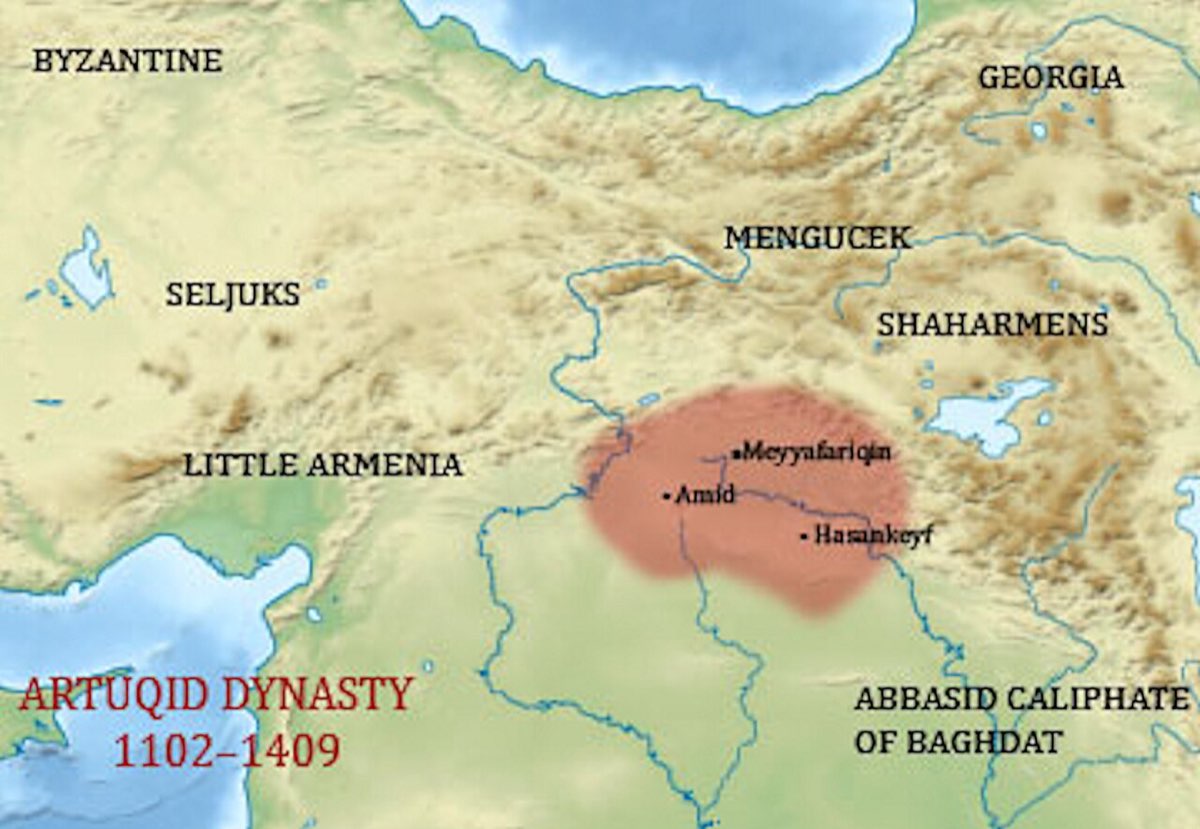
Artuklu Principality has been one of the long-lasting principalities that had left a significant trace through its culture and art. Artuk Bey who was a famous Turkmen Bey from the Dover tribes of Oguz people had provided great services in the course of the conquest of Anatolia. However, he had been on the side of Tutus in the course of the war between Tutus and Suleymanshah. He had helped him to win this war and he let Suleymanshah to commit suicide. Tutus had appointed him as the governor of Jerusalem in return for his great help. He had been on duty until the year of 1091 in which he died.When Artuk Bey died, the Jerusalem was captured by Fatimi State. However, Artuk Beys sons, Sokmen and Il-Gazi founded principalities in the regions that were given by the ruler of Seljuk State to them. These principalities that had been founded by Artuk Beys sons had developed in three branches:
1. Hisn Keyfâ and Âmid, 2. Mardin and Meyyâfârikîn, 3. Harput.
They were the members of a Turkmen dynasty that dominated in three branches stated above.
Artuk Bey had firstly been in the service of Sultan Alp Arslan and joined in the Manzikert War (1071). Artuk Bey had been among the emirs that had played important role in the conquest of Anatolia for Turks. Then, Artuk Bey drew back to Huvan that had been given him as a feoff by Sultan Melikshah. He successfully accomplished his duty to subdue Ahsa and Bahrain Karmati people. After a while, Artuk Bey got offended by Sultan Melikshah and this vexation led him to be in the service of Tutus who was the Ruler of Syrian Seljuk State. Tutus had appointed him as the governor of Jerusalem and its environs (1085-6).
Artuk Bey died in this city in the year of 1091. However, his sons, Sokmen and Ilgazi could not defend the Jerusalem. The army of the Fatimi State under the command of Emîrul-cüyûş Efdal captured this city pursuant to a blockade of forty days (1098).
Muîn ed-Dîn Sökmen had provided great help for Musa who had been the ruler of Mosul that had been besieged by Cokurmus, the possessor of Cezîret-i Ibn Ömer. He was given 10.000 dinars and the castle of Hisn Keyfa in return to this service of him. Therefore, Sokmen founded the first branch of Artuklu principality that was called as Hisn Keyfâ and Sokmeniyye (1102). Melik Kamil who was the ruler of Eyyûbî State firstly captured Amid and then Hisn Keyfa, and abolished hisn Keyfa branch of Artuklu principality (1231-2).
When Necmeddîn Ilgazî had been dismissed from the consulate of Baghdad in April 1105, he came to Mardin and dominated in this city. Then, he founded the branch of Artuklu principality called as Mardin or Ilgaziyye in this region (1108).
Ilgazi gradually dominated the lands of Seljuk State in this region and captured Aleppo in the year of 1117. He set in motion with an army composed of 20.000 people together with Togan Arslan who was the ruler of Bitlis and Erzen. He won a great victory against the Crusades under the command of Antioch prince Roger in Tel Afrin war (1119). Then, they successfully followed the King Baudouin II in Tell Danis. Sultan Mahmud of the Seljuk State gave the city of Meyyafarikin to Ilgazi as a feoff (1121). Then, Mardin Artuklu principality maintained their existence under the domination of Eyyubi State and sometimes under the domination of Turkey Seljuks State. Kara Arslan el-Muzaffer (1260-1292) had submitted to the domination of Mongolians and made a state of peace with them.
Thus, he provided the permanence of the dynasty and saved the city of Mardin from a calamity. The last ruler of this branch was Melik el-Salih. When he understood that he could not defend Mardin any more, he gave the delivery of this city to Kara Yusuf who was the chief of Karakoyunlular State (1409). Therefore, the Artuklu State has come to an end.
The third branch of Artuklu principality had been founded in Harput and within its environs in the year of 1185. Sultan Ala ed-Din Keykubad I captured Harput in the year of 1234 and abolished this branch of Artuklu principality.
Artuklu principality was a Turkish state that depended on large Turkmen groups. Therefore, they had maintained their national organisation and traditions. They had shown the maintenance of the traditions through using the ancient Turkish titles such as Alp, Inanc, Kutlug, etc.
Regarding the state administration, the Artuklu principality had applied the ancient Turkish law stating that the state was the joint property of the dynasty. The existence of strong characters such as Ilgazi and Belek, etc. had provided the political union of Artuklu State, otherwise, they had dominated in separate principalities.
The rulers of Artuklu State had given fair service for both the Muslim and the Christian people and they had provided the order and security in the countries under their domination. Furthermore, they had contributed great help for the development of the commercial and economical life. Therefore, they had cancelled the commercial taxes in some cities. This economical development could also be understood from the works of architecture.
Artuklu people had constructed several architectural works and some of them have existed so far. The works built by them included; complex of buildings, mosques, theological schools, public baths, bridges, civil and military buildings, etc. Due to the development observed in the architecture in their period, every significant work in the region of south-east Anatolia has been tried to be attributed to Artuklu principality today.
The cities such as Meyyâfârikîn, Âmid and Mardin, etc. within the country of Artuklu principality had become centres of science and culture. The rulers that were the members of this dynasty had protected the scientists and the artists, and as a result, some of the works had been written in the name of these rulers.