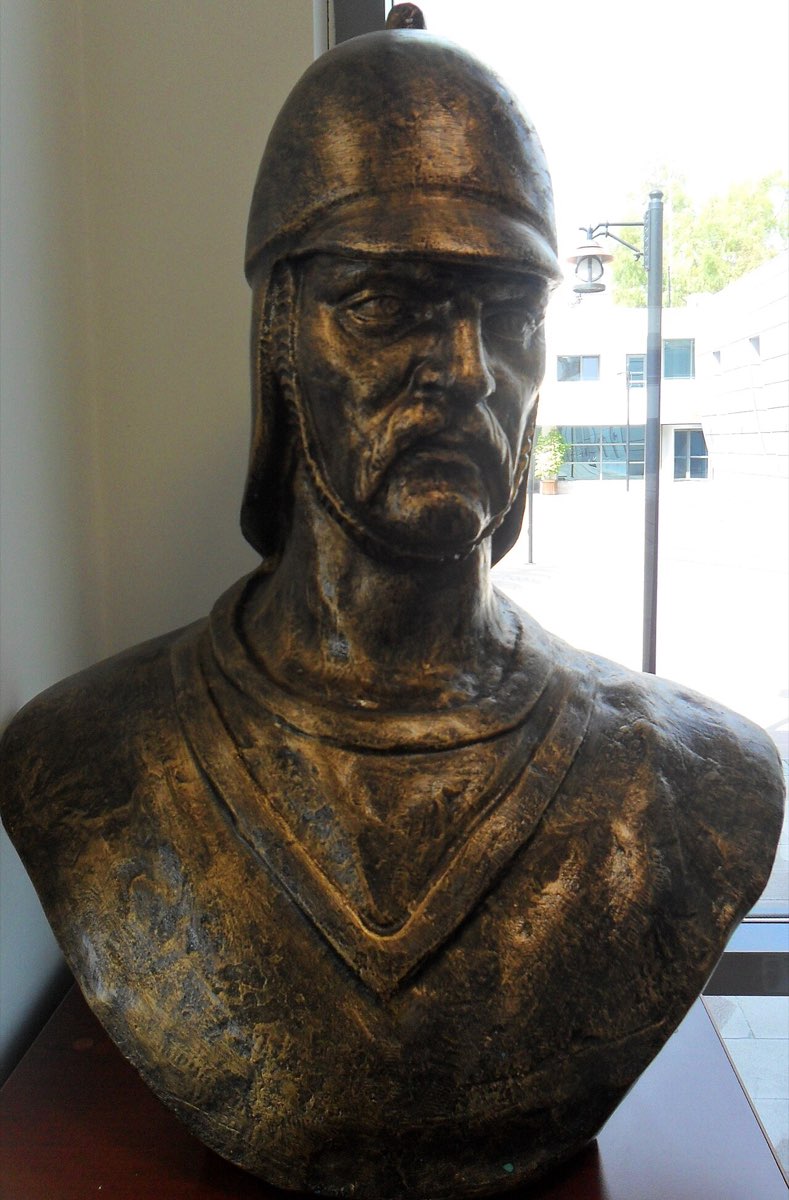
The life of Ghazi Umur Bey had been written in poesy in the epic style within the work of the poet Enverî titled as Düstûr-Nâme in the century XV. Ghazi Umur Bey was one of the perfect examples of Turkish initiatives and capabilities.
Izmir had been conquered by Suleyman Shah I who was the Conqueror of Anatolia and the founder of Turkey Seljuk State in the year of 1076. Izmir that had been given to Caka Bey had been the stage of the great marine projects and attempts of this Turkish Bey. Umur Bey reviewed thee projects and attempts after 2,5 centuries. The Byzantine recaptured Izmir, Iznik and the Western Anatolia, etc. from Turks in the year of 1097. Therefore, the first Turkish domination in Izmir could only last for 21 years. Then, Aydinoglu Umur Bey had recaptured Izmir in the year of 1320. As it can be understood, Izmir had remained under the domination of Christians for 223 years.
On the date of 28th October 1344, the Saint-Jean Chevaliers in Rhodes that had been supported by the troops of all the European countries forayed into Izmir; and they incinerated the shipyards and navies of Aydinogullari principality. The port changed hands into the domination of the Chevaliers. But the upper castle was in the domination of Turks. Therefore, the city was divided into two sections as the Muslim Izmir and the Christian Izmir. This situation lasted for 59 years until the repulse of Chevaliers by Timur in the first days of the year 1403.
Umur Bey had actively joined in the political world of Europe. He landed in Bozcaada together with Ibrahim Bahadir Bey who was Cuneyd Beys father between the years of 1328-9. He also set foot in the peninsula of Gelibolu. He forayed into the island of Semendirek with 75 ships in the year of 1332 and he set soldiers to penetrate into Gümülcine in the Western Thrace. In the same year, he set soldiers to penetrate into the Islands, Agriboz and Greece with a great navy composed of 250 units. He had passed the Aegean Sea from the east to the west for the first time and set foot in Attika in the terrestrial lands of Greece. He went to Mora with a navy of 170 units in the year of 1333. He organised joint military expeditions to Greece and Mora together with Saruhanoglu Suleyman Bey in 1333. Then, he met the Emperor Kantakuzinos in Foca in the year of 1336. He organised a military expedition towards Greece and the Aegean Islands again in the year of 1338. He realised a new expedition to Eflak, in other words, Romania in the year of 1339 and therefore, he reached towards the north of the Balkans. He raided towards the Crete and Cyprus coasts in the year of 1342. He set soldiers to set foot in Macedonia in the year of 1345; his ally, Saruhanoglu Suleyman Bey had died in battlefield as martyr in this military expedition.
Suleyman Pasha and his brother, Murad I from Osmanogullari principality had followed the traces of the martyr Aydinoglu Umur Bey and the martyr Saruhanoglu Suleyman Bey step by step and they coronated their attempts with their conquests.
The Byzantine Emperor Ioannis Kantakuzinos who could not withstand the Bulgaria kingdom had wanted help from Umur Bey. Umur Bey set foot in the continent of Europe with 32 battleships and 29.000 soldiers. He captured Dimetoka from the Bulgarians and gave it to his ally Emperor. In the following year, the Emperor asked help again from Umur Bey against the Paleologos family that was his rival and therefore, he let the Turkish ruler to intervene in the internal affairs of the Byzantine. Aydinoglu passed to Roumelia and realised the activities that were asked by the Emperor. These activities are the first entry of Muslim Turks to set foot in Roumelia.
Umur Bey wanted to recapture the Christian Izmir from the Chevaliers in the year of 1348, but he was killed by the enemy as a martyr in front of the castle. His martyrdom in the battle interrupted the projects in Roumelia. Osmanoglu Suleyman Pasha had continued from the place that was disconnected. When the Emperor had asked help again from Umur Bey in the year of 1344, Aydinoglu was occupied with the problem of Izmir. Then, he had advised to his ally Emperor to resort to Osmanoglu Orhan Ghazi. When his fleet was incinerated by the Crusades, Umur Bey had arranged a new navy that was quickly provided from his neighbouring principalities such as Menteseogullari, Saruhanogullari, Karasiogullari, etc. He set foot in the peninsula of Gelibolu with this navy and raked the valley of Vardar. He annihilated the Bulgarian forces. The Turkish Principalities in the Western Anatolia, in other words, the principalities of Osmanogullari, Aydinogullari, Menteseogullari, Saruhanogullari and Karasiogullari had attained great success due to the policy that they had followed in the course of the alliance with him. Of these principalities, Osmanogullari principality did not have any navy; however, they became the possessors of the naval forces pertaining to Karasiogullari principality that were not significant only after the year of 1345. However, the navies of Aydin and Mentese principalities were very powerful and they were dominant in the Aegean Sea.
Timur who defeated the Ottomans in Ankara War (1402) had given back the countries of the principalities that were conquered by Ottomans. Aydinogullari principality was among these principalities that achieved their country. In this period, Cuneyd Bey (1405-1426) attracts most attention with his activities. Cuneyd Bey had been involved in the struggles among the Ottoman princes in the course of the Interregnum period. This attitude was one of the reasons that lay foundation for the collapse of the principality. As a result, any army that was sent by Ottoman Sultan Murad II annihilated the Aydinogullari Principality (1426).
Some of the works of art pertaining to Aydinogullari principality have survived until today. The most significant works are the mosque of Ulu Camii constructed by Mehmed Bey in Birgi and the mosque of Isa Bey Camii constructed in Ephesus in the year of 1374.