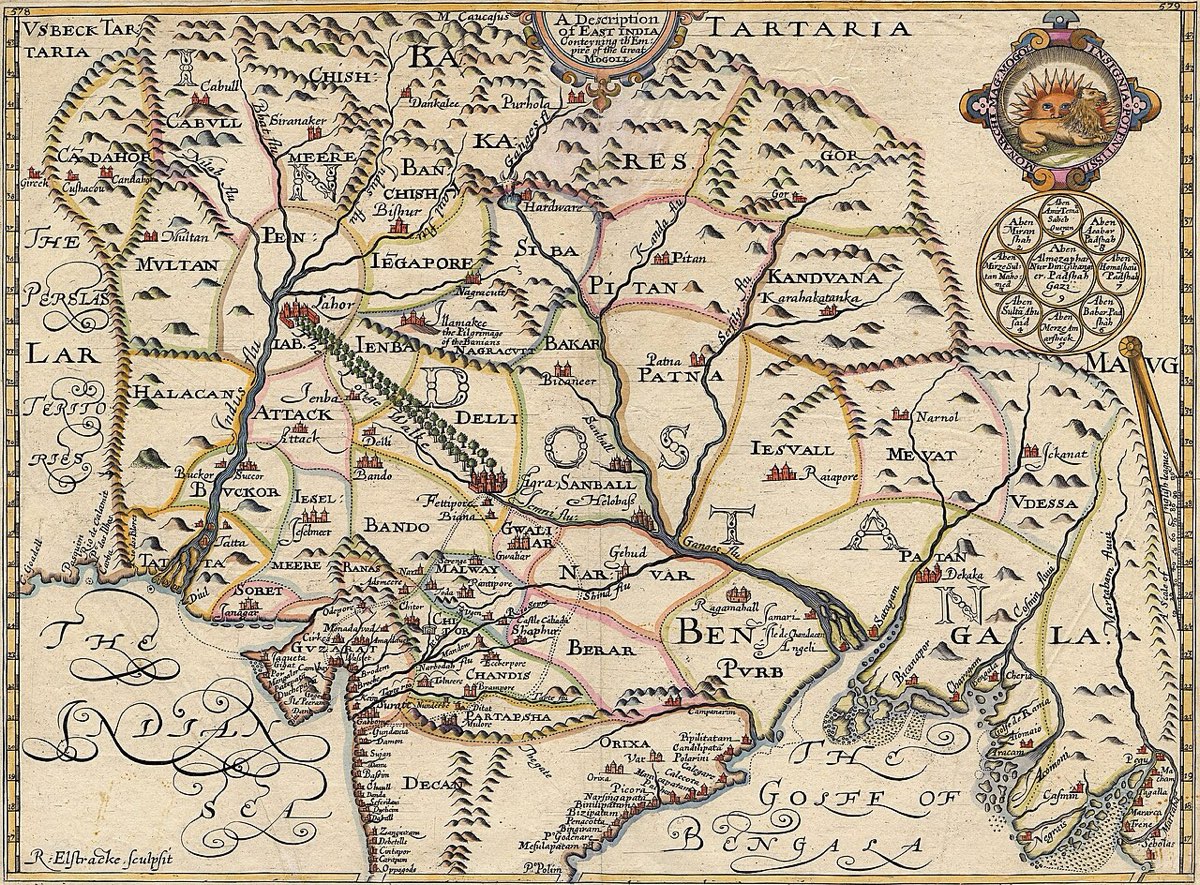
The Indian-Turkish Empire that was found by Zahireddin Muhammed Babur, one of Tamburlaine's grandsons had been the most long-lasting and the most powerful empire.
Zahireddin Mahmud Babur was born in Ferghana on the date of 14th February 1483. His father was Tamburlaine's grandson and Ferghana ruler, Omer Sheikh Mirza. When Omer Sheikh Mirza died in the year of 1494, his elder son, Babur replaced him. He had recognised his paternal uncle as the sovereign that had ascended the throne of the Great Sultanate in Samarkand. However, Babur was so young and the struggles for the throne had come into existence. Therefore, he could save his life under great difficulties and he went to Kabul together with the beys that supported him in the year of 1504. He moved the capital city of the state to this city.
Babur was entitled with the title of ruler in the year of 1507 and he declared himself as the greatest inheritor of Tamburlaine. He divided and shared the new lands that he had captured among his faithful beys. He established order in the administration and army. He passed over Sindhi River in the year of 1519 and he established dominion in the region of Punjab. He also established dominion in the region between Sindhi and Belucistan in the year of 1522. He defeated the forces of Delhi Sultan, Ibrahim Ludi in the year of 1524 and then, he penetrated into Lahor.
Ibrahim Ludî had a big army composed of 100.000 thousands of soldiers and 1000 elephants. He advanced towards Babur with the determination to annihilate Babur with this army. The main force of Babur was composed of the distinguished cavalrymen from Turkestan with the number of 13,500 people. However, Babur had firearms. Also, it had a troop of artillerymen under the command of an officer named as Mustafa Rumi from Ottoman Turks. The element that led to the victory of Babur was this troop of artillerymen and the cavalrymen.
Hindu people did not have any firearms. In the war that lasted for half a day, 40 thousands of people from the Ludi's army had died, most of them were taken prisoners, and the others ran away. Ibrahim Ludi died in this war.
Pursuant to this war, Babur penetrated into Delhi and thus, he established the Indian-Turkish Empire in the year of 1526. When he defeated an army composed of the idol worshipper Hindus in the year of 1527, he was entitled with the title of "Ghazi".
Babur was a fair and protective ruler that was proud of his and his soldiers' Turkish identity. His beys and commanders had liked him very much. At the same time, he was a great man of letters and a poet. He had adopted the Arabian alphabet; however, he had declared the Chagatai Turkish, actually the Central Asia Turkish as the official language. (His memoirs that had become famous with the name of Baburname and the cultural movements of his period will be mentioned in the end of the section. Let us state in brief that this work of him has been considered as the greatest masterpiece of Turkish language in the Turkish world and at all periods by both our historians, and the foreigners.)
Pursuant to the capture of Delhi, Babur captured Agra and then, he moved the capital city to Agra. He captured Luknov and Bengal in the year of 1528. However, he became sick towards the end of the autumn in the year of 1529. He invited the celebrities of the state to his presence and declared them that he had selected his son, Humayun as the crown prince and he made this situation to be approved by them. He died in the capital city of Agra in the year of 1530, but he was buried in Kabul. In the year of 1646, his grandson, Shahcihan had a magnificent mausoleum constructed over his tomb in Kabul.