Pursuant to the death of Jenghiz Khan in the year of 1227, the post of the great khanate was under the dominion of Ogedey. His domination is of great significance in respect of the organisation of the Turkish-Mongolian Khanate. To this effect, the grand assemblies had gathered and some of the general laws were enforced. Although the laws of Jenghiz had been applied, an administration was established in accordance with the requirements of the urban nd rural people. In the grand assembly that gathered on the occasion of the new issues that interested the state affairs in the year of 1235, the Western Military Expedition, in other words, the invasion of the Eastern Europe was resolved. To this effect, a great army was collected to be composed of mostly the Turks. It was probable that this Mongolian-Turkish army with an unknown amount of soldiers was composed of several hundred thousands of people. The beginning of the conquests coincided with the year of 1236.
The commander of this magnificent army was Jenghiz's grandson, Batu (son of Coci). In fact, the regions of Harezm, Caucasus and the western regions of the Irtish River had been possessed by his elder son, Coci (1224). However, Coci had died just before the death of Jenghiz Khan. Therefore, the places divided for him were granted to his son, Batu Khan. The name of the state that was established in the regions given to him was "Holden Horde" and the main founder of this state was Batu Khan. The Golden Horde is derived from the term of "Orda" in Mongolian language that meant nomadic tents. Since the tents of the khans were covered with golden sheet in the military encampment of the Khans, this tent was called as "Golden Horde". In the course of time, this term was written in the form of "Altin Ordu" in Turkish language. It was used with the meanings of both the people of Golden Horde, the "palace of the king" and the "military encampment". The regions pertaining to Batu Khan were called as "Cuci's Ulus" (Cuci's Lands) due to the name of his father. The term of Ulus was used with the meaning of "United Cities", in other words, as the name of a location.
Apart from him, several Jenghiz's sons (princes) would participate in this military expedition. We have observed one of the famous commanders, Sobutay (Sübegetey, Sübetey) as the commander of the vanguard divisions. Most of the soldiers were composed of the Turkish tribes that lived in the region between Orhon and Yayik and Irtish River. The first attack was against the Bulgarians. This movement was carried out in order to take the revenge of the attacks of the Bulgarians towards the Mongolian divisions that returned from the Don River in the year of 1224. The Bulgarians were defeated in a short period; and their cities and particularly the city of Bulgar were destroyed. It is probable that the people that lived in distant regions far away from the cities and the great routes did not suffer any losses from this invasion. Similarly, it has been observed that most of the urban and rural people had run away and hid themselves in the forests. Therefore, the Bulgarian element was not annihilated in the region of Middle Idyll pursuant to the Mongolian invasion. The thing that was abolished was the independent Bulgarian State. As a result, we have observed that the Bulgarian beys had some new activities in this region before long.
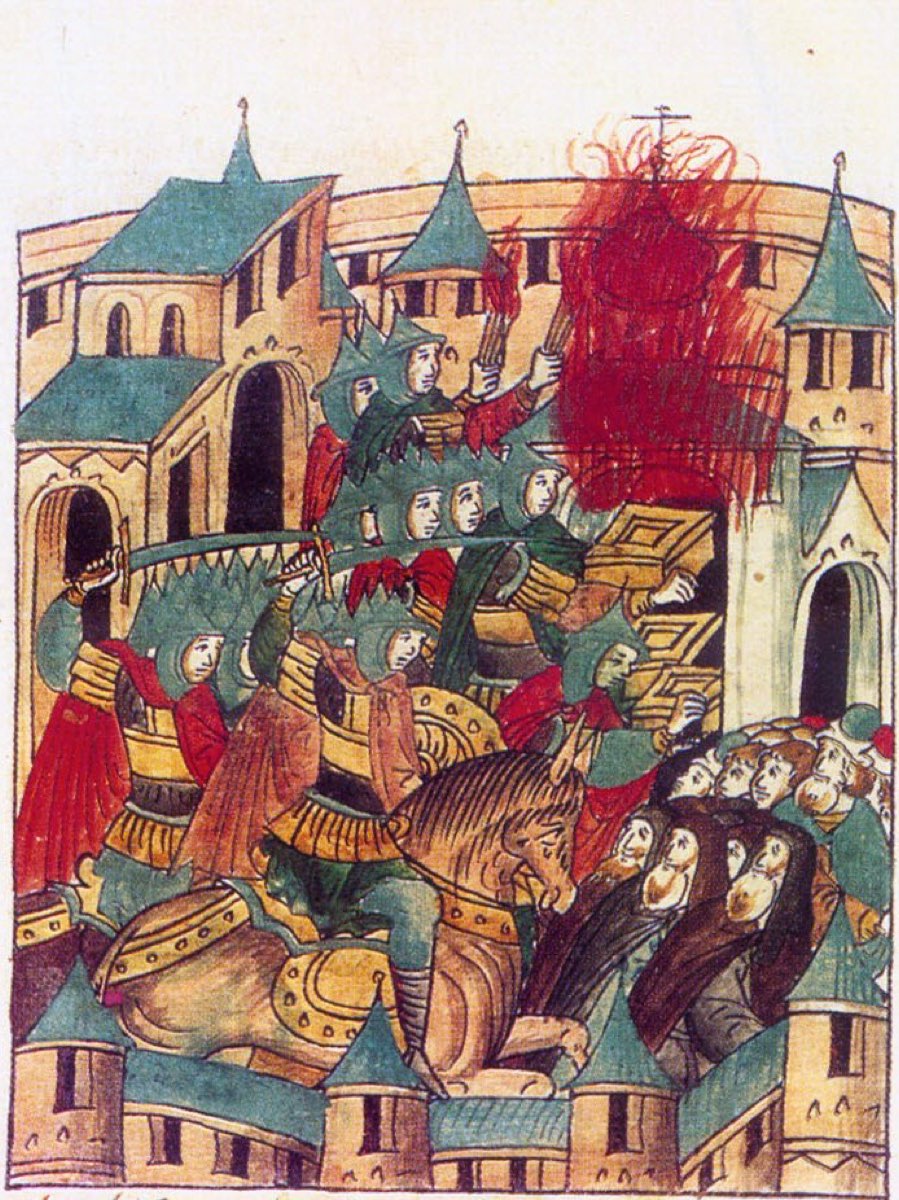
Although it was the season of winter at the end of the year of 1237, the Mongolian-Turkish army started to invade the Russian regions. Meanwhile, the Russian lands were divided into several princedoms. The princes that were the members of Ryurik dynasty dominated miscellaneous regions in the form of bey principalities. Kiev was not the centre of the state any longer; and Suzdal Russia (with the centre of Vladimir) has emerged in its place. The Golden Horn princes had gained power in the west. The city of Novograd in the northern coasts of Ilmen Lake had been in the state of an important economical and political centre. Since there were continuous struggles among these Russian princedoms, the Russian lands seemed with a vision of continuous anarchy. The armies of Batu Khan set in motion from the city of Bulgar in the year of 1237 and passed over the top region of Suru (Shura) river. Thgen, they advanced towards Ryazan. They captured this region with an attack; and burnt Moscow that was an insignificant town in that period. They captured the cities of Vladimir, Suzdal, Rostov and Yaroslav on the banks of Volga River. All these cities were composed of castles.
It has been observed that the Turkish- Mongolian army was not only talented in the pitched battles; they were also very successful and capable in the blockades and captured of castles. Despite the severe conditions of the winter, the forces of Batu Khan captured several castles and cities within 2-3 months. In the spring of 1238, this army had reached to the Lovat River in the south of Ilmen Lake. However, due to the requirements of the season, they could not advance in the direction towards the north, in other words towards Novgorod. It had been provided for the return of the armies towards the south. This time, the long-lasting resistance of the city of Kozelsk near Oka River slowed down the movement of the army; however, this castle was captured and its people were put to the sword. Afterwards, the Mongolian-Turkish forces came to the regions between the Don and Dneper Rivers. Upon this advance, the first stage of the military expedition had come to an end. Within a fairly short period and despite the season of winter, Batu Khan had captured the most important regions of the Russian lands with an "express" war and abolished the fundamental bases of the military forces pertaining to the Russian princes. The Turkish invasion coming from the east had abolished the political existence of the Russians with an only attack for the first time in history.