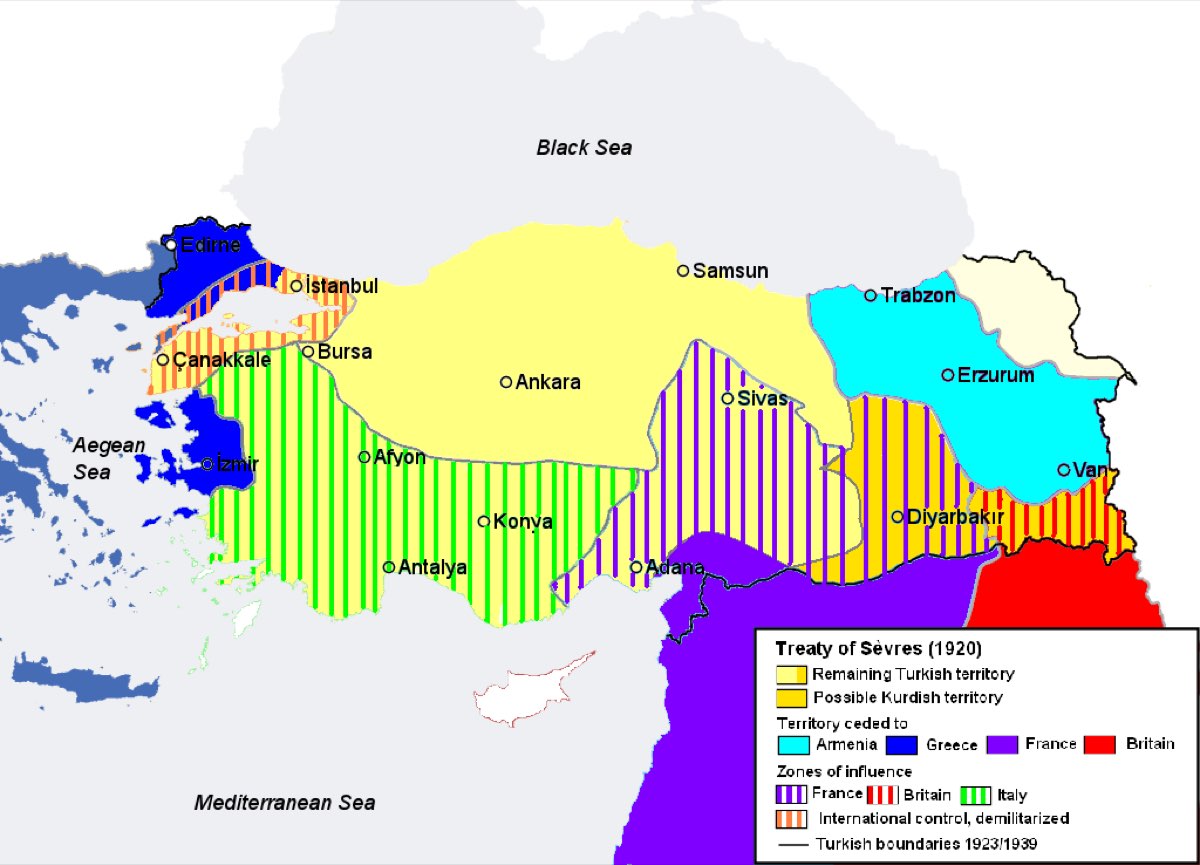
Within 6 years between 1908-1914, Turkey Empire was nearly dissolved on a fifty-fifty basis. Finally, when Turkey entered the World War at the end of the year of 1914, England annexed Egypt, Sudan and Cyprus to its lands. Therefore, the empire only had domination in the countries that constituted the states of todays Turkey, Iraq, Syria, Lebanon, Jordan, Israel, Yemen, and Saudi Arabia (excluding the section of Necid). The First World War that was called as Harb-i Umumi (General War) in the Turkish press of that period was a war with an extraordinary scope that had not been ever seen before in the history of the world. The reasons and the origins of the war were so old and so complicated. The principal reasons of the First World War were the attempts of Germany towards competition with England in the seas and colonies and the desire of the Britain to overwhelm Germany whatever may come in accordance with the traditional Britain policy that could not tolerate such a competition. The other principal reasons were the French-German competition, the remembrance of the incident of Alsace-Lorraine by France for 40 years, and its second degree in the territorial Europe under the superiority of Germany that gradually became a giant in this region.
The eastern front of this problem could be explained by the occupation of Russia in the Balkan policy pursuant to the event in which Japan had stopped the advance of Russia in the Far East, the Russian desire to lay foundation for the capture of the Straits, and the Russian provocation of the small Balkan states against Turkey and Austria-Hungary empires on a continuous basis. As a matter of fact, the Balkan Wars were considered as the real pioneer of the world war by the European political environments.
On one hand, Germany, Austria and Italy formed a group and on the other hand, England, France and Russia formed another group. This grouping activity forced to world to a doubtful future. The murder of the Crown Prince of Austria-Hungary Empire by a Serbian terrorist in Sarajevo resulted with the declaration of war to Serbia by this empire and then, Russia that defended Serbia declared war against the Austria-Hungary Empire. Therefore, the proper environment for the world war took shape. Germany that was the ally of Austria that would not permit the overwhelming of Slavism to Germanism declared war against Russia. Then, France that was the ally of Russia and that was afraid of the establishment of German dominion in Europe in case of the victory of Germany declared was against Germany.
England guaranteed the impartiality and integrity of Belgium, and it was the ally of France and Russia and the enemy of Germany. However, Germany that despised the role of England in continental war had arranged its war plan for years in order to overwhelm Russia and France with blitzkrieg. Therefore, it was required to run over the Belgium in the north and to penetrate into France. Thus, Belgium and Luxembourg took side with the Allies against the central powers of empires even in the first days of the war. The Montenegro did not leave Serbia that was of the same race with it. Despite all these events, Germany and Austria would not be defeated if the United States of America had not entered the war. Moreover, if England had not intervened in the affairs or if Italy would not have betrayed Germany and Austria and took side with the allies in the war, it would have been the definite victory of Germany and Austria. However, upon the entrance of England into the war and the declaration of impartiality of Italy without entering the war on the side of Germany-Austria, there was not any chance of victory for Germany-Austria. However, a harmless result or a consequence with less loss could be anticipated. Nevertheless, pursuant to the defeat in the battle of the Marne that would be stated below, this harmless conclusion was put into jeopardise and it was anticipated even in the beginning of the war that the Allies would win the war.
Any states did not deem likely that this war with this extensive scale would last for long years. There were some military and political experts that estimated that this war would come to an end within several months. The entrance of Turkey into war caused the decline of Russia and then, the collapse of it. These events extended the term of the war for principally two years as stated by Lloyd George that was the Prime Minister of England.
Inconceivable military forces encountered face to face in this war for the first time in the history of the world. The Central States (Central Empires): Germany with 40 army crops (109 divisions + 11 cavalry divisions), Austria Hungary with 16 army crops, Turkey with 63 divisions (9 armies), and Bulgaria with 15 divisions. The powers against these forces positioned by the Entente Powers (Allies) were as follows: France with 21 arms crops (33 divisions +10 cavalry divisions), Russia with 37 arms corps and additionally, 19 cavalry divisions, England and its colonies with 50 divisions, United States of America with 42 divisions, Italy with 45 divisions, Belgium with 6 divisions, Serbia with 19 divisions, Romania with 25 divisions, Montenegro with 3 divisions, Greece with 10 divisions, and Portugal with 5 divisions. Therefore, 246 divisions of the Central Powers encountered 441 divisions of Allied Forces.
With a more understandable estimation, it could be stated that the Allies had called up 42,7 millions of soldiers to take up arms while the Central Powers could not call up more than 22,9 millions of soldiers. This statement would be sufficient enough to understand the situation. Nearly each soldier of the Central Powers was obliged to fight against two soldiers of the Allies. Japan did not enter into the European continental war; however, he organised a naval movement with its great navy. The total population of the states in both sides of the alliances that entered into the war was nearly 1,170,735,000. Numerous states that declared war against the central empires but did not actually joined into the war were not included in these tables of estimation. Canada, Australia, New Zealand, India and several countries were included within the estimation of the population of England; and Morocco, Algeria and several colonies were included within the estimation of the population of France. It was estimated that the number of the people among the civil public that died due to various reasons principally due to poverty and the outbreak of epidemics- had exceeded 10 millions.
Germans who totally defeated the French Army V did not delay in advancing towards Paris. Luxembourg, Belgium and the Northern France were invaded. This blitzkrieg did not give any opportunity for France and England to apply and perform their war plans that they had arranged for years. The superiority passed to the domination of Germans. The forces of France- England-Belgium were running away in panic.
The bloody fight that took place over the Marne River between the dates of 6th-12th September (1914) stopped the Germans in the distance of 30-40 km. to Paris. This situation caused the discontinuation of the plan for the annihilation of the French forces with a blitzkrieg. Therefore, the plans of the German general staff that were designed for 43 years were left improductive by the armies of the Allied Forces. Von Moltke (he was the nephew of the Great Molke) that lost its title of Perfect Staff was dismissed and changed by Kayzer.
The entrance of Turkey into the war took place pursuant to this historical turning point after the battles of Marne. Until that time, Germany had convinced the entire world that it would get rid of France with a blitzkrieg in a possible war and then press against Russia with all its forces. However, pursuant to the battles of Marne, it was definitely understood that such kind of a progress would not be obtained and the war would be prolonged for an indefinite period and against Germany. The person that could not get aware of this fact was only Enver Pasha. Enver Pasha threw Turkey into the world seas without any need for this requirement together with the great states that owned all the economical facilities. Enver Pasha was the person that ordered the naval fleets to bombard the Russian ports without any notification to the assembly and council and without the knowledge of the ruler.
The impartiality of the state would give endless benefits for Turkey. First of all, it would close the Straits as an impartial state and therefore, Russia would be drowned. In the year of 1918, the world would get out of the war in an exhausted state. Therefore, Turkey would doubtlessly become the most powerful state in the Near East and the Balkans with its army that was not worn out in material and spiritual aspects. Besides, the state would not have suffered from incredible sacrifices of people and wealth. The calamities that lasted until the year of 1922 and that attracted the forces of the enemies towards Ankara ending up with the destruction of hundreds of Turkish cities and districts would not have taken place thereof. The Empire would not have been discharged by force. Turkey would spontaneously discharge its empire like England and France did upon their own will and arbitrariness after the year of 1945. Until these dates, it would have benefited from the petroleum of Iraq and Saudi Arabia. Similarly, several Turkish countries would not have been captured by the foreign states in this course of discharge.
The First World War was the most important event of the history of the entire world. In fact, the Second World War had outdistanced the First World War in respect of firepower and the destruction. However, the changes that it yielded in the modification of the order of the world were not much more than that of the First World War.
In this war, the military forces with incredible greatness and power that could not be ever expected or imagined in those times came face to face with each other. Great masses of people were piled up in each front. Since the forces in both sides had established equilibrium, these forces had to take shelter in the foxholes for years. Therefore, the great armies had to position themselves in fortified sites and to spend millions of ammunitions and projectiles in order to capture the places with the surface area of only several kilometres and even metres. This situation had not been ever experienced in the past. The ammunition expended in several days of a fiery struggle in the First World War were not even spend in any other war that had taken place in the past.
The innovations that this war brought further were aeroplanes, tanks, armoured- and motor-driven vehicles, giant artillery pieces, cannons, poison gases, cruel submarine war, and the overair bombardment of the cities (meanwhile Istanbul)
Pursuant to the war, the political map of the world has changed. The event that had much more importance was the change of the structures of the societies. A bloody regime like communism that benefited from the disasters of the war and denied all the human rights became established in Russia. This regime was on the verge of establishment in some other states. The nations were carried away in a collective madness. The monarchies for hundreds of years were abolished. The dynasties that were considered eternal such as Ottoman dynasty, Habsburg family, Hohenzollern family, Romanoff imperial line, etc. lost power. There were some fascist dictators organised properly in an extensive scale that came into existence in the states that were not contented at the end of the war. These dictatorships that were observed in some countries such as Germany, Italy, Spain, Hungary, etc. showed a merciless hostility against both communism and liberal democracy. The power could be gathered under one-man rule in such a manner that had not been observed in the history of the world before. These dictators regardless of either fascist or communist tyrants could pose a power of oppression that had not ever been imposed by the greatest autocrats that could occur to mind first such as the Pharaohs, etc.
Despite all these events, the confidence of the human being in democracy was not reduced; on the contrary, it increased gradually. England executed the democracy in a better manner and imposed great significance to the social rights. Therefore, it gained its former quality of being the greatest and the most powerful state of the world and it maintained this much better than it did in the past. Exactly one third of todays independent countries with the approximate number of 160 were under the domination of England in that period. It acquired the glorious state of Roma in the century I and the Ottoman Empire in the century XVI. Anyway, it has established influence in the most significant portion of the world population under its domination or field of influence. This state turned into the third endless world state following Roman and the Ottoman Empires and it had expanded to 6 continents within the structure of the Britain Empire However, in the same years, there were some indicators and signs of decline and even dissolution in this third world state. There was a general hatred aroused against the English imperialism. Most of the states in the Africa and Asia had become its colonies. Only Liberia in Africa and Turkey, Japan, Iran, Siam and partially China in the continent of Asia could escape from becoming a colony of England. The period between the two wars (1918-1939) was recorded in the history as the period in which the colonisation expanded to wide areas and fields even though it was not the glorious period of the colonisation.
The regimes that had been effective for hundreds of years had fallen down like playing cards. This abolition changed the spiritual situation of the societies. Most of the traditions and customs were abandoned and even denied. The people were on the verge of losing their kindness and good manners. As a result of this turmoil, the Second World War broke out. The parties suffered from millions of sacrifices in this war. The World was deprived of a significant class of intellectuals. Meanwhile, the sacrifice and losses of Turkey were on a terrible scale. In the wars that continued between the years of 1911 and 1922, thousands of Turks had died; a young generation that had been well trained with the adaptation of the Eastern and Western cultures was annihilated. Especially, the front of Dardanelles annihilated ten thousands of Turkish intellectuals in the form of a war of reserve officers. Turkey was shocked terribly due to the sacrifice of these real intellectuals. The social depression was of great significance that could not be recovered for a long time.
The Turks were exposed and subject to the biggest general disaster of their history including 2200 years. At the end of this year, the most valuable lands of Turkey that had never been invaded before were destroyed extending towards the central regions of Anatolia. Turkish economy that was actually under bad conditions before the war collapsed totally at the end of the war. In the beginning of the century, the population in the Anatolian cities had increased to 50-100 thousands. After the war, the population fell down below than the half of its older population figures. As a matter of fact, the census carried out in the year of 1927 indicated the population figure as only 13,648,000.
However, the First World War had revealed the military values and the spiritual power of the Turkish nation for once more. Some victories that were won in the course of this war and particularly the Dardanelles were included within the most important events of the military history. Turkish armies had fought in the Dardanelles, Caucasus, Galicia (Poland), Macedonia, Dobruca, Yemen, Hedjaz, Libya, Sinai and Palestine, Iraq, and Iran. Only a few armies were under capable and efficient powers apart from several commanders that had superior characteristics such as particularly Mustafa Kemal Pasha, Cevad Pasha, Mersinli Cemal Pasha, Ali Ihsan Pasha, Esad Pasha, and the Sehzade Osman Fuad Effendi (Pasha). The staffs of the commanders were sometimes composed of weak officers. The equipment was missing and insufficient. They were deprived of many necessities. If they would be equipped in a perfect manner like German and Austria-Hungary armies, the Turkish armed forces would have had great successes and victories.
Upon the entrance of Turkey into the war, England declared that the Turkish domination in Egypt-Sudan and Cyprus was abolished. According to the Treaty of Lausanne, Turkey acknowledged to have definitely renounced its rights in these places.
A terrible recession was observed in the industry, agriculture and trade all over the world; and there was a temporary poverty in some states. Some regions were nearly evacuated without any significant population. A decrease was observed in the population of all the cities. Only United States of America got out of the war with a great wealth and prosperity. However, the rest of the world lost much from its pace of development and progress.
The insults, provocation and the extremely unfair treatment that the four defeated states were exposed constituted the main reasons for the Second World War. Only the Turks rebelled against this unfair treatment. Germans, Austrians, Hungarians, and the Bulgarians gave in. The most valuable lands of these states were captured.
In the last days of the war, Abdülhamit II who was called as the Former Ruler died (10th February 1918) and after 4 months and 23 days, his brother Sultan Mehmed Reşat V Han died (4th July 1918). The funeral ceremony of Abdulhamit II was magnificent. The leaders that were the members of the Committee of Union and Progress also attended in this ceremony since they had started to appreciate and understand him much. Besides, the people shed tears after the former ruler in the most terrible days of the war since that they had lived in peace and prosperity in his period. Within 10 years, the environment had changed a lot to this extreme degree.
The Mondros Armistice that was concluded on the date of 30th October 1918 gave an end to the war. From that date on, a new era was opened in the history of Turkey. The Allies invaded Istanbul on the date of 16th March 1920. Therefore, the Parliamentary Council was closed by force and they exiled most of the members of parliament to Malta. Upon these events, the capital city of the Turkish Empire was actually under the English influence. On the date of 23rd April 1920, the Turkish Grand National Assembly convened in Ankara under the chairmanship of Mustafa Kemal Pasha with the participation of the members of parliament who could run away from Istanbul and this Assembly started to command and manage the National Struggle. Since the year of 1920 and even since the end of 1918, the histories of the periods of empire and the republic were patterned one within the other. On the date of 1st November 1922, the Turkish Grand National Assembly cancelled and abrogated the sultanate. The last ruler, Mehmet Vahdettin VI that replaced his elder brother, Sultan Reşat was left in his place only in the capacity as a caliph and he left Istanbul at night of 16th November. In his place, Abdulmecit Effendi who was the last crown prince replaced him and became the caliph. On the date of 3rd March 1924, the Turkish Grand National Assembly declared the abrogation of the caliphate. Abdulmecit II who was the 101st and the last caliph was expelled from Turkey with all the members of his dynasty. Meanwhile, on the date of 29th October 1923, the new regime was identified and the republic was declared.
The number of the rulers that were the members of the Ottoman dynasty beginning from Ertugrul Ghazi and ending with Mehmet VI (including Suleyman I and Sultan Musa) was 39. There were actually 40 members including Abdulmecit II who was only a caliph. Therefore, the total sultanate period of all these rulers was 639 years between the years of 1231 and 1924 (the period of the last 1 year, 3 months and 14 days pertain only to the caliphate). There were only 30 rulers that born the title of Caliph as the head of Islam for a period of 407 years, 6 months, and 5 days. The institution of caliphate that had commenced as of the year of 632 had ended in the year of 1924. This institution could not be maintained pursuant to the Ottoman dynasty since there were not any persons or dynasties with the proper spiritual and material power and influence that could bear such a capacity.
Upon the abrogation of the sultanate, the second stage of the history of Turkey was closed and the third stage that we currently are experiencing nowadays started henceforth.