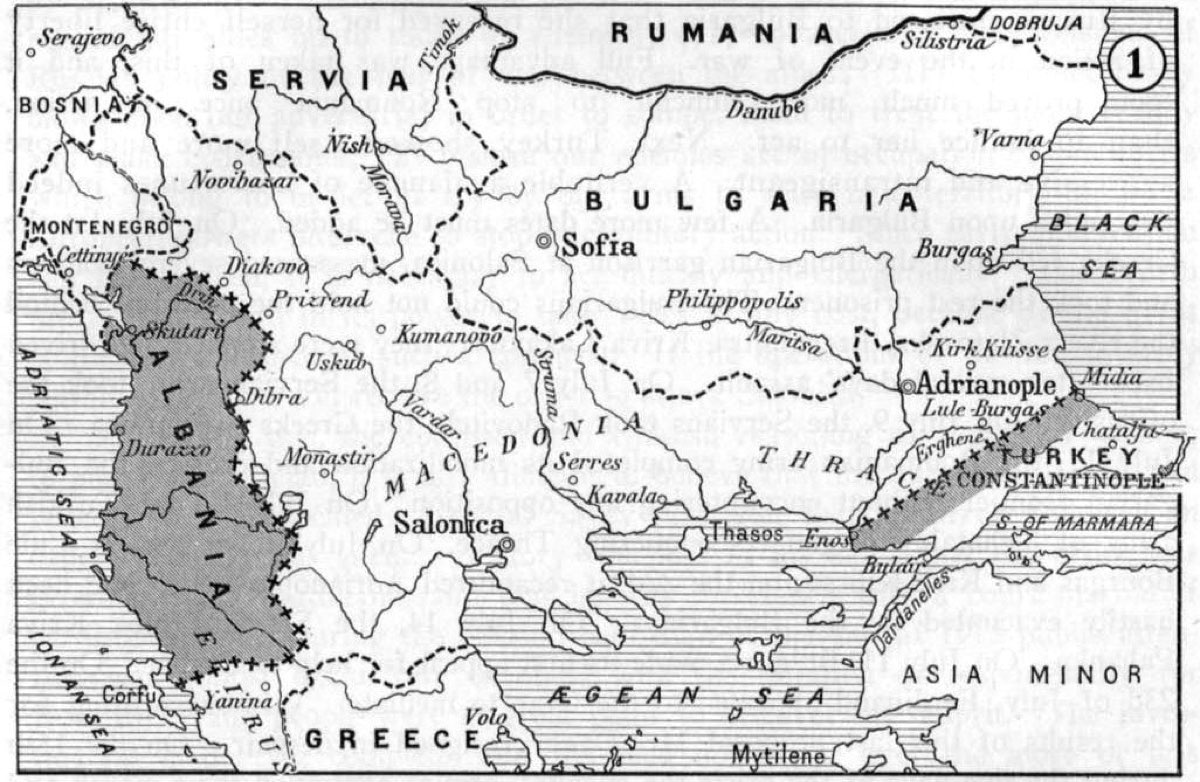
In the beginning the members of the Committee of Union and Progress did not establish dominion in the government. The ministers were elected among the viziers of the regime of Sultan Hamit. There was a great joy and bliss in the empire. Turks were pleased for freedom, and the minorities that had become the majority group in the empire were pleased for freedom with another implication. However, as a result of a fault of the members of the CUP (Committee of Union and Progress), the Princedom of Bulgaria (with the surface area of 96,345 km2, and the population of 4,338,000) declared its independence and separation from Turkey and it also declared that their rulers would bear the title of king henceforth. On the same date (5th October 1908), the province of Bosnia and Herzegovina (with the surface area of 51 564 km2, and the population of 1,932,000) was annexed to the lands of Austria-Hungary Empire and it got separated from Turkey. Greece also followed the same route and wanted to annex the province of Crete (with the surface area of 8,379 km2, and the population of 344,000), it could not accomplish it. The Sublime Ottoman Government recognised these annexations in return for the amount of 7,5 millions of gold. However, the full enjoyment was lost thereof. Within this atmosphere, the elections were carried out through various primitive and illegal means. The Parliamentary Council was opened by Abdulhamit II (17th December 1908) and 275 members of parliament were elected. There were 140 Turks, 60 Arabians, 25 Albanians, 2 Kurdish, and 48 Non-Muslim (23 Greeks, 5 Jews, 5 Bulgarians, 3 Serbians, and one Romanian) among the members of parliament.
The event that took place on the date of 13th April 1909 was also called as the Incident of 31st March. The members of COP had not relied on the 1st Army in Istanbul since they were so faithful to the ruler and they brought the marksman troops from the Army III in Salonika. In this event, these marksman troops rebelled with the slogan of wanting Muslim canonical law. There were various organisers of this rebellion that even did not have a leader among the officers. They did not have any relation with the ruler. However, Abdulhamit II was dethroned (27th April) and one of the greatest targets was accomplished thereof.
In the place of Abdülhamit II, his younger brother, Sultan Reşat was enthroned under the title of Mehmet V. The situation that went well until the end of the year of 1911 despite some rebellions and several unpleasant events started to become bad all of a sudden. A war broke out between Turkey-Italy for Libya (29th September 1911-15th October 1912). Italians had suddenly attacked to İibya that was two folds larger than todays Turkey. This attack forced the Turkish Empire to enter into a period of wars with calamities for eleven years that would not come to and until the end of the year of 1922. The conflict and turmoil that burst in the Balkans forced the Sublime Ottoman Government to abandon Libya to Italy.
The Balkan War broke out on the date of 8th October 1912. The kingdoms of Bulgaria, Serbia, and Greece and the princedom of Montenegro attacked to Turkey upon the support of Russia. The war followed a course of progress against the Ottoman State in an unexpected manner. The Turks were defeated in the war when the officers were classified in the groups such as the members of COP and Saviours and they did terrible military and diplomatic errors. The biggest fault was the permission of the government for the integration of the former provinces of the empire, namely the small Balkan states that were much more hostile to each other than they were to the Turks. Even though these states could integrate, the Turkish army should have overwhelmed the enemies easily. However, the enemy came with a blitzkrieg in front of Çatalca. The Turks that retreated from the Adriatic coasts to the River Maritsa could not even settle in this place. The castles of Ionia, Ishkodra and Edirne defended themselves in a legendary manner. Sukru Pasha could resist to the blockade for 5 months and 5 days.
Then, he gave the delivery of Edirne to the Bulgarians due to poverty (26th March 1913). When the war broke out, the Great States had declared that they would not give permission for any change in the territorial regions. However, upon the total defeat of the Turks, they imposed all sorts of pressure upon the Sublime Ottoman Government for the abandonment of the lands that were invaded to the Balkan States. Therefore, Roumelia that was one of the two wings of the empire and the second homeland of the Western Turks were abandoned after 550 years. Millions of immigrants poured out for emigration and thousands of them were annihilated. In the most ardent moments of the war, the Committee of Union and Progress organised a coup detat that was called as (Putsch of Ottoman Government) Babıali Baskını (23rd January 1913) and they seized the government. However, they abstained from the designation of a member of the party as the ruler of the government. Therefore, they assigned Mahmut Şevket Pasha as the grand vizier who was an unbiased person.
In the course of the pillage of the Great Turkish lands, the allied Balkan States could not get along well and come to a conclusion. They advanced against Bulgaria that constituted the greatest power of the alliance. When the Kingdom of Romania that had not joined to the first party attacked to Bulgaria, this state gave in. Therefore, Greece and Serbia took the lions share from this pillage on the contrary to the expectations in favour of Bulgaria. This was called as the Second Balkan War. Meanwhile, Turks had recaptured Edirne that was abandoned by the Bulgarians.
The Balkan Wars ended up with the loss of Roumelia that had been a Turkish homeland for over 5 centuries and the retreat of the Turks from Adriatic Sea to the River Maritsa. These wars constituted one of the most terrible calamities in the Turkish history. A great country in which the Turksh had settled upon the sacrifice of millions of martyrs and the expenditure of millions of gold was lost and Turkey was nearly deprived of its capacity as a European State apart from the location of Istanbul, its capital city in this continent. The victorious Balkan States that had won this war had had the following benefits: Bulgaria gained a surface area of 25,257 km2 and a population of 984,000 (the population of that period), Greece gained a surface area of 55,919 km2 and a population of 161,000. Furthermore, Albania with the surface area of 25,734 and a population of 800,000 got separated from Turkey. The situations of the Balkan States before and after the Balkan Wars were as follows: An increase in the surface area from 96,345 km2 to 121,602 km2 and an increase in the population from 4,388,000 to 5,322,000 in Bulgaria, an increase in the surface area from 64,895 km2 to 120,060 km2 and an increase in the population from 3,041,000to 4,900,000 in Greece, an increase in the surface area from 45,427 km2 to 87,300 km2 and an increase in the population from 3,000,000 to 4,492,000 in Serbia. Before the war, the total surface area of the 4 allied Balkan States was 216,058 km2 and the total population of these states was 10,854,000; similarly, before the war, the only European lands of Turkey (excluding the Crete Island) had a surface area of 176,300 km2 and a population of 7,828,000. The total surface area of the entire Ottoman Empire was 7,231,239 km2 and the total population of the empire was 55,189,000 (actually 38,019,000 excluding Egypt, Sudan and the other subject states).
After this war, Turkey lost lands with the surface area of 167,312 km2 and a population of 6,582,000. According to the civil organisation of that period, 7 provinces (states) and additionally, 2 districts from the province of Edirne and the island of Samos were abandoned. The provinces that were lost were Salonika, Monastery, Kosovo (Skopje), Iskodra, Ionia, Cezayir-i Bahr-ı Sefit (Mediterranean Island, in other words, the Aegean islands), and Crete. There were 33 districts and 158 sub-districts (towns) were in these provinces.
The Grand Vizier and the War Minister, Mahmut Şevket Pasha was killed through an assassination (11th June 1913). This assassination was not committed by the members of COP; however, they condoned for the performance of this assassination. Therefore, they directly came to power and they executed or exiled their principal opponents on the pretext of this assassination. Enver Bey, a staff lieutenant colonel who was not at the full age of 33 yet became the War Minister. Damat Enver Pasha took the proper precautions in order to organise the army. Although he had discharged thousands of officers that were not the supporters of the committee of union and progress, he was able to organise a powerful army within a year. However, he would not be able to maintain such an army even for one year, and he would use up them before the end of the year of 1915 in Dardanelles and Sarikamiş. The capitulations were annulled (9th September 1914). Meanwhile, the First World War broke out; however, the Turkish Empire did not join into this war.
In the beginning of the World War, the political balance of the world was as follows: The Grate States arranged in order in accordance with their range of significance were England, Germany, United America, France, Russia, Japan, Australia, Italy, Turkey and China. Between the years of 1900 and 1915, the population increased from 382 millions to 461 millions in England together with all its colonies, from 66 millions to 79 millions in Germany, from 86 millions to 111 millions in the United America, from 76 millions to 84 millions in France, from 133 millions to 181 millions in Russia, from 56 millions to 78 millions in Japan, from 45 millions to 52 millions in Austria-Hungary, from 33 millions to 38 millions in Italy. The population of Turkey decreased from 57 millions to 29 millions (Egypt was not included in the latter figure), and the population of China increased from 238 millions to 398 millions. The world population increased from 1,491,000 to 1,782,000,000. Within these 15 years, the total population of the great states increased from 1,282,000,000 to 1,411,000,000 and the total population of the other states increased from 209,000,000 to 371,000,0007.
In these 15 years, the number of the cities on the world with the population over a hundred thousand increased from 288 to 402, the number of the cities with the population over a million increased from 17 to 25, the number of the cities with the population between a half million and a million increased from 30 to 50, and the number of the cities with the population between a hundred thousand and a half million increased from 241 to 377. In the year of 1915, the number of the cities with the population over a hundred thousand was 90 in England (together with all the colonies, 59 in United America, 39 in Russia, 37 in Germany, 26 in China, 22 in France, 16 in Japan, 15 in Italy, 13 in Turkey, 11 in Austria, 10 in Spain, 10 in the Netherlands, 6 in Brazil, and 48 in the rest of the states.
The situations about the populations of the big states were as follows: London with the population of 7,3 millions, New York with the population of 7,1 millions, Paris with the population of 4,6 millions, Berlin with the population of 3,8 millions, Essen (Great Essen) with the population of 3,3 millions, Chicago with the population of 2,5 millions, Vienna with the population of 2,2 millions, Petrograd (Leningrad, the former Petersburg) 2,1 millions, Tokyo with the population of 2,1 millions, Philadelphia with the population of 2 millions, Buenos Aires with the population of 1,8 millions, Glasgow with the population of 1,5 millions, Istanbul with the population of 1,4 millions, Hamburg with the population of 1,4 millions, Osaka with the population of 1,4 millions, Birmingham with the population of 1,4 millions, Manchester with the population of 1,4 millions, Liverpol with the population of 1,4 millions, Boston with the population of 1,3 millions, Hankeu with the population of 1,3 millions, Calcutta with the population of 1,3 millions, Rio with the population of 1,1 millions, Bombay with the population of 1 million, and Shanghai with the population of 1 million. In the year of 1915, the populations of the big cities in Turkey that followed Istanbul were as follows: Izmir with the population of 400,000, Damascus with the population of 300,000, Aleppo with the population of 240,000, Beirut with the population of 168,000, Baghdad with the population of 156,000, Erzurum with the population of 144,000, Edirne with the population of 135,000, Afyon with the population of 114,000, Manisa with the population of 108,000, Jerusalem with the population of 101,000, Bursa with the population of 100,000, and Mosul with the population of 100,000. Furthermore, there were 23 cities with the population of 50-100 thousands in Turkish Empire.