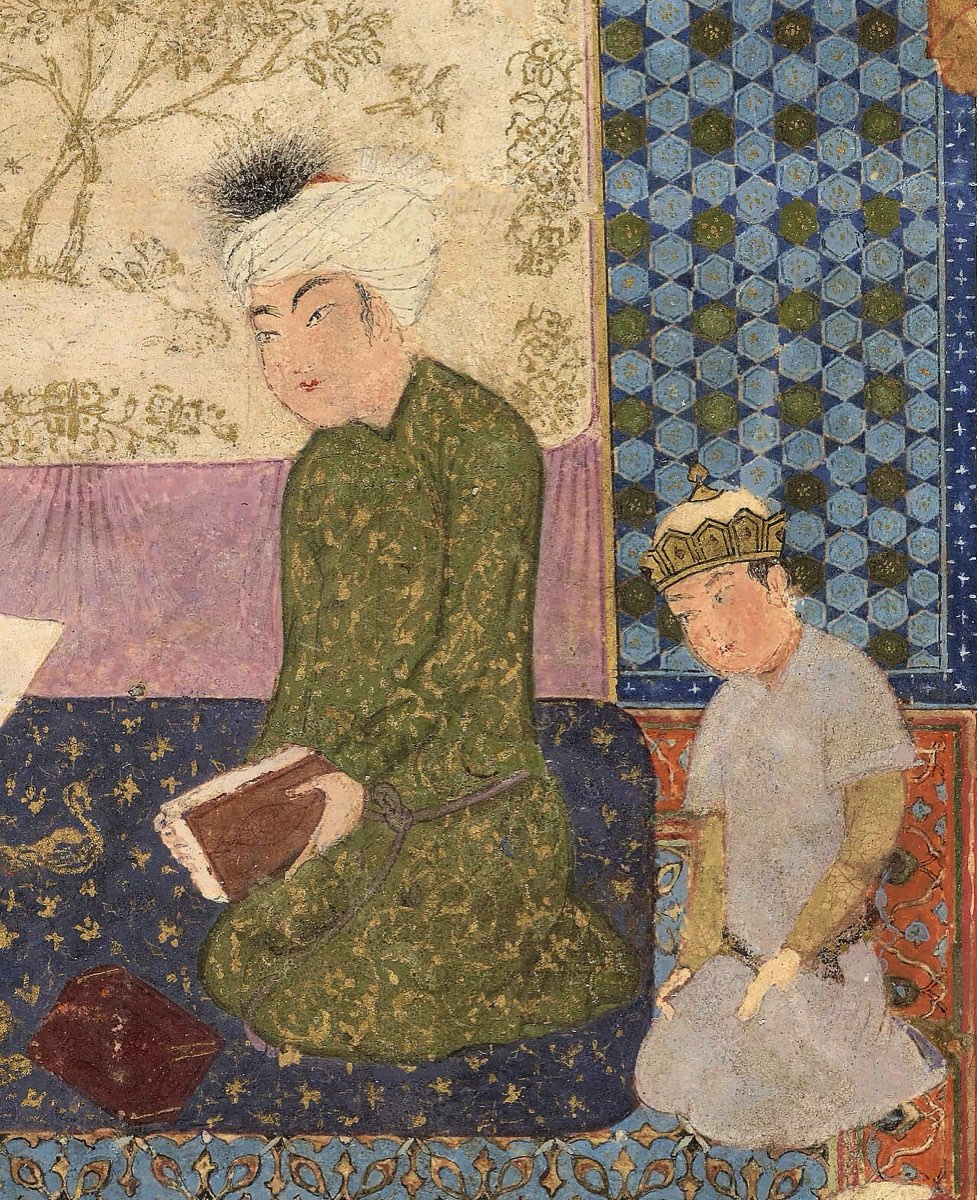
Hüseyin Baykara
The poet ruler that turned his palace into an Academy of Sciences.
In the course of the struggles that burst out pursuant to the period of Ulug Bey, Hüseyin Baykara who was the son of Timur's grandson, Baykara Mirza was in the service of Ebulkasım Babur who was one of the grandsons of Tamburlaine that had established dominion in Herat. He had acquired proper experience in relation with the state administration here. Actually, he was a well-educated and intelligent person.
When Herat Emir, Babür died in the year of 1457, the struggle burst out in this region, too. Hüseyin Bayraka departed from Herat and came to Merv. Here, he was married with the daughter of Muizzuddin Sencer who was the ruler of the region and his elder son, Bediüzzaman Mırza was born from this wedlock.
Huseyim Mirza established dominion in a small region in the site of Ozboy in Ceyhun with his few men that were his supporters and through the support of Sadibey from Uzbek people. After a while, he annihilated Sadibeg and expanded his borders and he captured Mazenderan through the support of some other Uzbek groups. Afterwards, he was involved in a struggle with Ebu Said who was the ruler of Herat. When Ebu Said was defeated by Akkoyunlu ruler, Uzun Hasan, he captured Herat (1469).
In the first period of his sultanate that started as stated above, Baykara encountered some difficulties. Ebu Said's son, Yadigar Mirza collaborated with Uzun Hasan who was the reason for his father's death and he advanced towards Herat with the support that he had provided from him. Huseyin Baykara who had been in a difficult situation recaptured Herat with his fellows composed of 350 people upon a night attack that he organised on the date of 24th July 1470. Then, he hogtied Yadigar Mirza in this region.
Afterwards, Hüseyin Baykara organised some military expeditions in order to defend Herat from Şeybani people (Uzbeks in the North) and he fortified the castles on the banks of Ceyhun. Then, he established his dominion in Transoxania and Harezm.
The sovereignty of Hüseyin Baykara lasted for 37 years and in his period, Herat was the centre of a great Turkish civilisation movement that was called as "Renaissance of Timur's sons". In that period, the population of Herat that was the biggest city of the word exceeded 2 million. Istanbul could exceed the city of Herat only after the year of 1507.
The Great Khan Hüseyin Baykara was a great poet at the same time. He did not write his poems in Farsi and Arabian languages like some of the other Turkish poets. He wrote them in Turkish language and he used the pseudonym of "Huseyni". He also attached great importance to the scientists, and the other fields of art and he had turned his palace into the Academy of Sciences.
Hüseyin Baykara had sent his sons to various regions of his country as governors. Towards the end of his sultanate, his sons were in a severe struggle for the independency and this posed a threat for the integrity of the country. He was on strained terms with his elder son, Bediuzzaman. Bediuzzaman besieged Herat in the year of 1499; however, he could not attain any results. On the other hand, Uzbek people increased their pressure over Herat. Meanwhile (in the year of 1501), Ali Şir Nevai died and Huseyin Baykara lost his greatest assistant. Afterwards (in the year of 1506), he decided to organise a military expedition against Uzbek people and he wanted help from other Timurlu people. Hüseyin Baykara set in motion for his military expedition before the arrival of the army sent by Babur. He died on his way and his corpse was brought to Herat.
Pursuant to Hüseyin Baykara, Bediüzzaman who was one of his sons replaced him. His sons did not have the proper qualifications in order to command the armies that were arranged by their father and to fight with Uzbek people. Although Babur wanted to continue to fight, his proposal was rejected. Upon his rejection, he retreated. The army was discharged and within a year, Uzbek people captured Herat under the command of Seybani Muhammed. Therefore, the state founded by Huseyin Baykara was abolished.