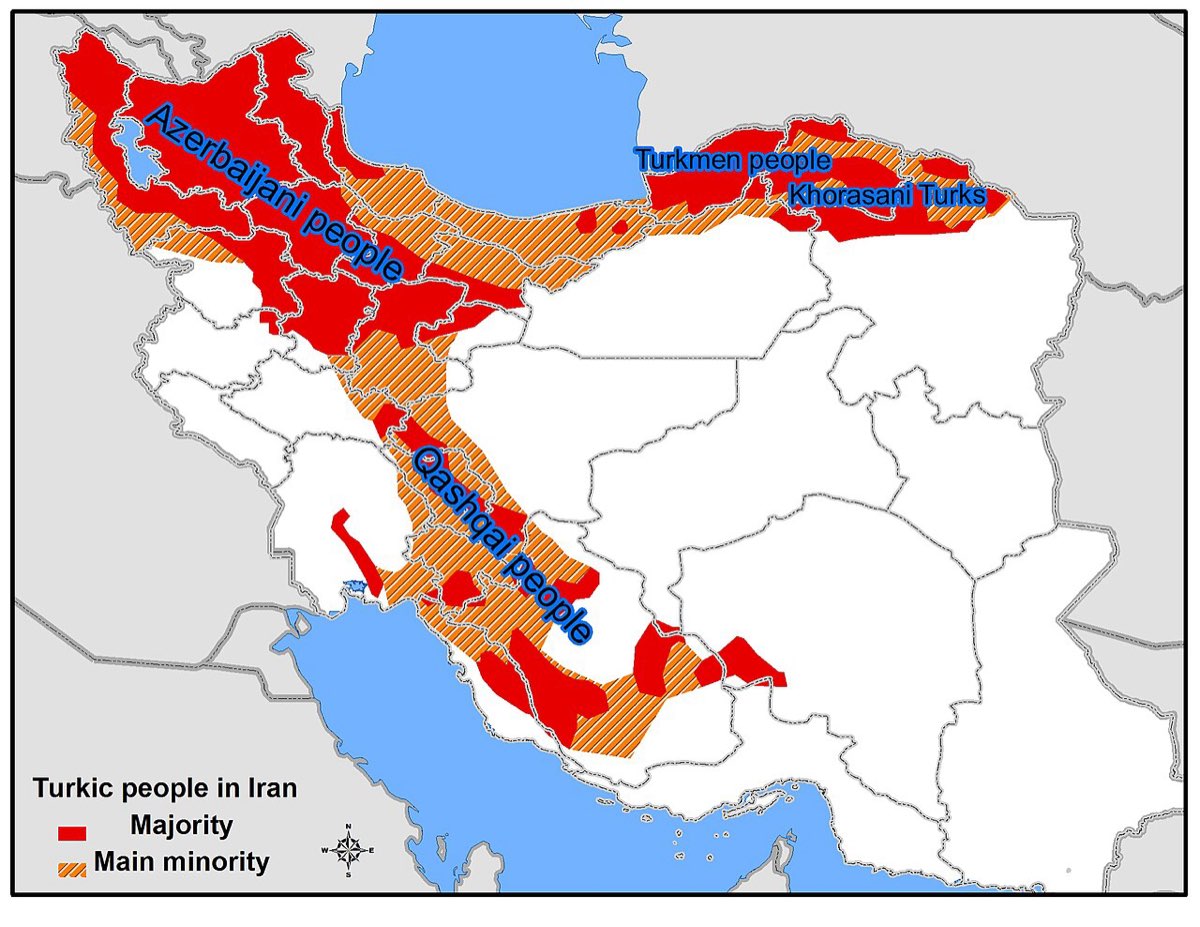
For a period of nearly 950 years between the last quarter of the century X and the first quarter of the century XX, Iran was the country of Turks that stayed either under the dominion of Turks or under the administration of the Turkish dynasties. Therefore, Iran is one of the leading countries in which the Turks and the Turkish culture are most dense. Although Turks constitute nearly half of the population of Iran today, they were the most underdeveloped Turkish group that could not develop in respect of their knowledge and practice about their language and history due to the chauvinistic stance of Iranians. The population of Iran that is a Muslim country is approximately 60 millions. Of this population, nearly 25 millions of people are composed of Turks, nearly 30 millions of people are composed of Iranians (Farsi) and nearly 5 millions of people are composed of the other ethnical groups. Iranians have not entitled the Turks that constitute nearly half the population with the right of education in their own language and this stance is contradictory to all sorts of human right and the international law.
The majority of the Turks that live in Iran are composed of the Azerbaijani Turks. As it is known, the northern sections of Azerbaijan were invaded by the Russians in the first quarter of the century XIX. Nearly 8 millions of Azerbaijani Turks live within the independent Republic of Azerbaijan. The Southern Azerbaijan is under the dominion of Iran. Over 20 millions of Turks live in the Southern Azerbaijan that has a surface area of 107.000 km2. The principal centres of population in which most of the Turks live in the Southern Azerbaijan are as follows: Tebriz, Hoy, Erdebil, Urumiye, Selmas, Maku, Meraga, Astara, Culfa, Merendi, Halhal and Soğukbulak.
The settlement of Turks in Azerbaijan in mass groups occurred in the Seljuk period. Azerbaijan that had stayed under the Mongolian dominion for a while was then administered by the Turks for a long time afterwards. The dominion of Timur people, Ak-Koyunlular and Kara-Koyunlular States enabled the development of Turkish culture in Azerbaijan. Therefore, Azerbaijan has entirely become a homeland of Turks.
As we have stated in our previous researches, the most significant incident in the history of the Azerbaijani Turks was the dominion of a group that had adopted the Shiah Islam in the centre of Erdebil and the activation of the Shiite sect in the region. İsmail, one of the grandchildren of the Sheikh Safiyüddin that was the leader of the Shiite group reorganised this religious branch in accordance with his political interests and then, he established dominion firstly in Azerbaijan then in the entire Iran. İsmail gave the name of his grandfather to the state that he established and the dynasty of this state. He was the pioneer of a policy that orientated the destinies of both the Azerbaijani Turks and the Turkish-Islam world under his title as Ismail Shah. The Safevi dynasty that was founded by Shah Ismail had given precedence to the Azerbaijani Turks for nearly two and a half century (1500-1735).
But the continuous activation of the Shiah Islam by the Safevi people prevented the amalgamation of both the Azerbaijani Turks and the Ottoman Turks. Moreover, the sect of the Shiites was an unpassable bridge between the Azerbaijani Turks and the Ottoman Turks. Therefore, it caused the disconnection of the relations of these two Turkish regions. These situations created a negative effect in the establishment of the union within the Turkish world. Another negative effect of the Safevi dynasty was the strong diffusion of the Shiah Islam among the Iranians. In brief, Iran had used the Shiah Islam as a means for the protection f the national identity and had constituted an obstacle in front of the foundation of a union in Islam world. Iran was not contented with all these effects and then started to diffuse the Shiah Islam to the other Muslim countries and this situation caused an another disturbance in the Islam world. Thus, Iran has become the focus of secession and disintegration within the Islam world.
Pursuant to the Azerbaijani Turks, we should mention briefly about the two Turkish communities that dominated the fate of Iran. These communities are the Afsar Turkmens that are the ancestors of Nadir Shah and the Kacar Turks that established the second longest dynasty in Iran. As it is known, Afsar people were composed of one of the Oguz tribes. Some of Afsar people came to Anatolia and settled in this region together with the Seljuks and some others stayed in Turkistan. However, in the period of the Mongolian invasion, this second group of Afsar people who had stayed in Turkistan came to Azerbaijan and settled in this country. Taking the advantage of the gaps resulting from the decadence of the Safevi dynasty, the Halaç Turks that essentially lived within the environs of Kandahar succeeded in the establishment of their dominion in Iran.
This incident that was mistakenly registered in our histories as the invasion of Iran by the Afghani people is made up of the dominion of Halac Turks that were then named as Gılzay in Iran. Nadir, one of the leading beys of Afsar Turkmens put an end to the dominion of Halaç people. Under his title as Shah, Nadir invigorated the tribe that constituted the fundamental core of his dynasty. But for security purposes, he sent these people to miscellaneous centres of population in Iran. Therefore, Afsar people of today still live in a dispersed area in various regions of Iran. The population of Afsar Turkmens is estimated to be nearly 650.000 recently. Although they have presented their Turkish identity, they do not have a political influence in Iran.
Kacar Turks that established the second long-lasting dynasty following the Safevi State had come from Turkistan to Iran in the period of Tamburlaine. This Turkish tribe had firstly settled in the Caucasus fronts of the Northern Azerbaijan. But Safevi people that gradually got anxious about the development of this tribe in this region forced them to settle in the regions of Esterabad and Gürgen in Khorasan to outwear these Kacar people. The long-lasting turmoil resulting from the death of Nadir Shah attenuated Iran. In these critical days, Kacar people saved Iran from a probable decline. Kacar people who invaded Iran dominated the country with thedynasty that they founded between the years of 1794-1920 and they brought forth Iran to the modern times. However, this long-lasting period of domination fairly attenuated the Kacar Turks. As a result, the numbers of Kacar Turks that once established a dynasty have decreased and fallen to near 70-80.000. With this figure of population, Kacar people cannot create a political effect in the government of today in Iran. Kacar people still live in dispersed areas of miscellaneous regions in the provinces of Mazendaran and Gürgan.
to be continued