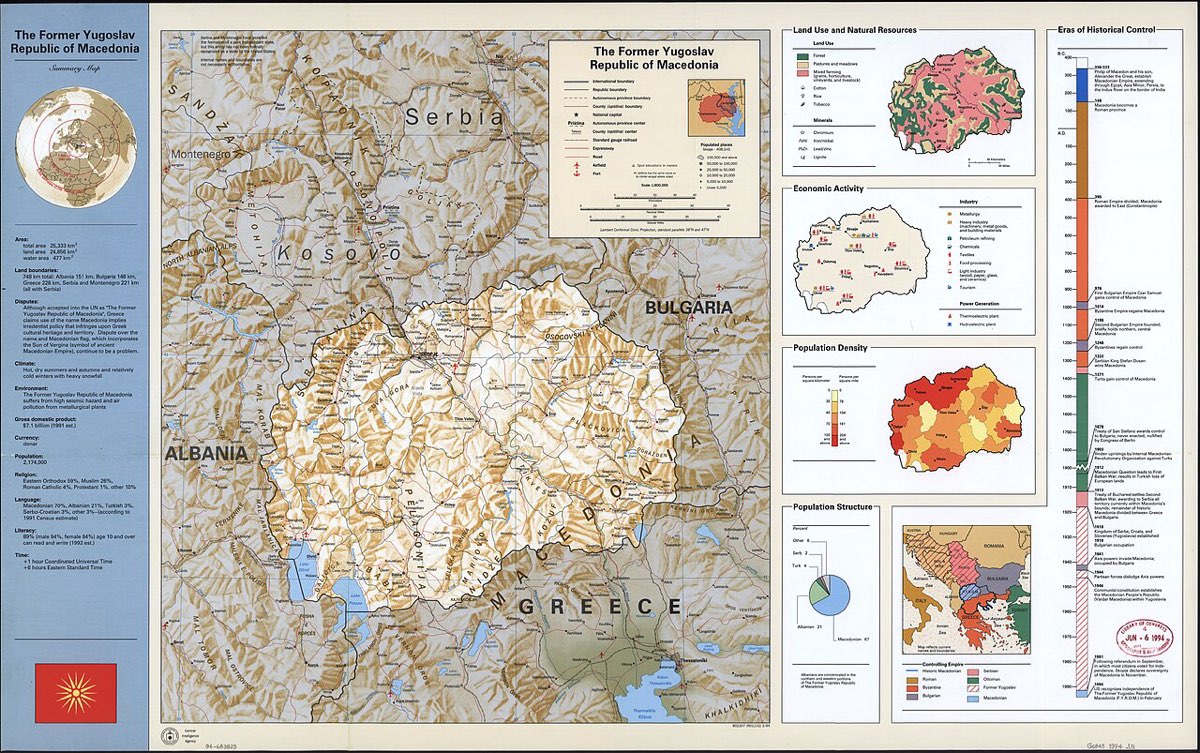
Being a land among Jugoslavia, Albania, Greece and Bulgaria, Macedonia lies between two valleys caller Middle Vardar. 60% of its population lives in cities. It was an autonomous republic until 1990 when it gained independence. But, it took three years for the to be recognized by UN because of rejection by Greece. Geographical Macedonia is not limited with the political country. 34,172 km2 of the historical Macedonia is in Greece today and there are 2 millions Macedonians living in this area. It is accepted that Macedonians and Greeks are of the same origin. But some Macedonian historians claim that they came from the same origin as Bulgarians. Perdikas from Argead Dynasty established Macedonia in 725BC. This dynasty is not of Greek origin. The region was under Persian invasion from 513BC to 479BC. After Filip II, Great Alexander became Macedonian King and extended the borders to Greece and then to Anatolia, Iran, Syria and Egypt. After him, Antigonos Kiklons became the king in 232BC and started a new dynasty.
Roman Empire defeated Macedonia in 168BC and the country stayed under Roman sovereign until Slav invasion in the 9th century. Bulgarian invasion followed it until its collapse in 1014 when Byzantium controlled the country. This continued until Turks came to the Balkans. Macedonians gave 8 emperors and 2 queens to Byzantium Palace between 867-1057. There had been established a Latin Kingdom in the country between 1204-1224 as a result of 4th Crusade. Bulgarians invaded again in 1230 and Serbian invasion followed it in 1280.
Except Capital City Üsküp, there are geographically important cities such as Manastır, Kalkandelen, Prilep, Resne, Ohri, Kumanova and Struga, because the country was built on a connection point. Ottomans first stepped on Rumelia in the period of Orhan Gazi and conquered the country in 1324 under the command of Prince Suleyman.
Sultan Murat I conquered Edirne in 1362 and won the Sirpsindigi War against Hungary King Layosh I in 1364. Thus their existence in the Balkans was confirmed. Ottoman armies defeated Serbian and Bulgarian armies in 1371 in Samaku War and conquered Yanbolu, İslimye, Samaku, İhtiman, Karınova, Aydos, Burgaz, İskeçe, Drama, Kavala, Serez, Avrathisarı, Vardır Yenicesi and other cities. After the Kosova War in 1389 against Serbian King Lazar I, the whole region was under Ottoman Sovereign. Sultan Mehmet I defeated the Crusade Armies in 1448 at Kosova War II and the period of long Ottoman sovereign started again. After this time, Ottomans brought thousands of Turk immigrants from Anatolia and settled them in Macedonia where they became majority in time.
Macedonia was first mentioned during 1876 Istanbul Conference. Reform project of European countries included also Macedonia. The region was left to Ottoman Country with the condition to make some reforms. But his resolution made the situation more complex.
Serbians and Greeks were waiting for separating the country, on one hand. On the other hand, Bulgarians wanted to reach Aegean Sea through Macedonia. Thus, there of them claimed that Macedonians are their relatives. They were fighting with each other in order to control the region and terrorizing the inhabitants. Sultan Abdulhamit II prepared a reform plan for Rumalia Provinces. But both Austria and Russia did not like this development because of their interests in the region.
There had been a bloody rebellion in 1903 in Macedonia. Ottoman armies stopped them, but the efforts continued to separate Macedonia from Ottoman Empire. German, French, Italian, English and Russian commissioners observed the reform applications in the region and Ottoman Bank was assigned to collect taxes. The opposition party, Ittihat ve Terakki Cemiyeti, condemned Sultan for betraying the homeland. Young officers Captain Niyazi and Enver Pasha started bandit actions. Manastir Armiy under the control of this opposition party revolted. Conflicts were so spread out that Sultan had to accept Monarch II on 23 July 1908.
Busy with Albanian and Trablusgarp revolts, Ottoman Empire lost Macedonia wholly after the Balkan War I against Greece, Serbia, Bulgaria and Karadag. But these countries fought each other in order to share these lands. After the Balkan War II, Greece captured Selaniko region, while Bulgaria got Strumca valley and Serbia got inner parts of Macedonia. Being in alliance with Germany in 1941, Bulgaria invaded Macedonia and some Greek lands during World War II after which they had to leave all these lands. Then autonomous Macedonian Republic was established within Jugoslavian Federation after the World War II.
Staying as an autonomous republic until 1990, Macedonia announced its independence with the start of conflict and disorder after the death of Tito. %90 of its population voted in favor of independent at the referendum mad on 8 September 1991. Same year elections were made and Macedonian Nationalist Party came to power with 27,5% of the whole votes. Kiro Gligorov was selected as president.
There live 67% Macedonian, 19,8% Albanian, 4,5% Turks, 2,3% Serbians, 2,3% Gypsies, 2,1% Bosnians and 2% other ethnic groups in Macedonia. While official figures say that there are about 80,000 Turks in the country, leaders of Turkish society claim that the population of Turks in Macedonia is about 150-200 thousand. Most of the population is Christian. However, there are important number of Muslims and a small group of Jews in the country.