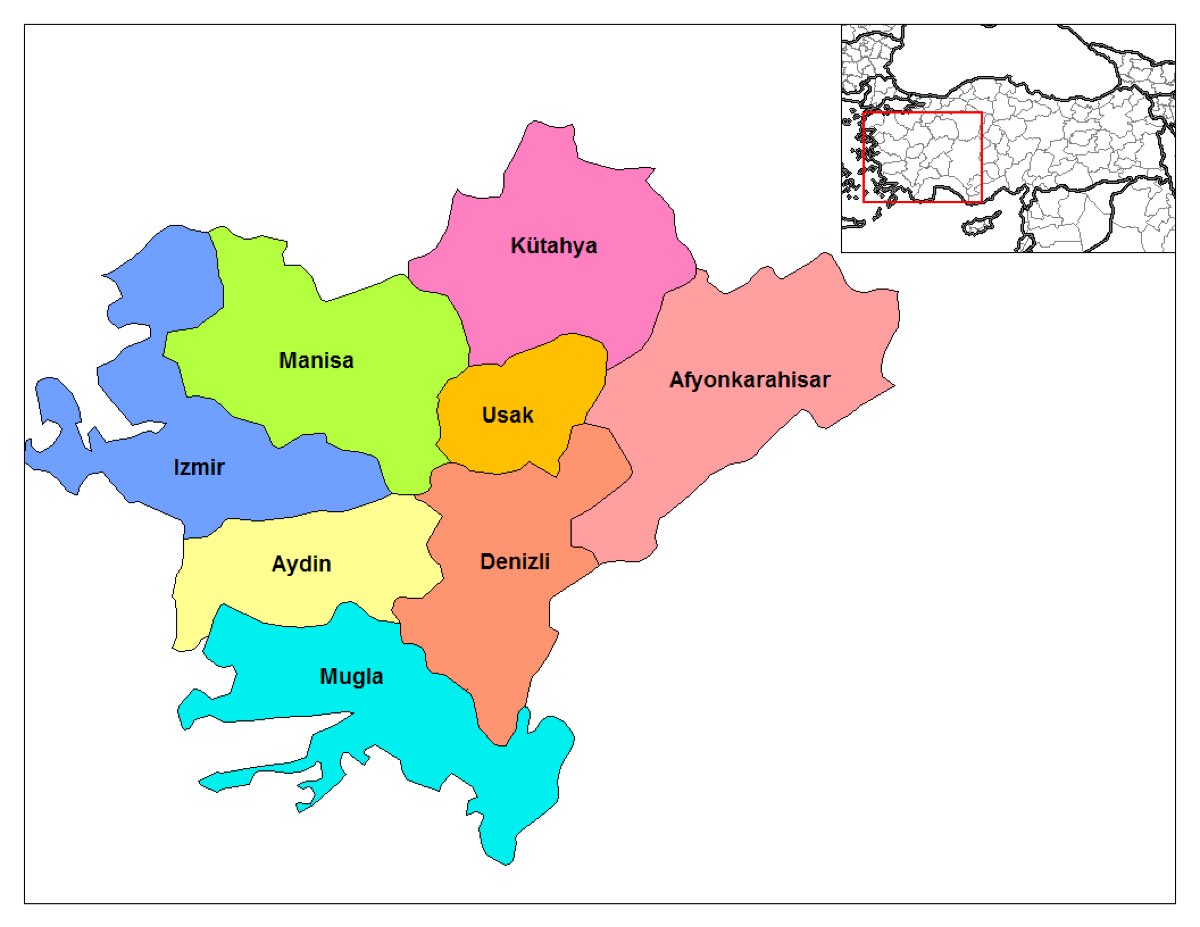
Aegean region is the only region of Turkey that is opened towards the sea in a wide scale. With its surface area of approximately 79.000 km2, the region covers 11% of the total lands of the country. The region that is located in the west of the country has taken its name from the neighbouring sea. The cities of Izmir, Aydin, Manisa, Kütahya and the city of Uşak excluding some small sections of it are entirely located within the borders of the region. Some lands of the cities of Mugla, Denizli and Afyon are located within the boundaries of the Mediterranean and Central Anatolian regions. Similarly, the Aegean coasts of the province of Balikesir and some districts of Bursa that are located within the Marmara region extend beyond the borders of the Aegean region. In respect of the industrial activities, the Aegean Region is in the second line following the Marmara Region. There are particularly the textile, food and automotive industries and also machinery, spare parts and the other industrial corporations in Izmir and the oil industry is concentrated in the section of Ayvalik and Edremit. There are sugar factories in Uşak, Kütahya and Afyon and nitrogen plants in Kutahya. The cotton textile is widespread in Izmir, Uşak, Aydin, Nazilli and particularly in Denizli. Denizli is the most important centre of textile in the entire region and this city performs exportation transactions to foreign countries. The carpet business is highly developed in the Interior Western Anatolian section in Uşak, Kula, Gördes, Simav and Demirci. Afyon is known with its marbles and marble production plants. Çamaltı Saltpan located in the Izmir Gulf is the most important centre of salt production in Turkey. In the region, there are thermic power plants in Soma, Tunçbilek and Yatagan and also hydroelectric power plants in Kemer and Demirköprü and these power plants have great contributions in the total generation of electricity in Turkey. There is a big petroleum refinery in Aliaga near Izmir.
The arable and planted fields cover wide lands in the Aegean Region. The fruit growing and viniculture are of great importance in the Interior West Anatolian section. Over the half of the tobacco production of Turkey is covered by the Aegean Region. The share of the region in the total cotton production of the country is nearly one third. The seedless grapes that are reaped from the Savanna of Gediz are dried and then imported within the country and particularly exported to the foreign countries. Besides, the cultivation of fig in the Savanna of Menderes and the production of olive and olive oil in Edremit Gulf have great contributions in the economy of the region. The region covers more than one-third of the grape production in the country and four-fifth of the fig production. 48% of the olive trees in Turkey are planted in this region. The citrus fruits are also significant export goods of the region.
The tourism that is highly developed in the Aegean Region provides a significant contribution to the economy of the country. As stated with the phrase of Herodotus who was the famous historian from Halicarnassus, the Aegean coasts have the most beautiful sky and the best climate conditions of the world. There are gulfs, peninsulas, coves, islands and beaches with fine sand that are successively ranged in order along the Aegean coasts. In the region that has lived in harmony with numerous mythological events for centuries, there are frequent theatres, temples, agorae and castles and also the famous antique cities that can be seen everywhere. These cities have laid foundation for the Western civilisation through the city planning in the tunnel of time and the successful performances in the fields of philosophy, medicine, mathematics, astronomy, architecture and the other artistic branches.