Negotiations and Protocols
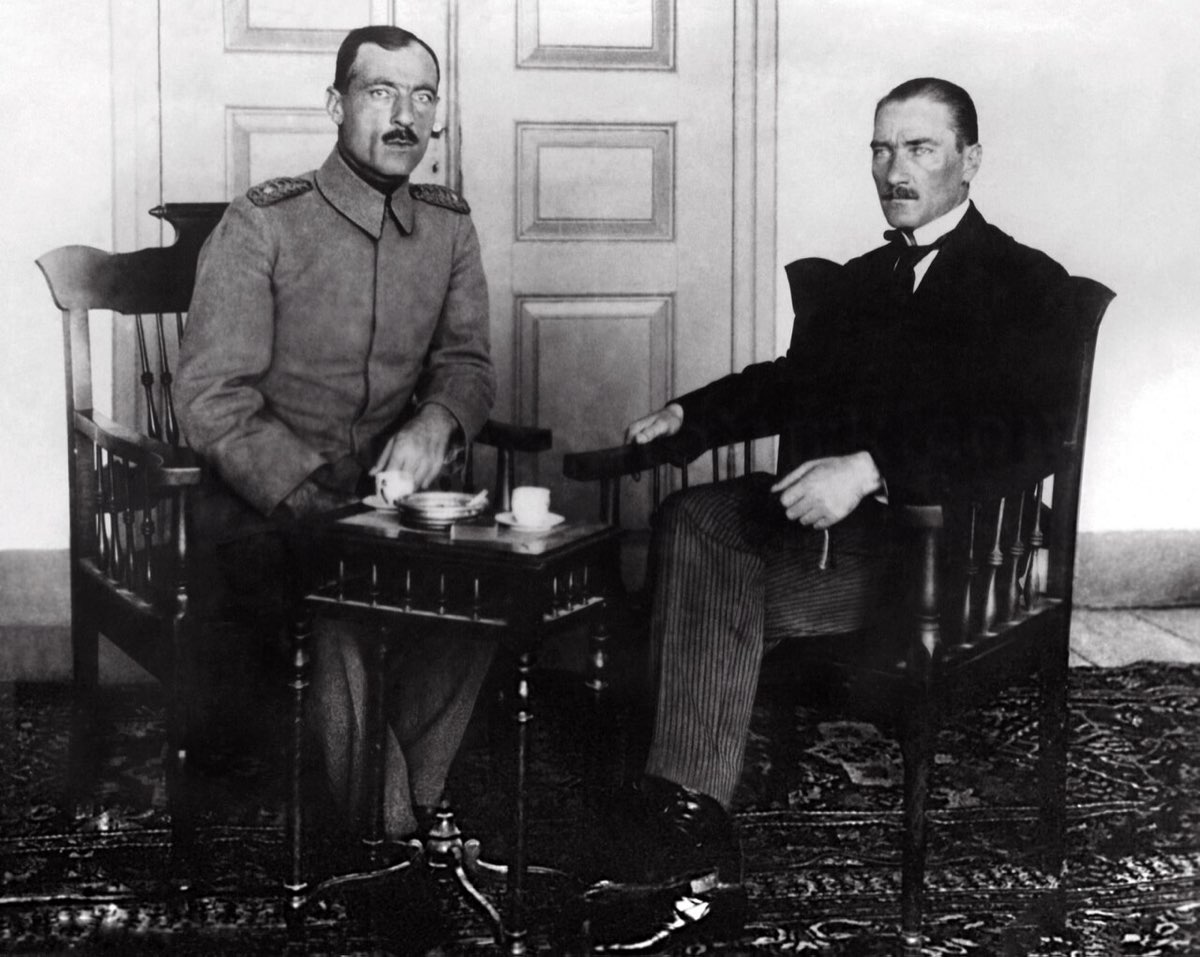
Upon the resignation of the Government of Damat Ferit Pasha, Ali Rıza Pasha was assigned with the establishment of the new government. Mustafa Kemal Pasha wired immediately a telegram to Ali Riza Pasha and declared that the National Forces would provide help and support in case that the new government showed respect to the national organisation and purposes stipulated in Erzurum and Sivas Congresses. He also wanted that the new government should not undertake any obligation in relation with the future of the nation until the foundation of the Assembly and the commissioning of it. Similarly, he demanded that the reliable delegates that had perceived the national case should be elected for the peace conference. Therefore, the reciprocal correspondence was initiated between the Representative Committee and the new government that was established under the influence of the National Forces in order to arrange a common sense. The War Minister, Cemal Pasha had forwarded a telegram that stated that the new government was of the same opinion with Mustafa Kemal Pasha and it accepted the domination of the national determination. Upon this telegram, Mustafa Kemal Pasha published a declaration in the name of the Representative Committee on the date of 7th October 1919. He declared that the prohibition of official communication should be abolished since a full agreement was reached between the nation and the government. As a result of the correspondence between the parties, it was resolved that the parties should meet in Amasya in order to negotiate and come to an agreement on details. Amasya Negotiations were carried out between the group of Mustafa Kemal Pasha, Rauf and Bekir Sami Beys in the name of the Representative Committee and the War Minister, Salih Pasha in the name of Istanbul Government between the dates of 20th-22nd October 1919. As a result of these negotiations, three explicit and signed protocols and two confidential and unsigned protocols were concluded between both parties. First protocol included the demands of Salih Pasha. These demands included the resolutions that the army would not be occupied with policy; and that the movement of the Union and Progress would not be aroused; and that the interventions that would humiliate the government would be abstained; and that those who were arrested on the grounds of opposition to the organisation, if any would be set free; and that the deported criminals would be punished; and that he thoughts asserting that we had equitable reasons for waging war would be kept confidential; and that the elections would be carried out freely; and that the circumstances that would unbalance the public order would be prevented; and that any article would not be written in favour of or against the government, etc.
The principal issues that were resolved in the second protocol were as follows:
Providing the compliance with the final decision of the National Assembly, the borders that have been stipulated before shall be protected (the principle of the integrity and indivisible union of the country was accepted thereof).
Any privileges that can derange our political sovereignty and social balance shall not be granted for the Non-Muslim minorities.
The Anatolian and Roumelian Council for Defence of Rights shall be recognised by Istanbul Government.
It is inappropriate for the Representative Council to convene in Istanbul. It is resolved that the Representative Council shall temporarily convene in a place in Anatolia determined by the government until the establishment of the state of peace.
Salih Pasha had indicated that he personally agreed with the opinion that it was inappropriate for the Council to convene in Istanbul. He declared that he could not promise in the name of the government. However, he had stated that he would try as best as he can in order to make the members of the government approve this condition. He also stated that he could resign from the government in case that he could not succeed in this purpose.
In the third protocol, it was resolved that the Representative Committee shall not intervene in the elections providing that this committee shall inspire the prevention of the election of those related with deportation. It was also resolved that the Christians shall be entitled to participate in the elections. Therefore, the fact that the representative power covered the entire country could be shown to the world.
Pursuant to the completion of the negotiations, Salih Pasha returned to Istanbul. However, he could not make the government approve the condition about the assembly of the Conucil in a place out of Istanbul. The opinion of the government about this issue was notified by the War Minister, Cemal Pasha to Mustafa Kemal Pasha. Salih Pasha alleged that the Kanun-i Esasi (Constitution) prohibited this event and he remained at his office in the government. Mustafa Kemal Pasha was not satisfied with the Government of Ali Riza Pasha. However, he decided to support the government until the foundation and commissioning of the Council. His purpose for this support was to prevent the establishment of a government that was much more antagonist to Anatolia.
As a consequence, Amasya negotiations provided significant benefits for the national movement. Istanbul Government was willing to carry out such negotiations and thus, it participated in these negotiations. Therefore, the government accepted the existence and power of the national movement and its representative, the Anatolian and Roumelian Society for Defence of Rights. The Allied States had perceived that they could not achieve their goals through only imposing pressure and obtaining the approvals of Istanbul Government. The resignation of the Government of Damat Ferit Pasha exalted the prestige of the National Forces and increased the number of the participants who attended the National Resistance. In this case, a member of the new government was sent to Amasya to the presence of the supporters of the National Forces. These events accelerated this process.