Firdevsî, kalk, kalk da, her satırında kötülediğin mağlup Türk'ü şimdi gör!
(Hey Firdevsi, get up, get up and now see the defeated Turk that you speak ill of in each line of you!)
The Christian Western world cites Timur as a tyrant and destructive ruler. Timur had replied to such allegations in his lifetime.
He emerged as an undefeated power in the period when the Ilhanli State and its subject, the Chagatai Khanate lost power due to the civil turmoil, struggles and intrigues. Turkish, Iranian and Arabian historians have stated that this civil turmoil resulted from primarily the Jewish merchants and the Christian missioners. These merchants and some of the missioners carried out the activities of espionage for the European kings and they were abundant in Turkestan. Timur gave an end to their activities. He provided the exile of the Christian missioners from India and the dissemination of the religion of Islam in this continent. Therefore, the Christians were his enemies.
Tamburlaine had demolished all the residuals and idols of the Greek and Roman works in the places that he invaded. Therefore, he was called as a "destructive" ruler. However, the contemporary Muslim scholars of his period had called him with the titles of "Kutübeddin","Sâhib-Kırân-ı Âzam Cennet Mekân" and therefore, they had stated that he was the pole of the religion, the greatest celebrity of Islam; and a Glorious, Powerful ruler that deserved the Heaven".
When he put seventy thousands of people to the sword in Isfahan and piled their heads that were cut off like a tower, he was called as the "ruler that made powers from human heads". His reply to this allegation was as follows: "In return for the fact that they had rebelled and put to the sword all of my officials and my soldiers composed of five thousands of people that I had left in Isfahan without leaving anybody alive and they followed the path of atheism "
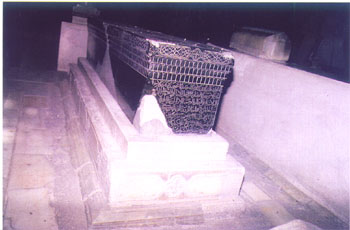
The reason for the continuous opposition of the Iranian historians against Tamburlaine and the severe criticism about him in the east just like in the west was as follows: Tamburlaine had visited the tomb of the famous poet, Firdevsi that was the author of Şehname in the course of his military expedition towards Iran and he had stated that "Get up, get up and now see the defeated Turk that you speak ill of in each line of you!".
There have been some people who had alleged that Tamburlaine had impeded the progress of the Turkish nationalism through giving priority to the religion of Islam and getting benefit from the religious leaders. However, he had stated the following words about his source of pride with an extraordinary approach that no other Turkish ruler had shown until his period but for Bilge Khan:
"Biz ki Mülük-i Turan, Emir-i Türkistan'ız:
(We are the possessors of Turan and Emir of Turkestan)
Biz ki Türk oğlu Türk'üz;
(We are real Turks that are the sons of Turks)
Biz ki milletlerin en kadîmî ve en ulusu
(We are the members of the oldest and the highest nation)
Türk'ün başbuğuyuz!..."
(We are the leaders of Turks)
When he defeated Yildirim Bayezid in Ankara War and incinerated the city of Bursa, it was not expected from the Ottoman historians to speak well of Tamburlaine. However, after centuries, it has been possible to evaluate all the aspects in an objective manner. We will deal about the details of the war that he had fought with Yildirim Bayezid while mentioning about the period of Bayezid in the section of Ottoman Empire.
Without dealing about the period in which he lived, his conqueror character and the works he had accomplished, we would properly state his high gravity when we consider only his personal character:
Tamburlaine was the father of the scholar ruler, Shahruh who had introduced himself as the Great Turkish Khan and stated his submission to the Ottoman ruler through a letter that he had written to Sultan Murad II Khan in the year of 1441; and he was the grandfather of the poet ruler, Hüseyin Baykara and Ulug Bey whose name was given to one of the biggest craters on the Moon, thus providing the existence of Turkish name in the Moon map.
to be continued