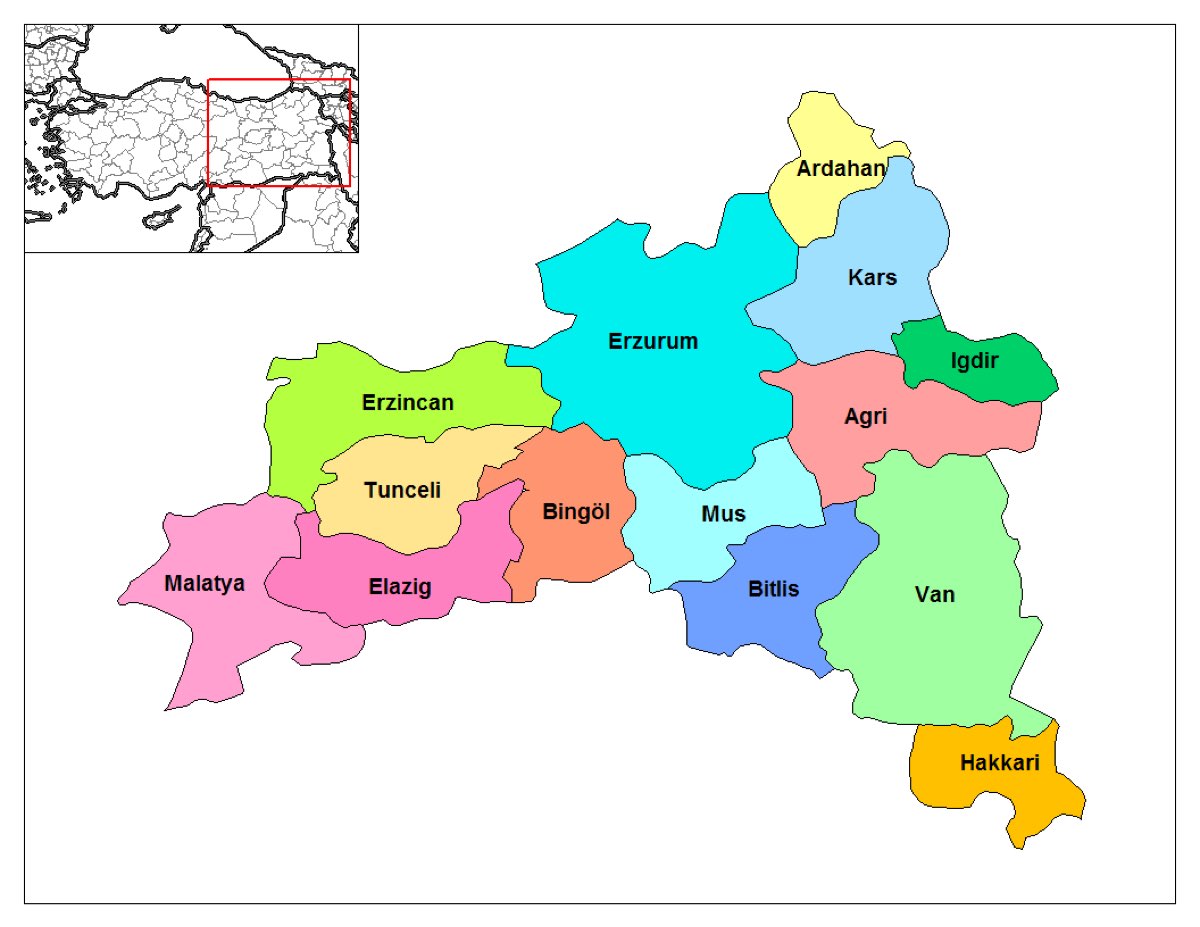
The largest geographical region of Turkey is the Eastern Anatolian Region. With its surface area of approximately 163.000 km2, this region covers 21% of the total area of Turkey. It is neighbouring the Black Sea, Central Anatolian, Mediterranean and the Southestern Anatolian Regions. Furthermore, it has borders with Georgia, Armenia, Nachicevan, Iran and Iraq. The Eastern Anatolian Region is the highest and the roughest region of Turkey. The average height is approximately 2000 m. The highest summits of Turkey are located in the region. Agri Mountain has the height of 5137 m, Reşho summit in the Cilo Mountain has the height of 4135 m and Suphan Mountain has the height of 4058 metres. Its high and mountainous position and its separation from the sea with mountain ranges lead to the low values in respect of the annual average temperature and the hard weather conditions in winters within the Eastern Anatolian Region. This region is much different from the other regions in respect of snowfall and the number of days when the ground is covered with snow. The number of days when the ground is covered with snow in Kars and Erzurum is approximately 90 days.
Stockbreeding and agriculture are the principal economical activities in the Eastern Anatolian Region. The abundant pastures and grasslands in the region have increased the number of the animals and therefore, much attention has been paid to the production of animal materials. As a matter of fact, the production of animal materials in the region is nearly one-fourth of the total production in Turkey. Purebred cattle are bred especially in the region of Kars-Ardahan in the northeast section of the Eastern Anatolian Region.
The fields suitable for agriculture are limited in the Eastern Anatolian Region. Only one-tenth of the lands of the region is composed of arable fields. More than 90% of the arable fields are divided to cereals. Wheat takes the first place and barley takes the second place among the types of cereal grains. However, the plantation of crash crops is not widespread. Cotton, tobacco and sugar beet can be considered among the principal cash crops that are planted. The plantation of sugar beet has been started pursuant to the construction of sugar-beet factories in the region.
All of the fruit trees nearly disappear in the higher section of the region. However, various fruits are produced in some hollow plains and lowlands that are protected from the cold. In this respect, the plains of Erzincan, Malatya and Elazig are of great significance. Fruits of good quality are grown in the narrow line within the environs of Van Lake. The section of Aras Valley lower than Kagizman and Igdir Plain are the regions with thick fruit trees.