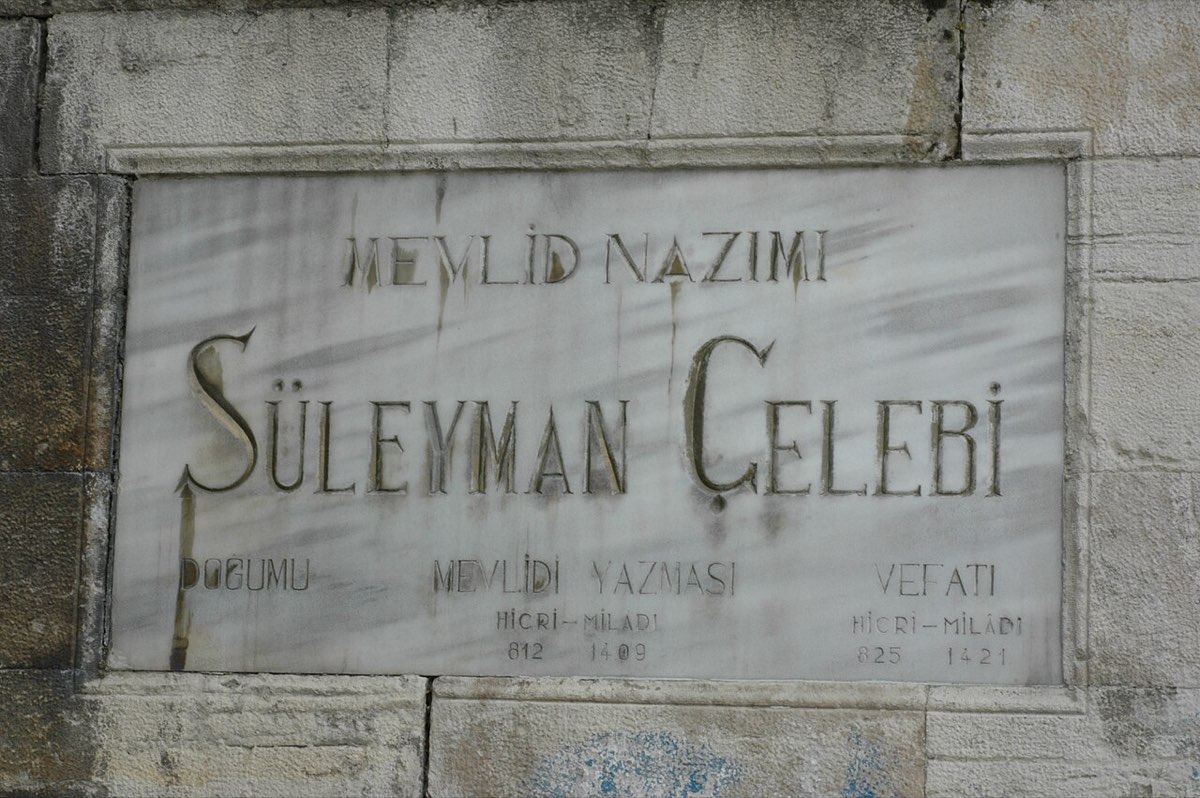
Ottoman Sultan Yildirim Beyazid completed construction of Ulu Mosque, in the capital city Bursa with 20 domes in 1399 and appointed Suleyman Celebi as its imam.
Who was that long youth? How could a sultan like Yildirim Beyazit, who was mature and knowledgeable, could prefer him among so many imams? People asking this question was many in those days, but time revealed answers automatically.
Suleyman Celebi, the imam of Ulu mosque, gave a masterpiece read and listened to with pleasure for about six hundred years to Turkish literature, just as Yildirim Beyazit constructed that 20-dome Ulu mosqe. The name of this masterpiece was Vesîletü'n-Necât, that is, Mevlid. It depicted the deep respect and love for prophet in a vast excitement and clear Turkish. Although we do not have the original and complete text of Mevlid, we understand from the old texts we have that it is about 750 couplets in total.
Mevlid, as known, starts with the couplets:
Allah adın zikredelim evvelâ
Vâcib olur cümle işde her kula
Allah adın her kim ol evvel ana
Her işi âsân ede Allah ana.
and continues in the form of Mesnevi of our Divan literature within (Failatün Failatün) meter. The couplet in the last chapter of the work:
Hem sekiz yüz on ikide târihî
Bursa'da oldu tamam bu ey ahi
reveals that Mevlid was completed in Bursa in 1410.
Although Mevlit has excited all hearts for centuries and has been read by all Muslim Turks in every occasion such as birthdays of the Prophet, in festivals, religious festivals, death anniversaries, we know only a little and have inadequate knowledge about its pet Suleyman Celebi. So much that the masterpiece overshadowed its creator and made us forget its writer.
According to the information we obtain from the sources, Suleyman Celebi was born in Bursa near 1350 during the reign of Orhan Ghazi. It is said that he is originated from Sheik Edebali, the father-in-law of Sultan Osman. It is known that he received systematic education and was thought by skillful scholars, in particular, by Emir Sultan Buhari.
That he drew attention of Yildirim Beyazit with his knowledge and manners is understood from his being immediately appointed as imam to Ulu mosque. "Çelebi" title is granted to him because of his being scholar, effendi, humble, and mature. Some say that Suleyman Celebi was a Mevlevi, and so he was granted the title of Suleyman Dede.
Although we do not know his exact year of death, some investigators stress 1422 and accept this date as his date of death. His grave is next to Old hot spring on Çekirge road in Bursa. The grave was reconstructed as a monument in recent years. There are many rumors about the reasons of writing Mevlid. One rumor has it that a preacher in Bursa, told that Prophet Mohammed was no different from other prophets, and Suleyman Celebi, being grieved, wrote Mevlid to show that Mohammed was the last and superior prophet.
According to another rumor, Suleyman Celebi was sorry to see that various religious people told about Prophet Mohammed in different styles and ways and decided to write a book in verse which everyone can easily understand and cannot change, and succeeded. Although hundreds of similar poems were written, none of them could reach the reputation Mevlid gained, and Mevlid persisted as the eternal religious masterpiece of Turkish literature. The language of Mevlid is 15th century Anatolian Turkish. The language is plain, simple and sincere. Therefore, Mevlid remained as Turkish common property and loved for centuries. Although some contributions and annexes to Mevlid was made in time, those brought only little to the book, and did not harm its integrity.
Mevlid was translated into many languages, and English in particular, and was published in many places of the world. Although there are many handwritten Mevlid texts in the libraries in our country, the oldest or one of the oldest of all is the Mevlid copy dated 1510 in Istanbul Saint Sofia Library. The copy of Mevlid written in Suleyman Celebi's handwriting or when he was alive could not be found yet.