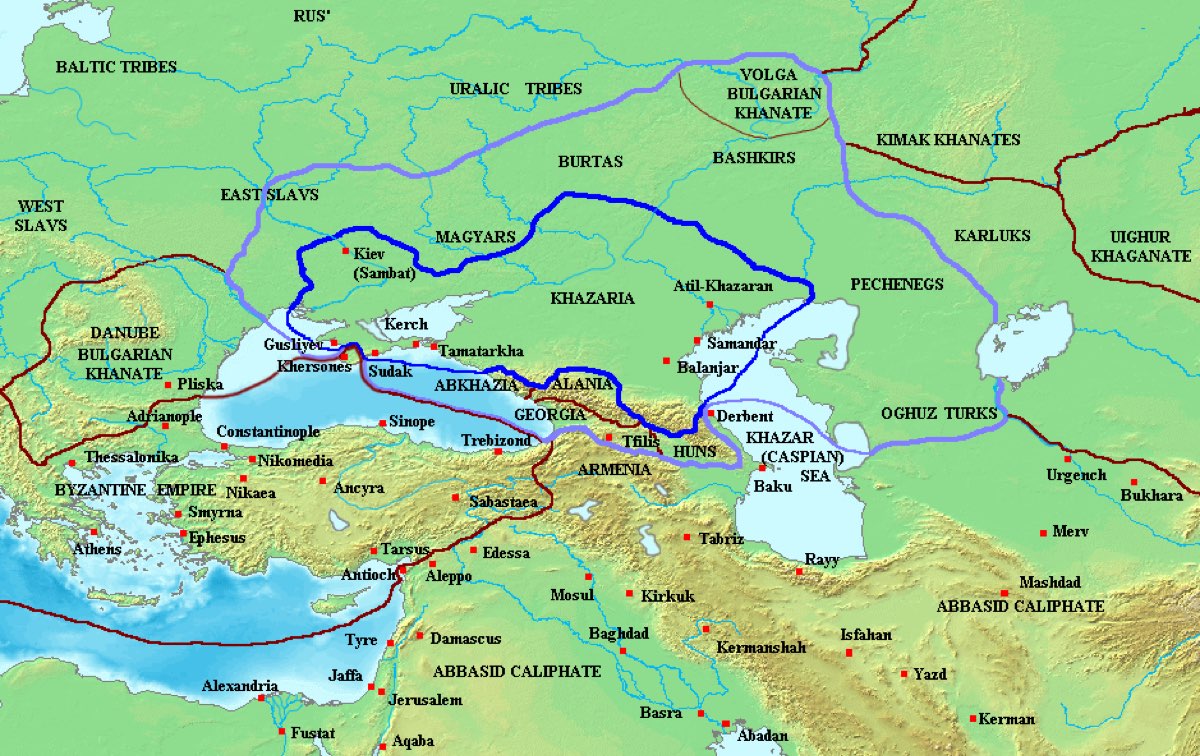
Although the Islam Army won victories in nearly all fronts and conquered countries, they could not achieve successful results from the wars against Khazars. However, Arabian armies had won some military expeditions, but they could not penetrate into any lands. The Arabian-Khazar struggles that started in the period of the Caliph Omar and lasted until the period of Harun el-Reşid continued intermittently. In these struggles, either party could not gain a crushing superiority upon the other. The diffusion of the religion of Islam among Khazar people took place in the period of peace pursuant to the end of these reciprocal wars and particularly after the development of the commercial relations. The military expedition of Mervan B. Mohammed carried out in the year of (737) was ended upon the invasion of Idyll, the capital city of Khazar State. After this expedition, he declared that he would only leave the country providing that the Khazar Khan would adopt the religion of Islam. Upon this declaration, the Khan had to accept this proposal inevitably. However, pursuant to the withdrawal of Mervan, the khan must have abandoned the religion of Islam that he had supposedly adopted since the khan and his family converted to the Judaism in the first years of the century IX. However, according to a condition of an agreement, Mervan assigned two Muslim jurists named as Nuh b. Sabit el-Esedî and Abdurrahman el-Hulânî with the charge of teaching the religion of Islam to Khazar people and then, he left Idyll.
These two Muslim jurists were in the service of the diffusion of Islam among Khazar people despite their insufficiency. Ibn Rusteh who had written his work of art in the first years of the century X (903) stated that there were lots of Muslims, small mosques, imams and muezzins in Idyll that was the capital city of Khazar. In addition to this information, Ibn Fadlan determined that the khan protected the Muslims and he had assigned special officials for the pursuit of their affairs. The khan and the state authorities were tolerant to the believers of the other religions although they were Jews. According to the resources of the period, It is stated that as a result of this tolerance, there were 30 mosques and nearly 10.000 Muslims in the capital city of Khazar in the second half of the century X and two Muslim judges heard their cases. However, the continuous attacks of Russians who cam from the north in the same years led to the decline of the Khazar State and finally to the collapse of the state. The Muslims who rejected the Russian dominion immigrated to the other Islam countries.
The second large group of Turks that adopted the religion of Islam is Karahanli State. The third Muslim Turkish State following Karahanli State is Gazneli State with its capital city of Gazne. This state was founded by Alp-Tegin who was one of the commanders of Samani people in the year of 963.There were some Muslim colonies in the cities such as Yenikent, Huvare and Cend, etc. that were under the dominion of Oguz people and in some cities that were under the dominion of Karluk people in the beginning of the century X. Oguz people learned the principles of the religion of Islam from these Muslims that had a high level of civilisation. On the other hand, the big commercial caravans from the Transoxania and Harezm had to have an acquaintance with a Turk in order to travel abroad to the most distant countries. Furthermore, we should add that the Muslim dervishes and sheikhs came to the Turkish countries together with these merchants and they tried to introduce the religion of Islam.